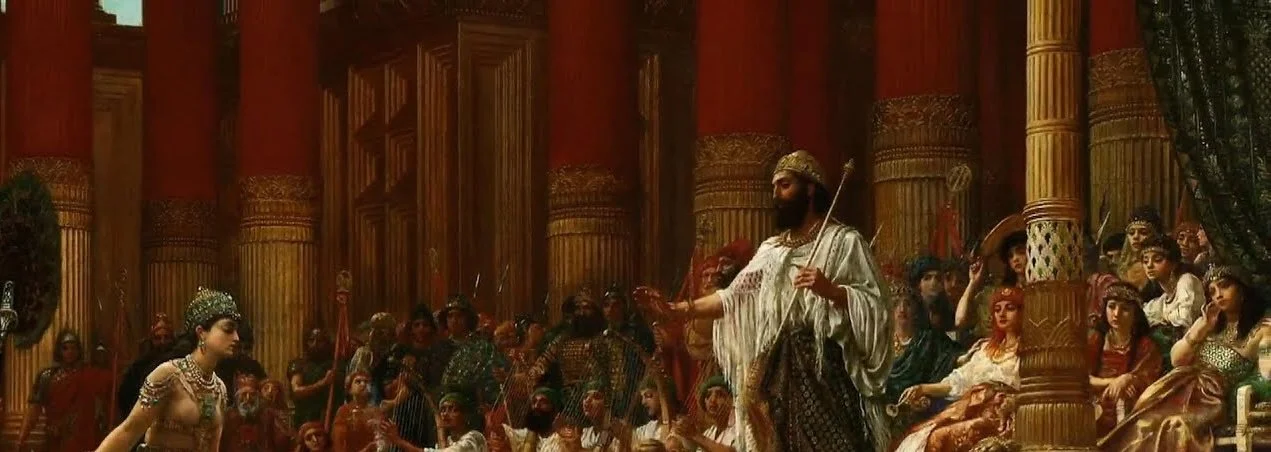
“14 Then the LORD raised up against Solomon an adversary, Hadad the Edomite, from the royal line of Edom. 15 Earlier when David was fighting with Edom, Joab the commander of the army, who had gone up to bury the dead, had struck down all the men in Edom. 16 Joab and all the Israelites stayed there for six months, until they had destroyed all the men in Edom. 17 But Hadad, still only a boy, fled to Egypt with some Edomite officials who had served his father. 18 They set out from Midian and went to Paran. Then taking men from Paran with them, they went to Egypt, to Pharaoh king of Egypt, who gave Hadad a house and land and provided him with food. 19 Pharaoh was so pleased with Hadad that he gave him a sister of his own wife, Queen Tahpenes, in marriage. 20 The sister of Tahpenes bore him a son named Genubath, whom Tahpenes brought up in the royal palace. There Genubath lived with Pharaoh’s own children. 21While he was in Egypt, Hadad heard that David rested with his fathers and that Joab the commander of the army was also dead. Then Hadad said to Pharaoh, “Let me go, that I may return to my own country.” 22 “What have you lacked here that you want to go back to your own country?” Pharaoh asked. “Nothing,” Hadad replied, “but do let me go!”
23 And God raised up against Solomon another adversary, Rezon son of Eliada, who had fled from his master, Hadadezer king of Zobah. 24 He gathered men around him and became the leader of a band of rebels when David destroyed the forces of Zobah; the rebels went to Damascus, where they settled and took control. 25 Rezon was Israel’s adversary as long as Solomon lived, adding to the trouble caused by Hadad. So Rezon ruled in Aram and was hostile toward Israel.
26 Also, Jeroboam son of Nebat rebelled against the king. He was one of Solomon’s officials, an Ephraimite from Zeredah, and his mother was a widow named Zeruah. 27 Here is the account of how he rebelled against the king: Solomon had built the supporting terraces and had filled in the gap in the wall of the city of David his father. 28 Now Jeroboam was a man of standing, and when Solomon saw how well the young man did his work, he put him in charge of the whole labor force of the house of Joseph.
29 About that time Jeroboam was going out of Jerusalem, and Ahijah the prophet of Shiloh met him on the way, wearing a new cloak. The two of them were alone out in the country, 30 and Ahijah took hold of the new cloak he was wearing and tore it into twelve pieces. 31 Then he said to Jeroboam, “Take ten pieces for yourself, for this is what the LORD, the God of Israel, says: ‘See, I am going to tear the kingdom out of Solomon’s hand and give you ten tribes. 32 But for the sake of my servant David and the city of Jerusalem, which I have chosen out of all the tribes of Israel, he will have one tribe. 33 I will do this because they have forsaken me and worshiped Ashtoreth the goddess of the Sidonians, Chemosh the god of the Moabites, and Molech the god of the Ammonites, and have not walked in my ways, nor done what is right in my eyes, nor kept my statutes and laws as David, Solomon’s father, did.
34“ ‘But I will not take the whole kingdom out of Solomon’s hand; I have made him ruler all the days of his life for the sake of David my servant, whom I chose and who observed my commands and statutes. 35 I will take the kingdom from his son’s hands and give you ten tribes. 36 I will give one tribe to his son so that David my servant may always have a lamp before me in Jerusalem, the city where I chose to put my Name. 37However, as for you, I will take you, and you will rule over all that your heart desires; you will be king over Israel. 38 If you do whatever I command you and walk in my ways and do what is right in my eyes by keeping my statutes and commands, as David my servant did, I will be with you. I will build you a dynasty as enduring as the one I built for David and will give Israel to you. 39 I will humble David’s descendants because of this, but not forever.’ ”
40 Solomon tried to kill Jeroboam, but Jeroboam fled to Egypt, to Shishak the king, and stayed there until Solomon’s death.”
99 cent burgers, 99 cent fries, 99 cent pop… we didn’t know how good we had it. Showing up just thirty minutes before your flight, getting a full meal on the plane, sticking your legs out. We didn’t how good we had it.
“Don’t it always seem to go that you don’t know what you’ve got ‘til it’s gone?” as Joni Mitchell sang. “They paved paradise—put up a parking lot.”
That’s what the people after Solomon would be saying, “we didn’t know how good we had it.” By his sin, Solomon was paving paradise and putting up parking lots for idol shrines. We didn’t know how good we had it is what sin will leave you with—far worse than nostalgia, though. How will Solomon respond to crushing regret? Sin brings complicated consequences; repent early and often; that would have been Solomon’s wise move and that’s the claim of this sermon.
We see this in three points. First: a threat from the south. Second: a threat from the north. Third: a threat from within. First, in verses 14-22, a threat from the south; second, in verses 23-25, a threat from the north; third, in verses 26-40, a threat from within.
We see the complicated consequences in our first point: a threat from the south. This week’s passage follows on the heels of last week’s just like pain following a blow; “Then the Lord raised up against Solomon an adversary…” The Lord warned that the kingdom would be peeled away and now we begin to read about this peeling away.
The Lord had promised the kingdom wouldn’t be peeled away in Solomon’s lifetime but that doesn’t mean there wouldn’t be consequences now. That’s how it goes—sin leads to “dying until you die,” as the Lord warned in Eden. That’s the force of this passage.
The Lord raised up an adversary—something we haven’t seen for Solomon since he cleaned house with Adonijah, Joab, Abiathar, and Shimei. Solomon has been unopposed for decades. That’s coming to an end because he made it his business to oppose the Lord and His ways.
There are always consequences and here the consequence take the form of an adversary or, in the Hebrew, a satan. The Lord has purposes for His satans—without a capital “s” and with. We never know all that the Lord is up to with anything and even less with what He is doing with such adversaries—in the Garden of Eden and in our lives. It is one of the many mysteries of life that we only hover around the edges of understanding. Here what we know for sure is that the Lord raised up adversaries as a consequence of Solomon’s disloyalty.
This adversary was an Edomite—a member of the royal line—named Hadad. The relationship between Edom—the line of Esau—and Israel—the line of Jacob is a storied one. The Edomites were not to be treated like the Canaanites, but it seems that David’s often-excessive general, Joab, was wiping out their royal line as if they were Canaanites. Some, including the boy Hadad, escaped when to Egypt. Now we see him return as a threat. It’s as if Joab’s mistakes are still haunting the line of David.
None of this trouble happened while Solomon was devoted to the Lord. Last week we saw Solomon connections to secure his already secure throne. Paradoxically, it’s his attempt to secure the throne his own way that leads to threats. We’d be far better to accept God’s ways than force our own. We, in our flesh, try to secure what is only secure by the Lord’s giving—be it peace, righteousness, a legacy. We try to make it happen and our seeking to secure it on our own terms reveals a lack of faith in God’s giving. We try to work for what comes only by faith.
The young Hadad fled to Midian and then made his way to Egypt where the Pharaoh welcomed him into his own court. That’s a mix-mash of Moses who as a youth was welcomed into Pharaoh’s court but then had to flee to Midian before coming back to Egypt. The Lord can use the same elements in different arrangements for different purposes. He worked through Moses to bring his people out of Egypt. He works through Hadad to afflict Solomon for falling in with the ways of his father-in-law, Pharaoh of Egypt.
It’s likely that this Pharaoh of Hadad, though, came before Solomon’s father-in-law. He ruled during a time of chaos in Egypt when they wanted good relations with anyone. This Pharaoh saw an opportunity to build goodwill with Edom. He gave Hadad a family member as a wife to try to secure the sort of connection we studied last week. All of this was going on before Solomon became king. Interestingly, Hadad decided to go back only when young King Solomon executed Joab. We don’t know the effects of what we will do—both our wise and unwise acts.
We need to keep obeying and trusting and leave the results to the Lord. King Solomon would have done well to listen to King Jesus whose political and life advice was, “seek first the kingdom of God and all these things will be added to you.” That’s what Solomon did at the beginning of his reign asking for wisdom to rule righteously. That’s what he lost along the way. Don’t lose it along the way of your life and with that we turn our attention to our second point: the threat from the north.
Now we have another “satan”—adversary—“And God raised up against Solomon another adversary, Rezon son of Eliada, who had fled from his master, Hadadezer king of Zobah.” Years before when David had decimated the forces of Zobah, Rezon ran for his life and became a leader of a ragtag group of troublemakers. If you know the books of Samuel, that sounds familiar. That sounds like David, Solomon’s father. Hadad had some of the same markings as Moses. Rezon has some of the same markings as David. The Lord is reworking the same themes for different purposes. You can imagine all of history as music. It’s as if God brings all the themes of life—the notes of rebellion, trust, death, resurrection, rejection, grace—and weaves these musical themes in symphony.
Rezon and his misfits took over Damascus, the power center of Syria. We aren’t told how Rezon organized or governed his misfits. We were told how David organized and governed his misfits. More importantly, we are told how Jesus organizes and governs us misfits. That’s church—our leader, Jesus, doing something beyond our power or imagination and our qualification simply being that we misfits fit with him.
The Lord up to very different purposes through Rezon, though. His misfits are to serve as a thorn in Solomon’s side; verse 25, “Rezon was Israel’s adversary as long as Solomon lived, adding to the trouble caused by Hadad. So Rezon ruled in Aram and was hostile toward Israel.”
We are only told about this after the Lord removed His favor from Solomon’s rule; that’s when the Rezon problem becomes wearying. Solomon doubtlessly dealt with all sorts of troubles 1 Kings hasn’t told us about largely because they weren’t terribly troubling to him then. You know how it goes. Your knee pain twinges, and then ebbs and flows and then no longer ebbs—it’s now constantly flowing; it keeps you up at night. What was once barely an annoyance has become all-consuming. So it goes for Solomon’s troubles which only became all-consuming after he was no longer all-consumed with God.
Ironically, Solomon took his focus off God in the first place because he was trying to stave off people like Rezon by way of connections. It is a nasty, bruising world, and Solomon tried to keep it in line by his own understanding. “The portrayal of Rezon, brief as it is, makes clear that this is a political world in which power is highly personal and deeply volatile. Staying on top of the heap must have required endless vigilance,” as one commentator put it. Solomon’s endless vigilance took the wrong form. He should have been vigilant about ttrusting the Lord like his father David.
So now we have trouble to the north with Rezon and to the south with Hadad. “Where there was peace on all sides, now there are only enemies,” as Provan puts it. That’s the opposite of Romans 8. In that chapter, the worst can’t separate you from God. Here everything is becoming an indication of Solomon’s separation from God and to repurpose Romans 8, “if God is against you, who can be for you?” Will Solomon direct his endless vigilance back toward the Lord? Would you? Do you? Will you? We’ve considered the threat form the north, the threat from the south; now, in our third point, we see the threat within.
We see neither Hadad nor Rezon again. This third threat, though, has staying power; “Also, Jeroboam son of Nebat rebelled against the king…” That’s the first of 79 uses of this man’s name in 1 and 2 Kings. That’s far more than Josiah or even Hezekiah. It’s just more than Ahab. Jeroboam is a big deal.
We start off by hearing that he’s a worthy man; “He was one of Solomon’s officials,” as verse 26 tells us; he was “a man of standing, and when Solomon saw how well the young man did his work, he put him in charge of the whole labor force of the house of Joseph” as verse 28 tells us. Jeroboam knew how to get tasks done and so Solomon put him in charge of the labor force building his projects. Remember, though, we’ve seen foreshadow after foreshadow that this forced labor business is going to come back to haunt Solomon; now it begins.
Jeroboam knew first-hand the resentment and frustration that was building against Solomon’s opulence and pride-projects. He knew the human cost. We don’t know what Jeroboam thought of it all. Perhaps he was happy to be a big cog in the Solomon’s machine. Perhaps he liked the lifestyle it afforded. Perhaps his heart went out to the people. We don’t know. What we do know one day Jeroboam was “going out of Jerusalem, and Ahijah the prophet of Shiloh met him on the way, wearing a new cloak.”
We haven’t heard about any prophets since the beginning of Solomon’s reign with Nathan siding with Solomon over Adonijah. It’s no surprise, though, that prophets start to show up again now that the land is descending into idolatry. It’s no surprise that they will continue to play a large role in Israel’s ongoing story as they, particularly Elijah and Elisha, call the people back to the Lord from the idolatry Solomon re-introduced.
We are told that this prophet has a new cloak. That’s not because the author of 1 Kings has a keen interest in fashion. No, the prophet and Jeroboam ‘were alone out in the country, and Ahijah took hold of the new cloak he was wearing and tore it into twelve pieces. Then he said to Jeroboam, “Take ten pieces for yourself…”’ The prophets often came at the truth in unexpected ways—telling a story about a stolen sheep, lying for months on their side eating food strangely, drenching an altar with water before a sacrifice. They punctuated their words with actions.
Ahijah tore his cloak into twelve pieces and gave Solomon’s head of the labor force ten pieces saying, ‘this is what the Lord, the God of Israel, says: “See, I am going to tear the kingdom out of Solomon’s hand and give you ten tribes.”’
That has history too. The prophet Samuel told David’s predecessor, Saul, that the kingdom was taken away from him like Solomon was told that the kingdom would be split. ‘As Samuel turned to go away, Saul seized the skirt of his robe, and it tore. And Samuel said to him, “The Lord has torn the kingdom of Israel from you this day and has given it to a neighbor of yours, who is better than you.” The kingdom was taken away, whole cloth, from Saul and given to David. Now the kingdom will be split—pieces of cloth—and Jeroboam will get ten.
If I were Jeroboam, I’d be amazed to get one or the two mentioned. I’d be dumbfounded to find myself getting the ten and yet that’s what the northern kingdom becomes and the sons of David in Judah live “in the shadow of whoever happened to be ruling Israel at the time,” as Oswalt puts it. Solomon never could have predicted that as he was trying to make his connections to secure his golden kingdom. We can’t predict all that sin will do. Our responsibility is to simply trust the Lord and obey the Lord for today and for the future.
So the cloak is divided. The kingdom is divided. It’s divided because something else is divided—someone else is divided. If you could bring up our slide.
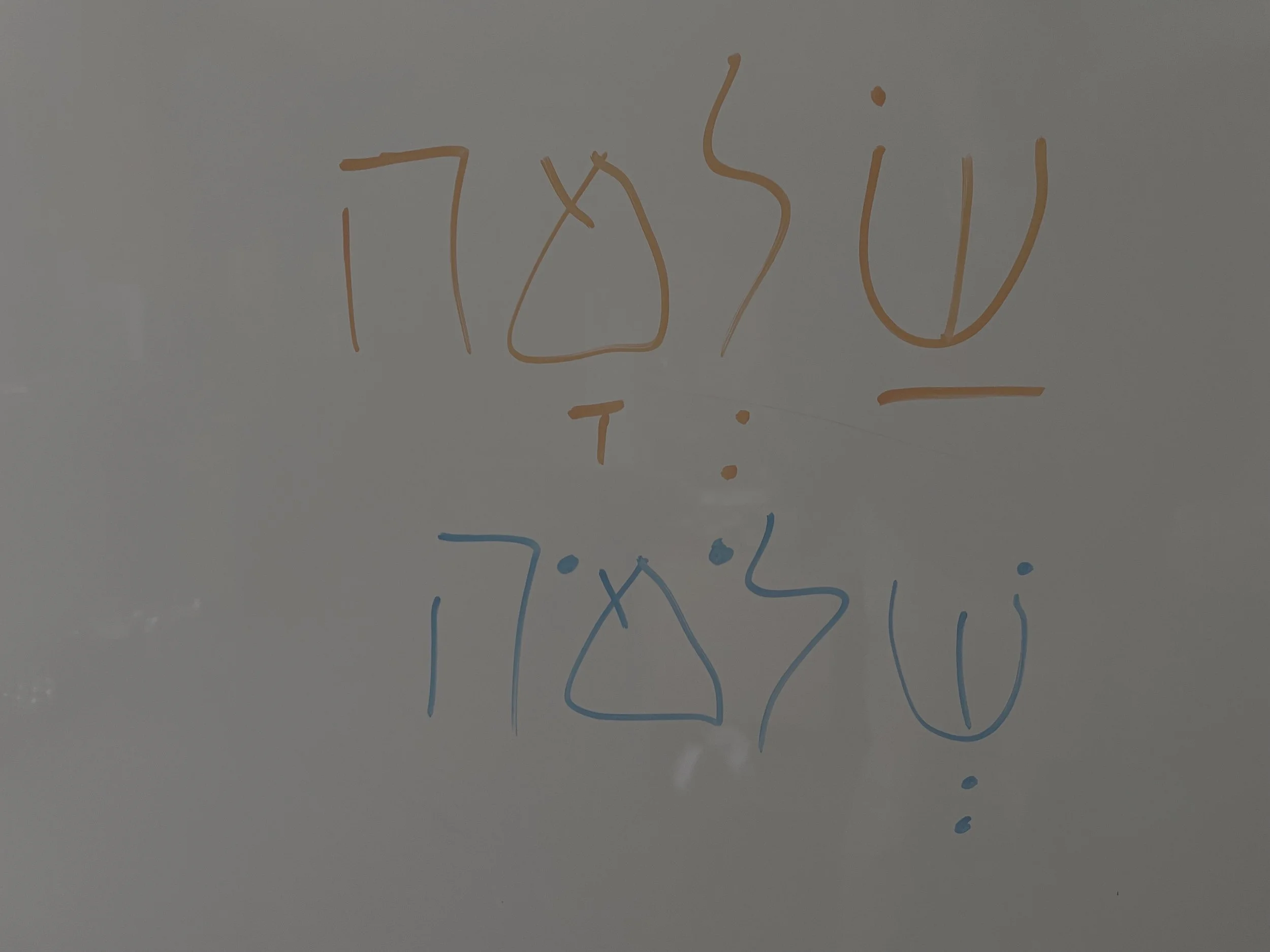
In the orange is the Hebrew word translated here as cloak—salma. The word below looks quite similar doesn’t it. The consonants are all the same, except the first being a “sh” rather than a “s.” The vowels are different and so we are left with “Shlomo.” They look almost identical, though, and that’s not by accident because the first was divided because the second was divided. The “salma” was divided because “Shlomo” was divided. Now if you called Solomon “Solomon”, he’d had have no idea what you were saying. The name “Solomon” is a garbled mess having passed from Hebrew through Greek and Latin to English. The king wouldn’t turn around if you called him that. He responded to Shlomo. That was his name. The “salma” was divided because “Shlomo” was divided. The cloak and kingdom was divided because Solomon was divided. “Purity of heart is to will one thing,” as Kierkegaard put it. “Seek ye first the kingdom of God and his righteousness,” as we’ve Jesus put it. Are you divided? It will lead to everything else falling apart.
There is still grace on offer, though, even in this. There are still two tribes. “I will humble David’s descendants because of this, but not forever,” as the Lord made clear to Jeroboam. Judah will be humbled for a long, long time but not forever. A shoot would arise from the tribe of Judah who would be the king Shlomo wasn’t. What’s left was more than enough for the Lord to bring about his plan to save the world.
The Lord isn’t handcuffed by our sin and folly. We are unless we turn to him for help. Jeroboam didn’t. He could have had a dynasty. There’s so much potential in ten out of twelve tribes, but rather than being loyal to the Lord as urged here, he exceeded Solomon’s idolatry and turned the worship of the Lord Himself into an idol factory by building the golden calves in the northern kingdom so the people couldn’t worship rightly. That’s why his name comes up so much in Kings, “the sins of Jeroboam, which he sinned and made Israel to sin.” That’s why he’s remembered. You want to be remembered—by God—for faith not for the opposite.
Jeroboam is not a man after God’s own heart like David who is all over this chapter. David is always in the background of Kings because he’s the king after God’s own heart but there is another king who has God’s own heart because he is God and it’s he who is needful, not Solomon or Jeroboam or even David or me or you. We would do well to trust King Jesus.
How does Solomon take all this news of the kingdom being split as God promised? Not well. “Solomon tried to kill Jeroboam, but Jeroboam fled to Egypt, to Shishak the king, and stayed there until Solomon’s death.” Who does that sound like—trying to murder the Lord’s anointed? That sounds like Saul. That sounds like the Pharisees, Sadducees, Herodians, zealots. That’s sounds like the world. That’s not good.
Jeroboam fled to Egypt—not coincidentally, the nation Solomon was imitating. It seems Pharaoh, Solomon’s father-in-law, had passed away and now there is a new Pharoah who has “no concern for good relations with Israel,” as Oswalt points out. So not even Solomon’s original wifely sin of marrying an Egyptian to secure support helped him now even with Egypt. Everything in which Solomon had put his trust in other than the Lord was now against him and so it will be for everyone who trusts in anything other than the Lord. Don’t let that be you. Trust in the Lord. You’d rather spend eternity amazed at how good God can make it rather than looking back with regret saying, “we didn’t know how good we had it.” Amen.