“25 Seven days passed after the Lord struck the Nile. 1 Then the Lord said to Moses, “Go to Pharaoh and say to him, ‘This is what the Lord says: Let my people go, so that they may worship me. 2 If you refuse to let them go, I will plague your whole country with frogs. 3 The Nile will teem with frogs. They will come up into your palace and your bedroom and onto your bed, into the houses of your officials and on your people, and into your ovens and kneading troughs. 4 The frogs will go up on you and your people and all your officials.’”
5 Then the Lord said to Moses, “Tell Aaron, ‘Stretch out your hand with your staff over the streams and canals and ponds, and make frogs come up on the land of Egypt.’”
6 So Aaron stretched out his hand over the waters of Egypt, and the frogs came up and covered the land. 7 But the magicians did the same things by their secret arts; they also made frogs come up on the land of Egypt.
8 Pharaoh summoned Moses and Aaron and said, “Pray to the Lord to take the frogs away from me and my people, and I will let your people go to offer sacrifices to the Lord.”
9 Moses said to Pharaoh, “I leave to you the honor of setting the time for me to pray for you and your officials and your people that you and your houses may be rid of the frogs, except for those that remain in the Nile.”
10 “Tomorrow,” Pharaoh said. Moses replied, “It will be as you say, so that you may know there is no one like the Lord our God. 11 The frogs will leave you and your houses, your officials and your people; they will remain only in the Nile.”
12 After Moses and Aaron left Pharaoh, Moses cried out to the Lord about the frogs He had brought on Pharaoh. 13 And the Lord did what Moses asked. The frogs died in the houses, in the courtyards and in the fields. 14 They were piled into heaps, and the land reeked of them. 15 But when Pharaoh saw that there was relief, he hardened his heart and would not listen to Moses and Aaron, just as the Lord had said.
16 Then the Lord said to Moses, “Tell Aaron, ‘Stretch out your staff and strike the dust of the ground,’ and throughout the land of Egypt the dust will become gnats.” 17 They did this, and when Aaron stretched out his hand with the staff and struck the dust of the ground, gnats came upon men and animals. All the dust throughout the land of Egypt became gnats. 18 But when the magicians tried to produce gnats by their secret arts, they could not. And the gnats were on men and animals.
19 The magicians said to Pharaoh, “This is the finger of God.” But Pharaoh’s heart was hard and he would not listen, just as the Lord had said.”
Magnus Carlsen became a chess grandmaster at the age of 14. He is perhaps the greatest chess player ever. What’s interesting is that the more you know about chess, the better he seems. I know very little about chess and so I can appreciate his skill somewhat. Someone who is proficient in the game, however, will appreciate his excellence. The better you know a field, the better you can recognize skill. The more experience you yourself have, the better you can recognize the exceptional.
That’s true in spirituality as well. The more like the Lord you become, the more you realize how very great He is. Just as an ignorant and arrogant man might look at Magnus Carlsen and think he is nothing special so the spiritually blind think the Lord is nothing special. It’s the insanity of ignorance and arrogance you see it in Pharaoh. He is so little like the Lord that he can’t see that no one is like the Lord. That’s a lesson that we must learn if we are to move out of arrogance and ignorance: there is no one like the Lord; that is the claim of this sermon.
We will study this in two points. First: the frogs. Second: the gnats. First, in 7:25-8:15, we see the frogs. Second, in 8:16-19, we see the gnats.
We see the glory of the Lord in our first point: the frogs. Last Lord’s Day we studied the first plague in which the Lord turned the Nile to blood. Moses called it striking the Nile as we see in verse 25, “Seven days passed after the Lord struck the Nile.” This is the same word for strike that we saw when that Egyptian taskmaster who struck that Hebrew slave. The plagues are public strikes for all the hidden strikes. “There is nothing hidden that will not be disclosed, and nothing concealed that will not be known or brought out into the open,” as Jesus put it.
Now that Pharaoh has had a taste of this judgment, the Lord sent Moses back to him saying, “Let my people go.” The Lord says it again as if He never said it before. The point is that the Lord can keep doing this as long as He wants. The question is, “can Pharaoh?” We’ll see; verse 2, “If you refuse to let them go, I will plague your whole country with frogs.”
This plague of frogs is ramps up the trouble. It’s as if last week’s plague on the Nile was spreading to the land; verse 3, “The Nile will teem with frogs. They will come up into your palace and your bedroom and onto your bed, into the houses of your officials and on your people, and into your ovens and kneading troughs.” With the first plague, if you weren’t near the Nile, it wasn’t much of a problem. Yes, you had to dig for water, but beyond that you were left largely alone. These frogs, though, would find you wherever you went. There would be frogs in your pantry and frogs under your pillow, frogs in your baby’s cradle and frogs in your bowls.
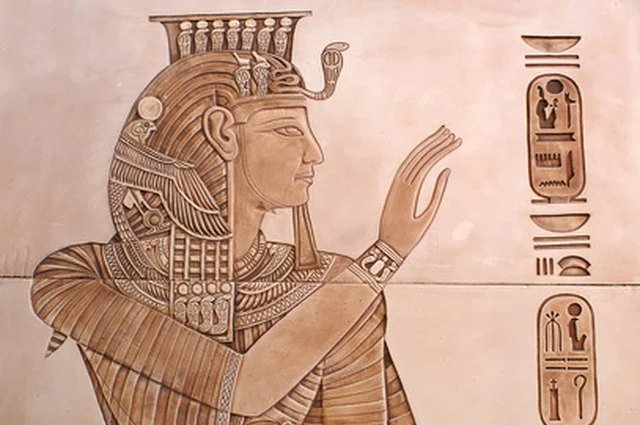
The Lord used these frogs to show the weakness of the Egyptians gods. If you could bring up the first slide. Here you see the Egyptian goddess Heqet. She has the head of a frog. You can see that in the second slide as well. The Lord used frogs to show that their frog god had no power. This is the equivalent of, “stop hitting yourself.” My guess is that many of us were the victim or the perpetrator of “stop hitting yourself.” Your big brother grabs your hand, uses it to hit you, and says, “stop hitting yourself; stop hitting yourself.” He does so to show you that your strength is nothing compared with his. That’s a bit like what the Lord is doing here in this plague. He is taking the Egyptian gods and hitting Egypt with them saying, “stop hitting yourself, stop hitting yourself,” to show them that the power on which they are depending is powerless.
The Lord continues to do that. He will use what the world worships against it to anyone with eyes to see that their power is powerless. If a man worships influence, the Lord might take some influence away to show him that it could never take care of him to begin with. If a woman worships other people’s opinions, the Lord might turn opinions against her to teach her to stop worshipping other mere mortals no different from herself. The goal is to set people free and this process is apparently the wisest way there.
The Lord may have also used frogs because Heqet is the goddess of childbirth. As with the plague on the Nile, the Lord has not forgotten about those drowned Hebrew babies. What the book of Revelation said about Babylon was true about Egypt and it’s true about what goes on in this dark world today, “her sins have piled up as high as heaven, and God has remembered her iniquities.” The Lord remembers injustices. He will put them right. This is different from the way He treats His children. We have to be careful interpreting here because Egypt is the world but the church is not. There is a real distinction between the way the Lord treats those who are His and those who won’t be His. There is a real difference between correction, which is what the Lord does with His people, and punishment which is what He does with the world. Our punishment was completed on the cross. The Lord is never against us—even in our darkness—as He is against this dark world. That might be a call this morning for you to come out of the world and to God.
So, the Lord brought this plague of frogs, but the Egyptian magicians could do this too; verse 7, “but the magicians did the same things by their secret arts; they also made frogs come up on the land of Egypt.” Now if you were Pharaoh, would you be impressed by your magicians producing more frogs? Your country overrun by frogs. You don’t want more. You want your magicians to make them go away. They can’t; that’s the point—not the ability of the Egyptian magicians but their inability. We have to choose the right metric by which to measure, and so verse 8, ‘Pharaoh summoned Moses and Aaron and said, “Pray to the Lord to take the frogs away from me and my people, and I will let your people go to offer sacrifices to the Lord.”’
Pharaoh came to Moses because his people couldn’t handle the problem. The tables were starting to turn. Moses, not Pharaoh, is starting to seem like the powerbroker; verse 9, “I leave to you the honor of setting the time for me to pray for you and your officials and your people that you and your houses may be rid of the frogs, except for those that remain in the Nile.”
You might have noticed that Moses told Pharaoh that the frogs wouldn’t completely disappear. They would just swarm the Nile. That wasn’t up for debate. Moses was so completely in charge that he left it up to Pharaoh to set the time for the frog’s leaving. You might wonder why Pharaoh didn’t just say, “immediately! Get the frogs out of here now!” Some think that it was pride. Others think that Pharaoh didn’t want to let the people go and so he was hoping the problem would just go away on its own. Others think that Moses’ words ran more along the lines of, “I leave it to you to set the day,” knowing that he would have to intercede for quite a while. We don’t know. What we do know is that when Moses prayed, the frogs outside the Nile died. They died where they were—in the grain, in the bedrooms. “They were piled into heaps, and the land reeked of them,” as verse 14 put it. I still remember a frog which had been run over on the cul-de-sac where I grew up. It was flattened and covered with flies—so disgusting. The land of Egypt was so disgusting. The Lord left that disgustingness there as a reminder because He knew that once the plague stopped, Pharaoh would change his mind about letting the people go; “when Pharaoh saw that there was relief, he hardened his heart and would not listen to Moses and Aaron, just as the Lord had said.” The Lord wanted the sights and smells everywhere to leave Pharaoh without excuse—“how did you already forget about the frogs?”
Pharaoh had forgotten. He was willing to let the people go while those frogs were hopping around, but now that they were dead, he changed his mind. “This is a disease common to all hypocrites,” said Calvin, “it is only their trouble that humbles them and that only for a short time.” Luther says we would be wise to learn from this because we too live in a wicked world. Reading this story he thought of Psalm 28 and wrote, ‘The wicked and workers of evil “speak with their neighbors in a friendly manner while evil is in their hearts.” That is the nature of all hypocrites, which we need to learn to recognize.’ Not everyone will repent.
The Lord had rescued Pharaoh who had made a promise to make some changes. Pharaoh didn’t. Louis Zamperini did. Zamperini was a bombardier in the Second World War. His plane went down in the Pacific, and he spent 47 days floating on a raft. He vowed that if he was rescued, he would serve the Lord. Zamperini was rescued. As the years went by, though, Zamperini didn’t give much thought to that vow. When his marriage began to fall apart, his wife begged him to come with her to hear a preacher named Billy Graham. Zamperini went and told her it was a bunch of hogwash. She begged him to come again the next night and he begrudgingly went, and he was again totally frustrated with it all. He got up to leave in the middle of the sermon and then what should float into his mind but that life raft. He remembered the promise he made, “if You rescue me, I’ll serve you forever,” and he couldn’t get away from that thought. He found himself not leaving but walking down the aisle to publicly accept Christ as his Savior. Zamperini went on to keep the vow he made, “if you rescue me, I’ll serve you forever.” That had consequences. Pharaoh didn’t keep his vow, “Pray to the Lord to take the frogs away from me and my people, and I will let your people go to offer sacrifices to the Lord.” That will have consequences. “Whatever your lips utter you must be sure to do, because you made your vow freely to the Lord your God with your own mouth,” Deuteronomy 23:23. That still holds true.
Pharaoh didn’t learn the lesson of the plague of the frogs and so now we have the gnats. That’s our second and shorter points: the gnats. The Lord had warned Pharaoh that if he didn’t let the people go, the plague of frogs was coming. There is no warning here. The Lord simply unleashes them; “Stretch out your staff and strike the dust of the ground and throughout the land of Egypt the dust will become gnats.”
This is about the inanimate becoming animate. The plagues deal with creation. They deal with rivers and animals and weather. The plagues mix these in weird ways. A life-giving river becomes blood. Dust becomes gnats. Light is replaced by darkness. The Lord is removing the structure of creation much as He did at the flood. He is showing that it is always He who kept the Nile flowing, who kept the frogs where they should be, who kept oldest sons alive and He can undo that. He is showing that He is in charge of everything in Egypt and Kalamazoo and Moscow and it is only normally orderly because He likes it that way. ‘It is possible,’ as Chesterton put it, ‘that God says every morning, “Do it again” to the sun; and every evening, “Do it again” to the moon. It may not be automatic necessity that makes all daisies alike; it may be that God makes every daisy separately but has never got tired of making them.’ It is the Lord’s good pleasure that there is the order we enjoy in this world. Here with the plagues, He removes that order just a bit to show the world how reality works. May we have eyes to see.
So now Pharaoh has gnats everywhere or, perhaps, mosquitos. Moses might have been talking about mosquitos. That changes it for most of us because most of us have more experience with mosquitos than gnats. I remember taking a group of high schoolers on a backpacking trip through the Adirondacks. Our guide accidentally set up camp next to a swamp. The mosquitos were so thick that our meatless chili had meat in it—mosquito meat; perhaps that’s what verse 17 describes, “gnats came upon men and animals.” It might be lice. It might be bedbugs. None of those choices sound all that enjoyable to me.
The Lord message here is that the Lord has armies of mosquitos or lice or gnats at His disposal for whatever He purposes. As Calvin said, “all creatures are ready at God’s lightest command whenever He chooses to make use of them to chastise His enemies.” Now the thought of creatures at God’s disposal might not seem impressive to us with our modern technology but how well do our weapons hold up in negative fifty-degree weather? Perhaps the record breaking brutal Russian winter of 1941-1942 had something to do with the Nazi advance and the Lord’s will. It’s still His world—always has been and always will be. You and I are just living in it and we live in it well by behaving as if it’s His not ours. Pharaoh will not learn that lesson.
You see it’s the Lord’s world in verse 18, “when the magicians tried to produce gnats by their secret arts, they could not.” Some think that the magicians couldn’t control the mosquitoes because while a magician might be able train a frog like a dove, who could train a mosquito? Others think that the magicians couldn’t do anything with the gnats because their dark magic was effective with water and water related animals than land related animals. All of that, though, is beside the substantive point, which is that the plagues are becoming more powerful. The Lord is upping the stakes.
The magicians saw that. They told Pharaoh, “This is the finger of God.” Jesus used this same phrase about his own wonders. After he cast out a demon he told the Pharisees, “If it is by the finger of God that I cast out demons, then the kingdom of God has come upon you.” Pharaoh saw the finger of God in that plague and he didn’t repent. The Pharisees saw the finger of God in Jesus’ miracles and they didn’t repent. That’s a pagan king and the most religious people of the day making the same mistake. Don’t think that being religious will keep you from missing the power of God. We all, like Pharaoh and the Pharisees, can blind ourselves to the obvious. Pharaoh didn’t want to let the people go and so He fought the Lord. The Pharisees didn’t want to follow Jesus and so they fought the Lord incarnate. What do you want that makes you fight the Lord? Stop it. You are going to lose.
We aren’t told that this plague of gnats was called off. We do know that the Nile still swarming with frogs. Perhaps some of these plagues became the “new normal” until the ten were finished.
The plagues were intensifying. How did Pharaoh respond? “Pharaoh’s heart was hard and he would not listen, just as the Lord had said.” Pharaoh has yet to learn that the there is no one like the Lord. He won’t learn that lesson. He is so unlike the Lord that He can’t see the Lord’s excellence. The Lord still seemed as unimpressive to him as Magnus Carlsen might seem to a gearhead who cares nothing about chess or as unimpressive as master mechanic Mike Besso might seem to a chess player. It takes perspective to recognize proficiency and Pharaoh, who doubtlessly had real perspective on any number of matters—he was after all the ruler of a superpower—will not recognize the Lord’s excellence.
Pharaoh will not learn. Our world, and this first part of Exodus we are studying is, in part, an examination of the power of the world, will not learn. From the perspective of the world the Lord seems about consequential to what happens in our culture as Reader’s Digest—quaint, still popular with a loyal few, mildly inspirational, ultimately weightless, and now that you think about it you are not sure if it’s been discontinued. The cultural air you breathe isn’t all that different from Pharaoh’s. You desperately need to know the Lord as do I. We need the humility and perspective necessary to learn that there is no one like Him. Amen.