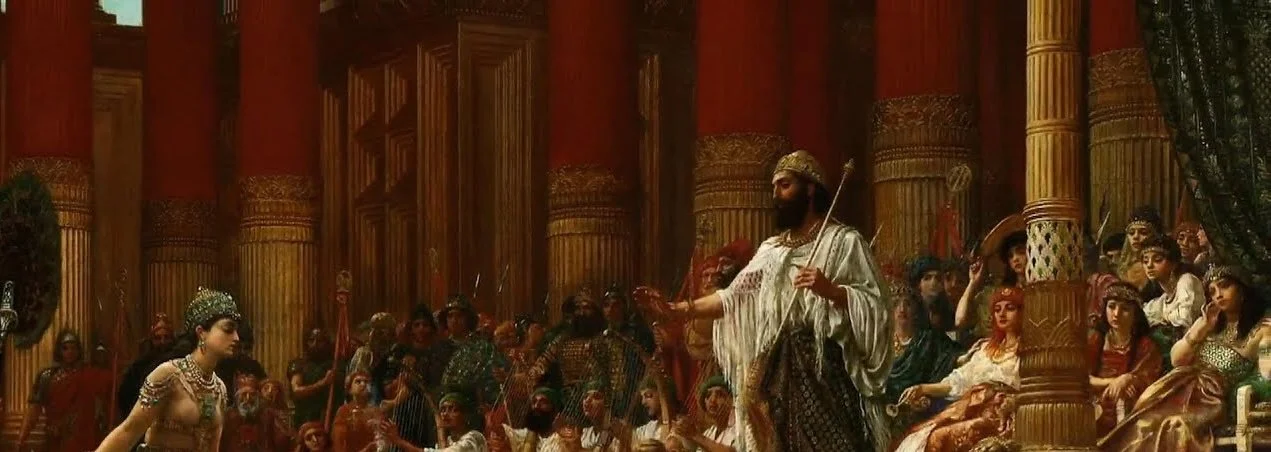
“28 Then King David said, “Call in Bathsheba.” So she came into the king’s presence and stood before him. 29 The king then took an oath: “As surely as the Lord lives, who has delivered me out of every trouble, 30 I will surely carry out today what I swore to you by the Lord, the God of Israel: Solomon your son shall be king after me, and he will sit on my throne in my place.” 31 Then Bathsheba bowed low with her face to the ground and, kneeling before the king, said, “May my lord King David live forever!”
32 King David said, “Call in Zadok the priest, Nathan the prophet and Benaiah son of Jehoiada.” When they came before the king, 33 he said to them: “Take your lord’s servants with you and set Solomon my son on my own mule and take him down to Gihon. 34 There have Zadok the priest and Nathan the prophet anoint him king over Israel. Blow the trumpet and shout, ‘Long live
King Solomon!’ 35 Then you are to go up with him, and he is to come and sit on my throne and reign in my place. I have appointed him ruler over Israel and Judah.” 36 Benaiah son of Jehoiada answered the king, “Amen! May the LORD, the God of my lord the king, so declare it. 37 As the LORD was with my lord the king, so may he be with Solomon to make his throne even greater than the throne of my lord King David!”
38 So Zadok the priest, Nathan the prophet, Benaiah son of Jehoiada, the Kerethites and the Pelethites went down and put Solomon on King David’s mule and escorted him to Gihon. 39 Zadok the priest took the horn of oil from the sacred tent and anointed Solomon. Then they sounded the trumpet and all the people shouted, “Long live King Solomon!” 40 And all the people went up after him, playing flutes and rejoicing greatly, so that the ground shook with the sound.
41 Adonijah and all the guests who were with him heard it as they were finishing their feast. On hearing the sound of the trumpet, Joab asked, “What’s the meaning of all the noise in the city?” 42 Even as he was speaking, Jonathan son of Abiathar the priest arrived. Adonijah said, “Come in. A worthy man like you must be bringing good news.” 43 “Not at all!” Jonathan answered. “Our lord King David has made Solomon king. 44 The king has sent with him Zadok the priest, Nathan the prophet, Benaiah son of Jehoiada, the Kerethites and the Pelethites, and they have put him on the king’s mule, 45 and Zadok the priest and Nathan the prophet have anointed him king at Gihon. From there they have gone up cheering, and the city resounds with it. That’s the noise you hear. 46 Moreover, Solomon has taken his seat on the royal throne. 47 Also, the royal officials have come to congratulate our lord King David, saying, “May your God make Solomon’s name more famous than yours and his throne greater than yours!” And the king bowed in worship on his bed 48 and said, ‘Praise be to the LORD, the God of Israel, who has allowed my eyes to see a successor on my throne today.’ ”
49 At this, all Adonijah’s guests rose in alarm and dispersed. 50 But Adonijah, in fear of Solomon, went and took hold of the horns of the altar. 51 Then Solomon was told, ‘Adonijah is afraid of King Solomon and is clinging to the horns of the altar. He says, “Let King Solomon
swear to me today that he will not put his servant to death with the sword.”’ 52 Solomon replied, “If he shows himself to be a worthy man, not a hair of his head will fall to the ground; but if evil is found in him, he will die.” 53 Then King Solomon sent men, and they brought him down from the altar. And Adonijah came and bowed down to King Solomon, and Solomon said, “Go to your home.””
Your character casts your consequence. Jacob lied to his father and became a father deceived by his sons. David trusted the Lord and the Lord entrusted him with the kingdom. Your character casts your consequence.
This means I would be wise to tend to my character as if it were garden—to pull weeds and plant seeds because there will be a harvest. There will be consequence cast by my character and so it will go for us all and so it was for Adonijah and for Solomon. The Lord will see to it. To the pure God shows Himself pure, but to the crooked He shows Himself shrewd; that’s these young men’s father, David, in Psalm 18 and that’s the claim of this sermon: to the pure God shows Himself pure, but to the crooked He shows Himself shrewd.
We will study this in three points. First: David finds his strength. Second: long live King Solomon. Third: scurrying away. First, in verses 28-37, David finds his strength. Second, in verses 38-40, long live King Solomon. Third, in verses 41-53, scurrying away.
We see Adonijah and Solomon’s father in our first point: David finds his strength. Last week we found David enfeebled by age. To his son Adonijah seemed toothless and so the young man made a play for the throne. Nathan and Bathsheba appealed to David’s integrity asking him to live up to his promise that Solomon would be king; we see David’s response in verse 28, ‘Then King David said, “Call in Bathsheba.” So she came into the king’s presence and stood before him. The king then took an oath, “As surely as the Lord lives, who has delivered me out of every trouble, I will surely carry out today what I swore to you by the Lord…”’
David doubles down on his oath that Solomon would be king. This word for swearing an oath is “sheba”, and so David gives a sheba to Bathsheba whose name means “daughter of an oath.” Promises matter and this daughter of an oath and her son will be saved by this oath. David rises to the occasion. He’s not dead yet. There’s plenty of vitality and virtue left in the man. He will do what needs to be done and he will do it now. That’s obedience—all the way, right away, with a glad heart. Children that’s how you are to obey your parents. That’s how we are to obey the Lord. Eventual obedience is like leaving your blinker on while driving straight for miles—misleading and dangerous.
David’s promise keeping is part of God’s plan. God had promised David a dynasty and David’s actions here are part of securing it. God enjoys working through His people just like parents enjoy doing tasks with their children for their own delight and their children’s growth. They learn. They mature. You enjoy. Our experience of that is a dim reflection of God’s experience with us. It’s all about us coming to know Him.
The daughter of an oath responds to this oath by honoring the king; ‘Then Bathsheba bowed low with her face to the ground and, kneeling before the king, said, “May my lord King David live forever!”’ That bowing is not worship. It is appropriate show of honor in that culture as is her statement, “May my lord King David live forever!” Bathsheba knows David is not going to live forever. This whole chain of events was set into motion by the fact he’s not going to live forever. It’s etiquette and it matters. Giving honor matters. Receiving honor honorably matters. It’s the bond of human relationships. It matters in your situation.
David lays out his plan; “Take your lord’s servants with you and set Solomon my son on my own mule and take him down to Gihon.” Gihon was Jerusalem’s principal water source. This was the place to which almost everyone in the city would go and David wanted Solomon’s coronation as public as possible. Adonijah’s party was private. Solomon’s will be public.
Solomon is to ride David’s mule as a sign that he has his father’s blessing. Some of you might have taken your father’s car to prom. No one there asked you if you had his permission. It was assumed and it was token of trust in you that you could take care of it. Solomon riding David’s mule was a token of trust in Solomon that he could take care of the kingdom. It’s David’s way of saying, “you’re in good hands with this son.”
Benaiah the military man applauded the plan; “As the Lord was with my lord the king, so may he be with Solomon to make his throne even greater than the throne of my lord King David!” This isn’t a disparagement of David; it is rather a conviction that the Lord not David or Solomon is over the throne. It’s Benaiah’s way of acknowledging that God is in this and that’s what’s needed. That’s always what’s needed when we consider the work of the church. Nothing can be made great without the Lord and nothing great will remain great without the Lord. Benaiah knows that it’s not ultimately about whether Solomon can be trusted; it’s about whether the Lord can be trusted. Are you trusting the Lord for you future? You will something. Everyone does. Choose wisely.
We see David’s plan come to fruition in our second point: long live King Solomon. When we read this passage, you likely noticed that it was highly repetitive. David explained his plan and then, in almost the same words, the plan went into action. Ancient near east literature was like that—repetitive and cyclical. It does it here to reinforce a point; David’s instructions were carried out to the letter. The king is still very much in charge and this shows you that his cabinet obeyed him as he obeyed the Lord. Obedience is never boring. It’s remarkable when it happens. You tell your employees the way you want it, and that’s how it winds up. That’s a wonder. It’s not misunderstanding or disobedience or sin that’s interesting in the end. Obedience is interesting. Commandment keeping is interesting. Love is interesting.
Since there is repetition, let’s focus on what we passed over in our first point. It’s worth noting the listing of Solomon supporters—“Zadok the priest, Nathan the prophet, Benaiah son of Jehoiada…” This list begins with the spiritual—the priest and the prophet—and ends with the military man. Adonijah’s list was the opposite. It’s a sign of where each party put its trust; “Some trust in chariots and some in horses,” David wrote; “but we trust in the name of the Lord our God.” That’s where Solomon would be wise to put His trust. Adonijah didn’t.
That list of men is the list of those Adonijah excluded. The tables are turning. It’s not over ‘til it’s over. That’s something to remember in the dramas of this life. Our own poets see that, “and don’t speak too soon for the wheel's still in spin and there’s no tellin’ who that it’s namin’. For the loser now will be later to win. For the times they are a-changin’.”
The times were a changin’ in Israel. Solomon is now king. ‘Zadok the priest took the horn of oil from the sacred tent and anointed Solomon. Then they sounded the trumpet and all the people shouted, “Long live King Solomon!”’ Anointing was a spiritual act—a sign of the Lord’s favor and choice. You’ve likely heard the Hebrew of anointing—me-sha-ch, Messiah. The Messiah is the anointed one par excellence, the uninterrupted favor of the Lord, His choice. That’s Jesus. Every anointing in Scripture is an invitation to consider Jesus a bit how every basketball player who dares put on number 23 is an invitation to consider Michael Jordan.
Solomon is now king. He’s likely co-regent with his father. That’s how it works. Adonijah tried to take the throne from David. Solomon will share it with David. There is no question about who David supports. This passage began with Solomon, but structurally sandwiches Solomon between talk of Adonijah almost as if Solomon is about to be swallowed by his brother. This text tells you that they snatched victory from the jaws of defeat. That’s often how it will seem for God’s people in this life. God likes to snatch victory from the jaws of defeat. He likes it surprising in this life or so it seems to us because we fallen creatures are so perpetually surprised by obedience, by order, and by grace. That’s worth remembering if nothing seems all that victorious to you this evening.
David’s plan was a rip-roaring success; “all the people went up after [Solomon], playing flutes and rejoicing greatly, so that the ground shook with the sound.” You could feel the percussion. If you’ve ever experienced something like that at a football game or concert, you remember the experience. People would remember what it felt like when Solomon was crowned king. That’s a bit of what it will be like when we find Christ is king. The ground will shake with the sound of celebration. The new creation is pictured as uninterrupted Jesus everywhere always. He’s the temple. He’s the sun. His is the book of life. His is the throne around which everyone circles. It’s image after image designed to tell you that you won’t be able to get away from Jesus’ victory and you’ll never want to do so.
So Solomon is king, but by whose plan? David’s, Bathsheba’s, Nathan’s, the Lord’s, but not by Solomon’s own plan. You nowhere see him grasping for power like Adonijah. He’s not trying to secure the throne. He receives it. That’s a distinction Jesus wants you to see about the kingdom. “Truly I tell you, anyone who will not receive the kingdom of God like a little child will never enter it.” As we saw with Exodus and the parables, the distinction between trying to secure and gracious receiving runs throughout the Bible. You are either trying to force God’s hand or you are happy to receive whatever is in God’s hand. Let’s not try to force God’s hand as a church or individuals. We’ll never force Him and we’ll lose what He has in His hand that would have been for us. Don’t try to force it by will power, by your works, by your goodness, by your badness. Be a gracious receiver. That’s part of honoring God, the gracious giver.
You see the perfection of that in Jesus. He received the kingship of the kingdom in the most passive way imaginable—death. That’s the ultimate trusting of what’s in the Father’s hand rather than trying to force it; that’s, “he humbled himself by becoming obedient to death—even death on a cross! Therefore God exalted him to the highest place and gave him the name that is above every name.” Jesus is more than we can imagine and here he is our template to copy. He shows us what it’s like to receive the kingdom. He advised and lived, “Truly I tell you, anyone who will not receive the kingdom of God like a little child will never enter it.” Don’t try to be wiser than him. That’s the ultimate form of foolishness. To the crooked, He will show Himself shrewd, but to the pure, He shows Himself pure. We see this reciprocal attribute in our final point: scurrying away.
Now we return to Adonijah. King Solomon will need to contend with Adonijah but now he will do so with the power of a king. We find Adonijah partying, “Adonijah and all the guests who were with him heard it as they were finishing their feast.” Adonijah celebrates while everything from his perspective falls to pieces. This a picture of Nero playing his fiddle while Rome burns. Adonijah’s pedigree prepares us for this. We were told that his mother’s name was Haggith which was connected to the word for “feast.” Adonijah is the son of a party. Solomon is the son of the daughter of an oath. Which one carries the weight of life—self congratulating parties or promises? Promises are what it is all about. The “I do” is what a wedding is all about. Trust in God’s promises are what faith is all about.
The son of the priest loyal to Adonijah arrives at the party with news and Adonijah says, “Come in. A worthy man like you must be bringing good news.” That’s putting on a good face. Adonijah is likely quite nervous by the appearance of messenger who is likely nervous to say, “Our lord King David has made Solomon king.” Notice what he calls David—“our lord.” This young man knows he’s backed the wrong horse. Now Adonijah knows he’s the wrong horse.
This passage began with Adonijah assuming that David was clueless about what was going on David’s kingdom. Now we find that it’s been Adonijah who is clueless as to what’s going on in David’s kingdom. The passage began with Bathsheba fearing for Solomon’s life. It ends with Adonijah is fearing for his own life. Everything Adonijah assumed about others and intended for others is coming back on his own head. To the pure God shows Himself pure, but to the crooked He shows Himself shrewd. God is the king who always knows what’s happening and will happen in His kingdom. We would be wise to subject ourselves to that.
Adonijah’s supporters now know what’s going on in Solomon’s kingdom; that’s verse 49, “At this, all Adonijah’s guests rose in alarm and dispersed.” The guests are scurrying away formulating their explanations for having been there. This is a day they will remember too and many of them will live to regret it. If you back King Jesus, you won’t know that sort of regret. Back anyone other than Jesus, and you’ll know it better than even Adonijah.
Adonijah runs for sanctuary—literally; “Adonijah, in fear of Solomon, went and took hold of the horns of the altar.” This practice of fleeing for safety might come from Exodus 21 in which the Lord promises a place to where the guilty might flee for refuge in certain situations.
Adonijah’s choice puts Solomon in a situation needing wisdom. Solomon can honor the sanctuary and let a potential threat live or he can put an end to Adonijah and begin his reign by spilling blood in a holy place. Adonijah pushes Solomon onto the horns of this dilemma asking saying, “Let King Solomon swear to me today that he will not put his servant to death with the sword.” Adonijah is asking for full pardon and a public promise of continued safety.
Solomon knows the game his brother is playing. He’s far too wise to give a blank check promise of safety. ‘Solomon replied, “If he shows himself to be a worthy man, not a hair of his head will fall to the ground; but if evil is found in him, he will die.”’ Solomon does what we all must do particularly with uncertain characters. We are to put the weight for their decisions back on them. Solomon gives Adonijah the freedom and responsibility to decide his own fate. Solomon is not as quick as Adonijah to deal out judgment and threats of death. Solomon is far wiser as we will see when these two butt heads yet again.
Solomon is not as wise as Jesus, though. King Jesus knows how to always put the weight of our decisions back on us. It is we who are in Adonijah’s situation when it comes to king Jesus. We have tried to take his throne. We are Psalm 2 sort of people, ‘Why do the nations conspire and the peoples plot in vain? The kings of the earth rise up and the rulers band together against the Lord and against his anointed, saying, “Let us break their chains and throw off their shackles.”’ King Jesus offers us clemency at the cost of his own death, but then, in effect, says, “If he shows himself to be a worthy man, not a hair of his head will fall to the ground; but if evil is found in him, he will die.” That’s the call to repentance and faith.
Don’t take the grace King Jesus offers for granted. Don’t try to play him by fostering renewed rebellion in your heart. You’ll find that King Jesus is ever wiser than King Solomon in dealing with continued rebellion. Your characteristic response to King Jesus will cast your consequence just as Adonijah’s will regarding Solomon. To the pure, he will show himself pure but to the crooked, he will show himself shrewd. What you assume about King Jesus will and what you intend for King Jesus will come back upon you. Be wise. King Jesus will be. Amen.