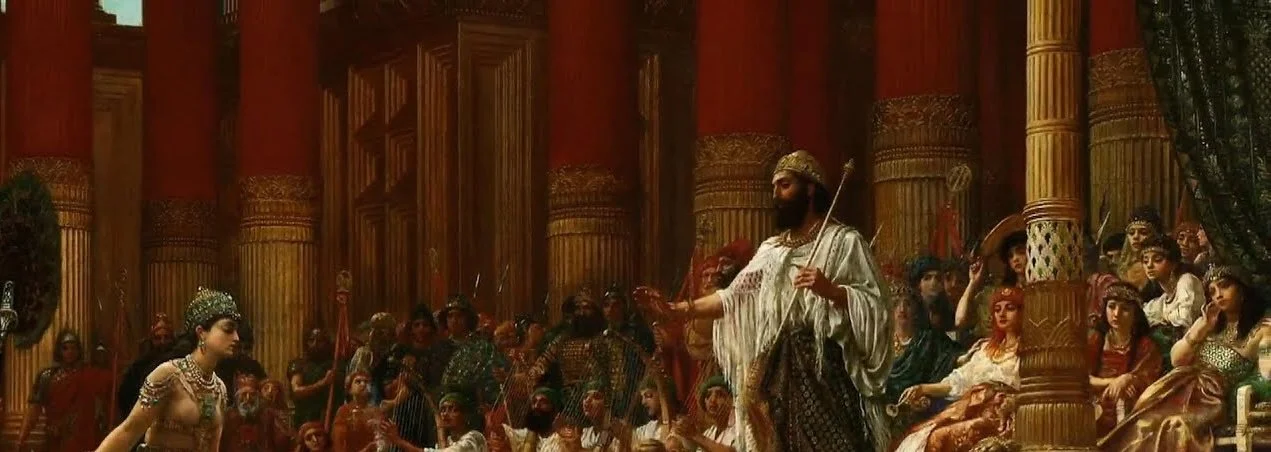
“54 When Solomon had finished all these prayers and supplications to the LORD, he rose from before the altar of the LORD, where he had been kneeling with his hands spread out toward heaven. 55 He stood and blessed the whole assembly of Israel in a loud voice, saying: 56 “Praise be to the LORD, who has given rest to His people Israel just as he promised. Not one word has failed of all the good promises He gave through His servant Moses. 57 May the LORD our
God be with us as he was with our fathers; may He never leave us nor forsake us. 58 May He turn our hearts to Him, to walk in all his ways and to keep the commands, decrees and regulations He gave our fathers. 59 And may these words of mine, which I have prayed before the LORD, be near to the LORD our God day and night, that He may uphold the cause of His servant and the cause of his people Israel according to each day’s need, 60 so that all the
peoples of the earth may know that the LORD is God and that there is no other. 61But Your hearts must be fully committed to the LORD our God, to live by His decrees and obey his commands,
62 Then the king and all Israel with him offered sacrifices before the LORD. 63 Solomon offered a sacrifice of fellowship offerings to the LORD: twenty-two thousand cattle and a hundred and twenty thousand sheep and goats. So the king and all the Israelites dedicated the temple of the LORD. 64 On that same day the king consecrated the middle part of the courtyard in front of the temple of the LORD, and there he offered burnt offerings, grain offerings and the fat of the fellowship offerings, because the bronze altar before the LORD was too small to hold the burnt offerings, the grain offerings and the fat of the fellowship offerings.
65 So Solomon observed the festival at that time, and all Israel with him—a vast assembly, people from Lebo Hamath to the Wadi of Egypt. They celebrated it before the LORD our God for seven days and seven days more, fourteen days in all. 66 On the following day he sent the people away. They blessed the king and then went home, joyful and glad in heart for all the good things the LORD had done for his servant David and his people Israel.”
“5, 4, 3, 2, 1, Happy New Year!” We began our time in this chapter by considering fun. We thought about New Year’s Eve parties that never seemed to live up the hype, weddings and receptions that do but couldn’t go on forever, and time at the beach that could keep going as long as want but runs its course.
Each of those examples is all about enjoyment. Do you think God is all about enjoyment? Do you think God knows how to have a good time? Do you think He knows how to have a good time better than you do?
That would be worth my consideration. If I think that I’m more fun than God, I’ll eventually find ways to ditch Him so I can have a good time. If I think He’s more fun than me, I’ll be concerned that I’ll miss out if I’m not where He’s at. Do you think He knows how to have a good time better than you do? That’s worth our consideration and so tonight we will because it’s all over this passage. God is into enjoyment—His and ours; that’s the claim of this sermon.
We will study this in two points. First: blessing. Second: celebrating. First, in verses 54-61, we see blessing. Second, in verses 62-66, we see celebrating.
We see that first in a topic we all want more of: blessing. Many of us don’t know what to do with blessings. They make some of us self-conscious. A friend I’ve known for decades recently drove up in a Jeep he only takes out in the summer. He immediately made clear that he got a scream of a deal on it. I know why he talked about the deal. I do the same with my blessings. I feel like I need to somehow justify them. Blessings make other people proud. They make other people greedy for more. We humans are strange creatures. We not only have trouble refusing what’s bad. We have trouble enjoying what’s good.
That trouble is not from God. He created everything for enjoyment—His and ours. “Don’t be deceived… Every good and perfect gift is from above, coming down from the Father of the heavenly lights, who does not change like shifting shadows.” We have trouble believing that God is that good. That’s not because of Him; it’s because of ourselves. We are so deformed by the fall and our sin that we need the blessing of learning to enjoy our blessings.
If you could bring up our slide for the evening.
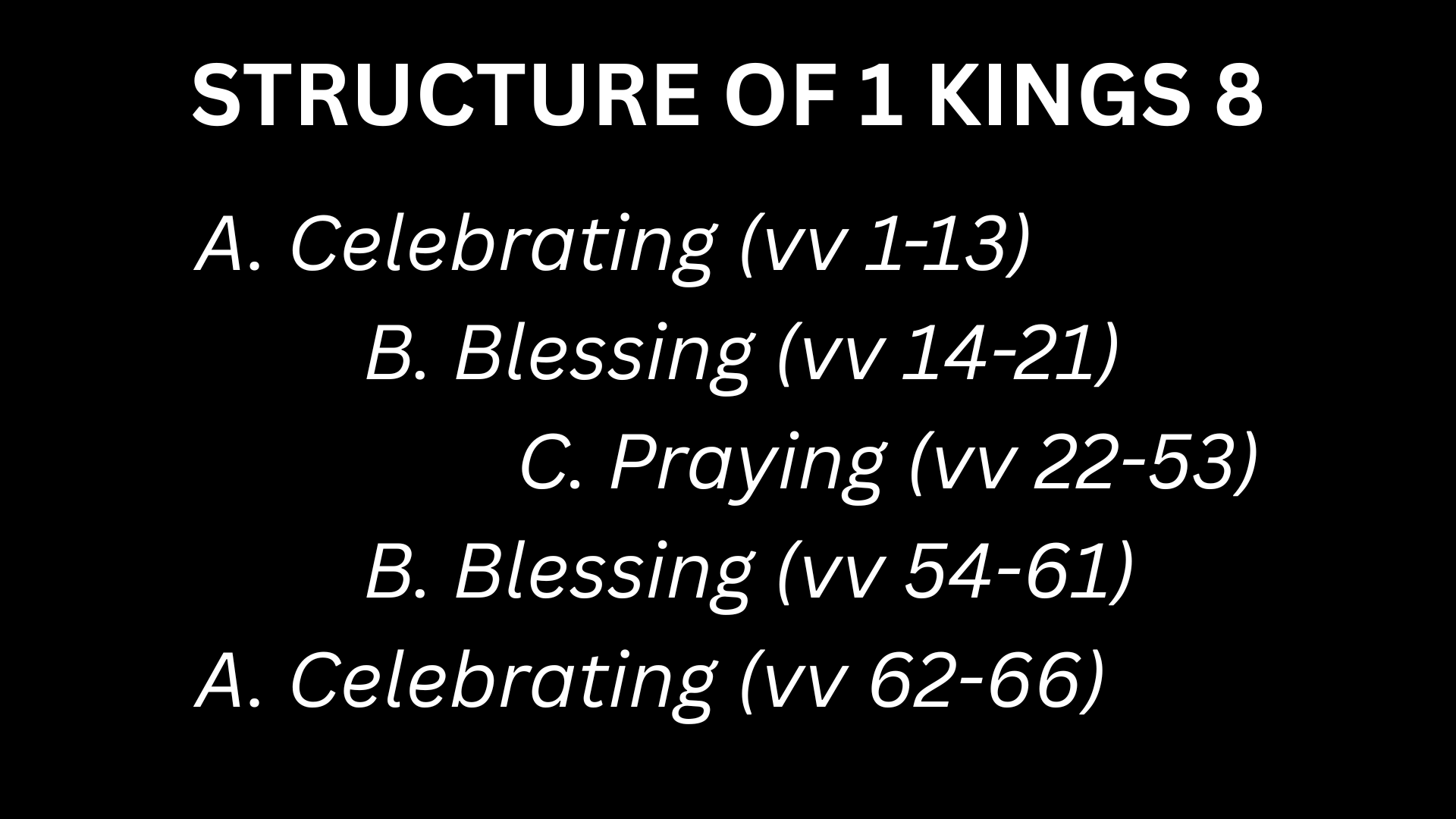
We just spent three weeks in section C because that’s the center of this structure and what’s in the center is central. We combined A and B in our first sermon on this chapter and, as you can see, are doing so again today so we can explore different aspects of each in each sermon. That means that today we are returning to blessing and celebrating.
If you look at this structure, what would say that God is into? Obedience for its own sake? Praying because that’s what good people do? He seems to be into enjoyment. It begins and ends with celebrating. It’s got blessing twice—blessings abound as we thought about it in our first study. In the middle is a prayer consisting of seven scenarios which ask for God’s help for blessings to continue to abound. This chapter seems to major in enjoyment and if you are anything like me, you miss that without it being made blindingly obvious. That means there is something in me that needs adjustment. I don’t want to be the sort of person who misses out on joy. I don’t want to be the sort of person who misses out on fun—and that’s what’s in this chapter with feasting and festivals. I don’t want to be the sort of person who misses out on what God is up to.
Faith is a holistic experience. It’s about all of life. You see an indication of that with Solomon’s posture at the end of his prayer, “When Solomon had finished all these prayers and supplications to the Lord, he rose from before the altar of the Lord, where he had been kneeling with his hands spread out toward heaven.” That’s interesting because we are told up in verse 22 that he was standing. It seems that the more he prayed, the more he sensed his utter dependence upon God and need to submit to God. That’s a proper byproduct of prayer. “Pray until you pray,” the Puritans put it and you know you’ve prayed until you’ve prayed if something in you changes. Something in Solomon changed. By praying he realized he needed to increasingly submit to the Lord.
He knew he needed to bless the people. That’s another byproduct of prayer. You’ve been with God and so you want to bless like God. Solomon now stands because he’s now talking not to God but to the people. He doesn’t submit to them like He does to the Lord and so doesn’t bow.
Notice His first words to the people, “Praise be to the Lord.” That’s who Solomon is thinking about. It’s like when a child comes home from a friend’s house. Who do you hear about? That friend and more about that friend and more about that friend; that’s as it should be. That’s who is on your child’s mind because that’s what they just enjoyed—time with that friend. Solomon talks about the Lord because that’s who is on his mind.
You see Solomon’s reasons for enjoying God in verse 56, “Praise be to the Lord, who has given rest to His people Israel just as He promised.” Solomon’s first reason for praise is rest, which is a substantial theme in Scripture—rest in the sense that God not you has it covered. “Come to me all you who are weary and heavy burdened and I will give you rest,” as Jesus put it. It’s a sigh of contented relief. “It is finished,” as Jesus secured. “Not one word has failed of all the good promises He gave through His servant Moses,” as Solomon said.
Now that everything seems at rest, what do the people need to keep it going? What do we need? That’s what we studied in the prayer and that’s verse 57, “May the Lord our God be with us as He was with our fathers; may He never leave us nor forsake us.” We need the Lord with us. That’s the center of Psalm 23, “You are with me.” You see it in the flesh in Jesus—Immanuel, God with us. You see it the Holy Spirit who is in us. What we need most is God with us and remember if I think I’m more into joy than God, I’ll eventually find ways to ditch Him so I can have a good time. If I think He’s more into joy than me, I’ll be concerned that I’ll miss out if I’m not where He’s at.
I’m the danger to myself here—me and my heart that’s prone to wander and so we have verse 58, “May He turn our hearts to Him, to walk in all his ways and to keep the commands, decrees and regulations He gave our fathers.” It’s about the heart; ‘there is no more subtle truth than that of the everyday phrase about a man having “his heart in the right place,”’ as Chesterton put it. The right place is with God.
The commands, decrees, and regulations Solomon speaks of are an expression of that; that’s how life works: behavior is an expression of belief, works are an expression of wants. If you want to please your husband, you’ll work at that. If you belief hard work pays off, you’ll behave as if hard work pays off. If you want to be near God, you’ll try to avoid doing what repels Him. It doesn’t make sense to say, “I can’t wait to be with my wife tonight so I can do everything she hates.” It doesn’t make sense to say, “I can’t wait to be with God so I can do everything He hates.” We are sensible enough to recognize that other people have behaviors they don’t appreciate. Why can’t we extend that respect and far more to God? Why doesn’t the One who started the party have a say in what keeps it going and what shuts it down?
This call to keep the commandments gets to the nub of why our fallen hearts take God for a killjoy. The Bible’s focus on sin and mercy is why we think we’re fun and God’s gloomy. That says more about us than God. Imagine a married couple who finds themselves deeply in debt. They want to put it right. A large percentage of their conversations in their marriage are, for a time, going to be about debt and repayment, but that’s not what their marriage is about. They’ll still have all sorts of delight in each other as they’re paying off that debt and once that debt is paid it off, they won’t keep talking about that debt at all. They’ll just focus more on what’s enjoyable. The Bible comes to us when we are the debt of sin and so it’s no surprise there’s so much focus on it, but that’s not the totality of our relationship with God any more than that debt is the totality of that marriage. It’s talked about with the purpose of getting through it so you can turn the focus to what’s enjoyable. That’s the entirety of the next life.
That’s the sort of relationship I want to be in. That’s the sort of relationship God is interested in. You see that in verse 60, “so that all the peoples of the earth may know that the Lord is God and that there is no other.” What is it that we are inviting others into? Why would you want to invite others to know a God who you think is less into joy than you. If you think He’s more into joy than you, you’re concerned not to miss out and you don’t want others to miss out. Which describes your angle on evangelism?
Which describes Jesus’ angle on evangelism—“the kingdom of heaven is like a job that’s crushing your soul but if you don’t do it, you’re out on the street, “the kingdom of heaven is like perpetually disappointed coach but one day you might make him smile,” or, “the kingdom of heaven is like treasure hidden in a field,” “the kingdom of heaven is like a merchant looking for fine pearls,” “the kingdom of heaven is like a king who prepared a wedding banquet for his son”? Finding treasure sounds fun to me. A wedding banquet sounds like a party to me. God is far more into enjoyment than our gloomy souls ruined by the fall dare to imagine. I’ll go with Jesus over than my imaginations on God every day I can. Our second point keeps the celebration going; that’s celebrating.
If you could bring up our slide again.
You see that we’re back where we started—with celebrating. These sacrifices might not seem like celebrating but that’s because we’re not all that familiar with this culture; verse 62, “the king and all Israel with him offered sacrifices before the Lord. Solomon offered a sacrifice of fellowship offerings to the Lord: twenty-two thousand cattle and a hundred and twenty thousand sheep and goats.” Some of us might be thinking—there’s an enormous out of blood there. There was a great deal of death so how dare we talk about enjoyment when something so serious as death and sacrifice is what’s called for? Well, the sacrifice is there to enable the enjoyment. The sacrifice was for the celebration. We tend to miss that and begin to think that sacrifice is good in and of itself. After all, Jesus offered himself as a sacrifice. We are told to lose our lives. True, but only if it is to find life. That’s why Jesus offered himself as a sacrifice—for life.
The living is the point. The enjoyment is the goal. The sacrifice is the means—not the end. Think of it in terms of a father sacrificing to pay the mortgage each month. Is he honored when his children live in that house as if it isn’t theirs too—when they treat it like a museum? Or is he honored when they live as if it’s their house too—when they do chalk art on the driveway and catch insects in the yard? He sacrifices to pay the mortgage not such sacrifice is good in and of itself. It’s a means to an end. That’s how Jesus saw the cross. “For the joy set before him he endured the cross.” It’s we who tend to glory in suffering for suffering’s sake—not God.
The goal of sacrifice is enjoyment. We might not be able to see that with these sacrifices in this passage because we aren’t thinking with our stomachs. What’s going to happen with those slain cattle, sheep, and goats? They people are going to eat them. They are going to feast. Those sacrifices which honored the Lord wound up on the people’s plates and that honored the Lord. They had ribs. They had steaks. They had brisket. They chops. They had leg of lamb. “The king was expected to go to huge expense to prepare a days-long feast for his people,” as Oswalt puts it—seven days of feasting or fourteen depending on how you read verse 65. So ask yourself again, is God all about enjoyment or are we more fun?
One author once defined a branch of Christianity as experiencing, “the haunting fear that someone, somewhere, may be having a good time.” God is more into having a good time than that. He’s also more into having a good time than that author who wrote those words.
The people feasted. They rarely got meat to eat let alone this much meat. They would remember this feast until they died. It was elaborate. It was extravagant. It was prodigal. We tend to think of that word regarding the prodigal son—he was recklessly extravagant in that foreign land. His father was too—he was recklessly extravagant. “Quick! Bring the best robe and put it on [my son]. Put a ring on his finger and sandals on his feet. Bring the fattened calf and kill it. Let’s have a feast and celebrate. For this son of mine was dead and is alive again; he was lost and is found.” That’s the same God you see here. And if we think we’re more responsible than Him you see us in that same parable. ‘The older brother became angry and refused to go in. “All these years I’ve been slaving for you and never disobeyed your orders. Yet you never gave me even a young goat so I could celebrate with my friends. But when this son of yours who has squandered your property with prostitutes comes home, you kill the fattened calf for him!”’ That’s what a party at a temple aimed at forgiveness is all about, though. It’s about God’s grace and giving. We’d be wise to humble ourselves enough to go to God’s party. We’d also be happier if we did.
These people were happy; verse 65, “So Solomon observed the festival at that time, and all Israel with him—a vast assembly, people from Lebo Hamath to the Wadi of Egypt.” That’s from the northern edge to the southern edge. From California to the New York island, from the redwood forest to the Gulf Stream waters,” as Woody Guthrie sang about our nation. It’s a beautiful image of unity and totality. It’s the rest every busy grandmother wants to experience when every child and grandchild is home for the holidays—unity and totality.
The dimensions listed harkens back to the dimensions of Eden in Genesis 2. The goal is always to get back to Eden even as we move forward. That’s where we arrive in the last book of the Bible—at rest in Eden, “on each side of the river stood the tree of life, bearing twelve crops of fruit, yielding its fruit every month. And the leaves of the tree are for the healing of the nations. No longer will there be any curse.” The goal is to get back to good, back to rest, back to joy, back to God. That’s where God takes His people—back to Himself; “May the Lord our God be with us… may He never leave us nor forsake us. May He turn our hearts to Him…”
That’s what Solomon stresses as he sends the people home—back to their tents if you want a more literal translation. We’ll see that phrase again; ‘it will not be so very long now… before Israelites will be found going “to their tents” for a very different reason and in a very different mood,’ as Provan explains. They will be going back to their tents after meeting with Solomon’s son, Rehoboam, and deciding to leave the union.
This goodness doesn’t last, but that doesn’t make it any less good in this moment; “joyful and glad in heart for all the good things the Lord had done,” was real in that moment and that moment matters. That’s worth remembering because that’s the major chord of this passage—joy, festivity, rest. There are experiences coming for each of us in this life which are other than that, but that doesn’t take the reality of this goodness away and that doesn’t mean those interruptions to God’s joy will last forever. Forever is God’s joy. Don’t miss out on where He’s at. You don’t want to miss that party. Amen.