“1 Then the Lord said to Moses, 2 “Tell the Israelites to turn back and encamp near Pi Hahiroth, between Migdol and the sea. They are to encamp by the sea, directly opposite Baal Zephon. 3 Pharaoh will think, ‘The Israelites are wandering around the land in confusion, hemmed in by the desert.’ 4 And I will harden Pharaoh’s heart, and he will pursue them. But I will gain glory for myself through Pharaoh and all his army, and the Egyptians will know that I am the Lord.” So the Israelites did this.
5 When the king of Egypt was told that the people had fled, Pharaoh and his officials changed their minds about them and said, “What have we done? We have let the Israelites go and have lost their services!” 6 So he had his chariot made ready and took his army with him. 7 He took six hundred of the best chariots, along with all the other chariots of Egypt, with officers over all of them. 8 The Lord hardened the heart of Pharaoh king of Egypt, so that he pursued the Israelites, who were marching out boldly. 9 The Egyptians—all Pharaoh’s horses and chariots, horsemen and troops—pursued the Israelites and overtook them as they camped by the sea near Pi Hahiroth, opposite Baal Zephon.
10 As Pharaoh approached, the Israelites looked up, and there were the Egyptians, marching after them. They were terrified and cried out to the Lord. 11 They said to Moses, “Was it because there were no graves in Egypt that you brought us to the desert to die? What have you done to us by bringing us out of Egypt? 12 Didn’t we say to you in Egypt, ‘Leave us alone; let us serve the Egyptians’? It would have been better for us to serve the Egyptians than to die in the desert!” 13 Moses answered the people, “Do not be afraid. Stand firm and you will see the deliverance the Lord will bring you today. The Egyptians you see today you will never see again. 14 The Lord will fight for you; you need only to be still.”
15 Then the Lord said to Moses, “Why are you crying out to me? Tell the Israelites to move on. 16 Raise your staff and stretch out your hand over the sea to divide the water so that the Israelites can go through the sea on dry ground. 17 I will harden the hearts of the Egyptians so that they will go in after them. And I will gain glory through Pharaoh and all his army, through his chariots and his horsemen. 18 The Egyptians will know that I am the Lord when I gain glory through Pharaoh, his chariots and his horsemen.”
19 Then the angel of God, who had been traveling in front of Israel’s army, withdrew and went behind them. The pillar of cloud also moved from in front and stood behind them, 20 coming between the armies of Egypt and Israel. Throughout the night the cloud brought darkness to the one side and light to the other side; so neither went near the other all night long. 21 Then Moses stretched out his hand over the sea, and all that night the Lord drove the sea back with a strong east wind and turned it into dry land. The waters were divided, 22 and the Israelites went through the sea on dry ground, with a wall of water on their right and on their left. 23The Egyptians pursued them, and all Pharaoh’s horses and chariots and horsemen followed them into the sea. 24 During the last watch of the night the Lord looked down from the pillar of fire and cloud at the Egyptian army and threw it into confusion. 25 He made the wheels of their chariots come off so that they had difficulty driving. And the Egyptians said, “Let’s get away from the Israelites! The Lord is fighting for them against Egypt.” 26 Then the Lord said to Moses, “Stretch out your hand over the sea so that the waters may flow back over the Egyptians and their chariots and horsemen.” 27 Moses stretched out his hand over the sea, and at daybreak the sea went back to its place. The Egyptians were fleeing toward it, and the Lord swept them into the sea. 28 The water flowed back and covered the chariots and horsemen—the entire army of Pharaoh that had followed the Israelites into the sea. Not one of them survived.
29 But the Israelites went through the sea on dry ground, with a wall of water on their right and on their left. 30 That day the Lord saved Israel from the hands of the Egyptians, and Israel saw the Egyptians lying dead on the shore. 31 And when the Israelites saw the great power the Lord displayed against the Egyptians, the people feared the Lord and put their trust in him and in Moses His servant.”
We can understand the motives and methods of someone on level with ourselves. The further someone is removed from us in regard to morality, wisdom, and power, though, the more inscrutable their motives and methods become. This is why likely none of us can really get our minds around why drug cartels do the terrible things they do. We don’t understand how they could use children as drug mules. We don’t understand how they could kill people in their hometown.
The further someone is removed from us in regards to morality, wisdom, and power, the more inscrutable their motives and methods become. So it is with us and God. The difference between His morality and ours is much greater than the difference between ours and that of a drug cartel. His wisdom, powers, and morality are beyond our understanding and so it stands to reason that His motives and methods will confuse us even more than that of a drug cartel.
The question of faith is whether we think God’s confusing ways are higher or lower than our own. Some argue His ways are lower. They, after all, wouldn’t have a hell or allow evil if they were all powerful. Faith accepts that God’s ways are higher than ours. As He said, “my thoughts are not your thoughts, neither are your ways my ways… As the heavens are higher than the earth, so are my ways higher than your ways and my thoughts than your thoughts.”
Today we see this played out in the pre-eminent act of salvation in the Old Covenant—the parting of the Red Sea. This plan of salvation seemed foolish but that’s because we’re not all that wise. It seemed bizarre because it is beyond us. That’s how it goes with us and God in this life. God’s seemingly unworkable plan is actually the only one that will work. That’s the claim of this sermon and that will be true every day of your ongoing salvation: God’s seemingly unworkable plan is actually the only one that will work.
We will study this in three points. First: setting and taking the bait. Second: responses to trouble. Third: the defining act of salvation. First, in verses 1-9, we see the Lord setting the bait and Egypt taking it. Second, in verses 10-18, we see responses to trouble. Third: in verses 19-31, we see the defining act of salvation.
We see this first in our first point: setting and taking the bait. Last week we recognized that the Hebrews were finally leaving Egypt and that the Lord had planned each step. You would think that would make leaving a smooth experience—not so. The Lord tells them turn around; verse 2, “Tell the Israelites to turn back.”
Imagine that you are ten miles into vacation when someone realizes they left their glasses or a wallet. How excited are you to turn around? Now imagine that you’re ten miles into your escape from slavery on the Underground Railroad and you need to turn around. What’s going on inside you then? That’s what’s going on inside God’s people.
That’s just the beginning. The directions that God gave them left them sitting ducks; verse 2, “encamp near Pi Hahiroth, between Migdol and the sea. They are to encamp by the sea, directly opposite Baal Zephon.” Please bring up the map.
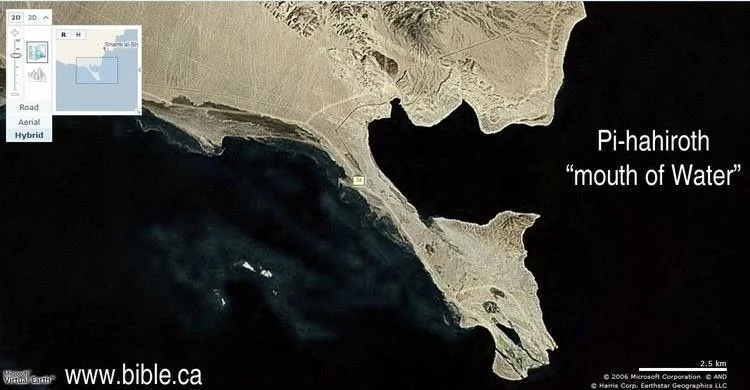
We can’t pinpoint the location, but it likely looked something this. The Lord led the people into a trap. He corralled them into terrain with only one route of escape—the way they came—and that’s where He was going to bring the Egyptians.
Is this any way to treat your children? Has God ever seemed to treat you this way? Has He ever put you in a seemingly intolerable situation cutting off every way of escape? “Why do You hide your face and consider me your enemy?” Job asked the Lord. “Will You torment a windblown leaf? Will You chase after dry chaff?”
These ways certainly seem lower than ours, but they’re not. The Lord is setting a trap for Egypt; verse 3, ‘Pharaoh will think, “The Israelites are wandering around the land in confusion, hemmed in by the desert, ”’ and that’s exactly what Pharaoh and his officials thought. They thought these former slaves were obviously too foolish to have their freedom. “What have we done? We have let the Israelites go and have lost their services!”
Days before, the plagues motivated Pharaoh and his officials to tell the slaves to get out. Now supply shortages motivated them to recapture the slaves. We, like Egypt, are often motivated by whatever pain we feel at the time. Such a perspective makes us fools. As Calvin said, “This is the stupidity of the wicked: they only dread God’s hand [when it’s on them] and [then] immediately forget all that they have seen [when it’s off].” You don’t want a heart which only opposes sin when you’re suffering the consequences of it. That’s the hard heart of Pharaoh.
Pharaoh, forgetting all about the plagues, was going to re-enslave these people. He took with him a weapon that we have yet to see—the superweapon of his day, the chariot; “he had his chariot made ready and took his army with him. He took six hundred of the best chariots, along with all the other chariots of Egypt, with officers over all of them.” This would be like saying, “they got in their Apache helicopters and had already sent drones to handle this defenseless ethnic minority lost in the desert.”
That’s what the Lord wants. He has been embarrassing Egypt’s strength. He turned the Nile to blood. He destroyed their agriculture. He humiliated their gods. Now He’s going to show everyone that these superweapons aren’t all that super; that’s verse 4, “I will gain glory for myself through Pharaoh and all his army, and the Egyptians will know that I am the Lord.” This is a glory war between Pharaoh and the Lord. It’s a reminder to every generation that the Lord is more glorious than any power of any age—including our own and whatever you fear.
Pharoah is doing what he wants to do—recapture his slaves—and that exactly what the Lord wants him to do; verse 4, “I will harden Pharaoh’s heart, and he will pursue them.” “Like a master chess player,” writes one commentator, “God induces Pharaoh to move his king into checkmate, and [Pharaoh] doesn’t even realize it.” The same could be said about Satan putting it in the heart of Judas to betray Jesus—like a master chess player, God induces Satan to move his king into checkmate, and Satan doesn’t even realize it. If you belong to this God, remember that you’re in very good hands even if it doesn’t seem like it in the moment and remember that given how much wiser He is than you, His ways will often seem foolish in the heat of life.
So, the Egyptian armed forces are now on the way. Let’s see the responses. That’s our second point: responses to trouble. Pharaoh had forgotten the power of the Lord. The moment the Israelites saw the Egyptian army, they forgot the power of the Lord too; “As Pharaoh approached, the Israelites looked up, and there were the Egyptians, marching after them. They were terrified and cried out to the Lord.”
Their cry to the Lord isn’t, “help us!” It’s a complaint; verse 11, “Was it because there were no graves in Egypt that you brought us to the desert to die?” The people were angry because they couldn’t see past the Egyptians. We get fixated on what we fear like a little girl who can’t stop talking about how dark it is in her room long enough to be calmed. The people refer to Egypt five times in two verses. ‘Didn’t we say to you in Egypt, “Leave us alone; let us serve the Egyptians.”’ “When hardship [comes],” as one author put it, “the miserable past suddenly looks like the good old days.”
The Hebrews complained that none of us this was their idea. They appreciated that fact days before. They thought God’s plan was grace. Now they opposed it. Our limited vision will often make it seem like the Lord is doing us wrong. The Scriptures remind us to keep watching what God will do. He’s wiser than we.
Moses responded differently from the people. One scholar referred to this as his finest hour; verse 13, “Do not be afraid. Stand firm and you will see the deliverance the Lord will bring you today. The Egyptians you see today you will never see again. The Lord will fight for you; you need only to be still.” Moses has been growing in grace. You can grow in grace. I can grow in grace. When the Lord met Moses at Sinai, he was full of excuses. Now there’s faith rolling around in him too.
Moses doesn’t deny the threat of the Egyptians. He doesn’t tell the people that they’re afraid of nothing. He acknowledges the threat. Moses just sees God as a bigger than the threat. Don’t deny the trouble, but remember God.
Moses was learning that salvation was about God and not about us. “The Lord will fight for you; you need only to be still.” Salvation is still about Him, not us. “We contribute nothing to our salvation except the sin that made it necessary,” as Jonathan Edwards put it. “The Lord will fight for you; you need only to be still,” is the message of the cross and the Red Sea. It’s the message of salvation. It’s about Him, not you. That’s why what we are doing in this sanctuary is about His glory not ourselves.
So, if Moses gets this right, why is he chided in verse 15, ‘Then the Lord said to Moses, “Why are you crying out to me? Tell the Israelites to move on”’? Moses was chided because he was their representative. In some ways, Moses stood between God and the people. If that doesn’t seem fair, remember Jesus took on a lot more than that by becoming our representative.
The Lord’s next word to Moses had to be bewildering; “Tell the Israelites to move on.” The obvious response is, “move where? Your direction pinned us in between water, mountains, and an army!” Now you see the unexpected nature of salvation. As Calvin put it, “God, by closing up all the ways by which the Israelites might have escaped, now opens a course for His wonderful power…”
No one expected this plan. That’s part of what makes it so memorable. There was build up to the plagues. There were warnings and explanations. Not now. The Lord simply brought His people into an impossible situation and then told Moses, “Raise your staff and stretch out your hand over the sea to divide the water so that the Israelites can go through the sea on dry ground.” What in the world is the Lord doing? He knows even if we can’t begin to guess. That’s true in your situation as well so don’t think your understanding will determine His plan.
While Moses was raising his staff to split the sea, the Lord would lure the Egyptians into the trap. What was salvation for Israel would become judgment for Egypt. The Lord can do far more in any moment then and now than we can begin to guess. We see that as well in our final point: the defining act of salvation.
As the Egyptian chariots charged toward the people, the pillar of cloud and fire put itself between the two groups so there was no way for the chariots to plow through. That night darkness covered the Egyptian side while the pillar of fire lit the Hebrew side. Does that remind anyone of one of the plagues? That’s how the plague of darkness went and when Egypt didn’t pay attention to that, they lost their firstborn sons. This was a warning from the Lord, “you’re going to suffer if you keep coming.” There are still warnings even here at the end.
As Moses stretched his hand over the sea, the Lord sent a strong east wind and turned a portion of the sea into dry land. It’s estimated that this gap needed for that many people to make it through during the last watch of the night would be at least half a mile wide. It’s amazing that the Lord used wind to work that wonder but remember that this same Lord brings every single wind you’ve ever felt with the same intentionality. He’s no less in charge of the weather in this moment that He was at that moment. We aren’t given this story to tell us that we should have trusted the Lord then. We are given this story so that we might trust Him now.
This now famous story is simply said. “The Israelites went through the sea on dry ground with a wall of water on their right and on their left.” Literarily, you can’t improve on that. The simplicity of its telling underlines its glory. It’s like the old hymn, “the children sang their praises, the simplest and the best.” Perfection doesn’t enjoy embellishment. God doesn’t need our hype and the same goes for all His workings.
The Israelites went through on dry ground—dry enough to support chariots. The Egyptians were nervous to enter between those walls of water, but they were more afraid of what Pharaoh would do if they didn’t and so they entered. They ran into trouble. We don’t know exactly what the Lord did—perhaps He brought some water into the sand to clog their wheels. The chariots, though, are the key, here; “He made the wheels of their chariots come off so that they had difficulty driving.” The point is that these superweapons are now useless. Old women with kneading troughs were making better time than the most advanced weaponry of the day.
The soldiers’ response to all this is one of the funniest parts of the whole Exodus; “The Lord is fighting for [His people] against [us].” You think?! That’s the whole story—plague after plague after plague the Lord has been fighting against you and you now only begin to see it? That’s what spiritual blindness looks like. Be thankful if you aren’t in it now because it’s only by grace.
The superweapons were literally stuck in the mud. Once the last Hebrew left the dry seabed, Moses stretched out his hand again and the waters fell drowning every Egyptian who had pursued them. “Not one of them survived,” as verse 28 puts it. Very few ancients could swim, but what’s more—the Lord had determined to destroy them. It seems that Pharaoh didn’t enter the seabed with his army. In some ways, him living with all of this is what the ancients would call a fate worse than death—“you lost everything in the plagues and after that, when given another chance, you lost even more. Now you live and one day die with that.”
This victory over Pharaoh became shorthand for salvation. “He turned the sea into dry land, they passed through the waters on foot— come, let us rejoice in Him,” as Psalm 66:6 says. “You divided the sea before them, so that they passed through it on dry ground, but you hurled their pursuers into the depths, like a stone into mighty waters,” as Nehemiah remembered. It’s shorthand for salvation for us too. As an old Christian prayer puts it thinking about conversion, “When I passed through the Red Sea by a way I did not expect. I rejoiced then for that unthought-of passage…” Our salvation is just as unthought of. Who would have imagined that the Lord would get His people out between a rock and a hard place by drying up the hard place? Who would have imagined that the Lord would deliver us from death by dying on a cross? Don’t try to engineer the ways of the Almighty. Our ways are not like His.
The Exodus is over and so you see that the people who had feared the Egyptians now feared the Lord; verse 31, “the people feared the Lord and put their trust in him and in Moses His servant.” What a difference the Lord can make. The question is whether you trust Him. Do you trust Him for an unthought-of passage? Do you trust Him in the surprises of grace? Do you trust Him because you see His ways are higher not lower than your own? That’s the only way home for you too—the unthought-of passage of grace. Keep walking through. Amen.