“1 Now Moses was tending the flock of Jethro his father-in-law, the priest of Midian, and he led the flock to the far side of the desert and came to Horeb, the mountain of God. 2 There the angel of the Lord appeared to him in flames of fire from within a bush. Moses saw that though the bush was on fire it did not burn up. 3 So Moses thought, “I will go over and see this strange sight—why the bush does not burn up.”
4 When the Lord saw that he had gone over to look, God called to him from within the bush, “Moses! Moses!” And Moses said, “Here I am.”
5 “Do not come any closer,” God said. “Take off your sandals, for the place where you are standing is holy ground.” 6 Then He said, “I am the God of your father, the God of Abraham, the God of Isaac and the God of Jacob.” At this, Moses hid his face, because he was afraid to look at God.
7 The Lord said, “I have indeed seen the misery of my people in Egypt. I have heard them crying out because of their slave drivers, and I am concerned about their suffering. 8 So I have come down to rescue them from the hand of the Egyptians and to bring them up out of that land into a good and spacious land, a land flowing with milk and honey—the home of the Canaanites, Hittites, Amorites, Perizzites, Hivites and Jebusites. 9 And now the cry of the Israelites has reached me, and I have seen the way the Egyptians are oppressing them. 10 So now, go. I am sending you to Pharaoh to bring my people the Israelites out of Egypt.”
11 But Moses said to God, “Who am I, that I should go to Pharaoh and bring the Israelites out of Egypt?”
12 And God said, “I will be with you. And this will be the sign to you that it is I who have sent you: When you have brought the people out of Egypt, you will worship God on this mountain.”
13 Moses said to God, “Suppose I go to the Israelites and say to them, ‘The God of your fathers has sent me to you,’ and they ask me, ‘What is his name?’ Then what shall I tell them?”
14 God said to Moses, “I AM WHO I AM. This is what you are to say to the Israelites: ‘I AM
has sent me to you.’ ”
15 God also said to Moses, “Say to the Israelites, ‘The LORD, the God of your fathers—the God of Abraham, the God of Isaac and the God of Jacob—has sent me to you.’ This is my name forever, the name by which I am to be remembered from generation to generation.””
“If you look at the world, you’ll be distressed. If you look within, you’ll be depressed. If you look at God, you’ll be at rest.” That’s Corrie TenBoom who, from her time in a concentration camp, speaks from a wealth of experience on all these matters.
Her experience is fitting here because Moses’ times weren’t all that different. He had tried to fix it all, and today when we find him, he is distressed about the world, depressed in himself, and has not yet found rest in God.
Perhaps that, despite your best intentions, is where you find yourself this morning. Perhaps the Lord has brought you to this sanctuary this morning so that you might be found again just as Moses was. Being found is our only hope. The Lord’s presence is our only hope, and that’s the claim of this sermon: the Lord’s presence is our only hope.
We will study this in four points. First: a meeting. Second: a mission. Third: who am I? Fourth: who are You? In verses 1-6, there is a meeting. In verses 7-10, we have a mission. In verses 11-12, Moses asks God, “who am I?” In verses 13-15, Moses asks God, “who are You?”
We see the groundwork for this hope in our first point: a meeting. Since we were with him last week, Moses has become a shepherd. This was yet another break with Egypt. The Egyptians revered sheep much as Hindus revere cows and so Moses’ adoptive mother would have been mortified to find her boy raising sheep for the slaughter.
When we meet him in chapter 3, Moses is taking his sheep far from home likely because there was little vegetation near home. This was the hand of God. God had controlled the rainfall and subsequent lack of vegetation to bring Moses to Sinai, or as it is called here, “Horeb, the mountain of God.” Now Horeb wasn’t the mountain of God when Moses arrived. It became that because this is where God met Moses and soon the Hebrews. We need to beware of magical thinking—as if we could visit Sinai today and find God there.
Moses had no idea this long sheep drive would bring him to the Lord. He was just living his life the way you and I were just living our lives yesterday. Moses, though, was living his life lost. He describes himself in verse 1 as being beyond the wilderness. He was off the map—off the map of life with no north, south, east, or west. He had no bearings. He thought he knew what his life was about when he tried to help his fellow Hebrews in Egypt. Now it was forty years of questions oscillating between regret and rage but always lost—never found. That’s wearying.
It’s in this lostness that the Lord finds him. The finds His man through a non-burning burning bush. A bush on fire wasn’t all that unusual in the wilderness. What was unusual here is that this burning bush didn’t burn up. It wasn’t changed by fire. Imagine a maple tree ablaze with leaves that burn. We would watch that with wonder. That’s what was going on here. This is the first of many unnatural moments we will see in Exodus—water turning to blood, dirt become gnats. The God who created the world can do whatever He wants with it and in it.
This fire that doesn’t go out is an apt description of the presence of God. Fire either destroys or purifies and that’s what the presence of God does. It invites and repels. Fire is attractive for its warmth, but we have a proper fear of it like the fear of God. It’s worth me considering whether I treat God the way I treat fire and the same goes for you.
Moses remembered this fire for his entire life. In his last message to God’s people, he asked that they would receive, “the best gifts of the earth and its fullness and the favor of Him who dwelt in the burning bush.” This fire stuck with Moses. It sticks with us. It’s one of the reasons we remember this story so well.
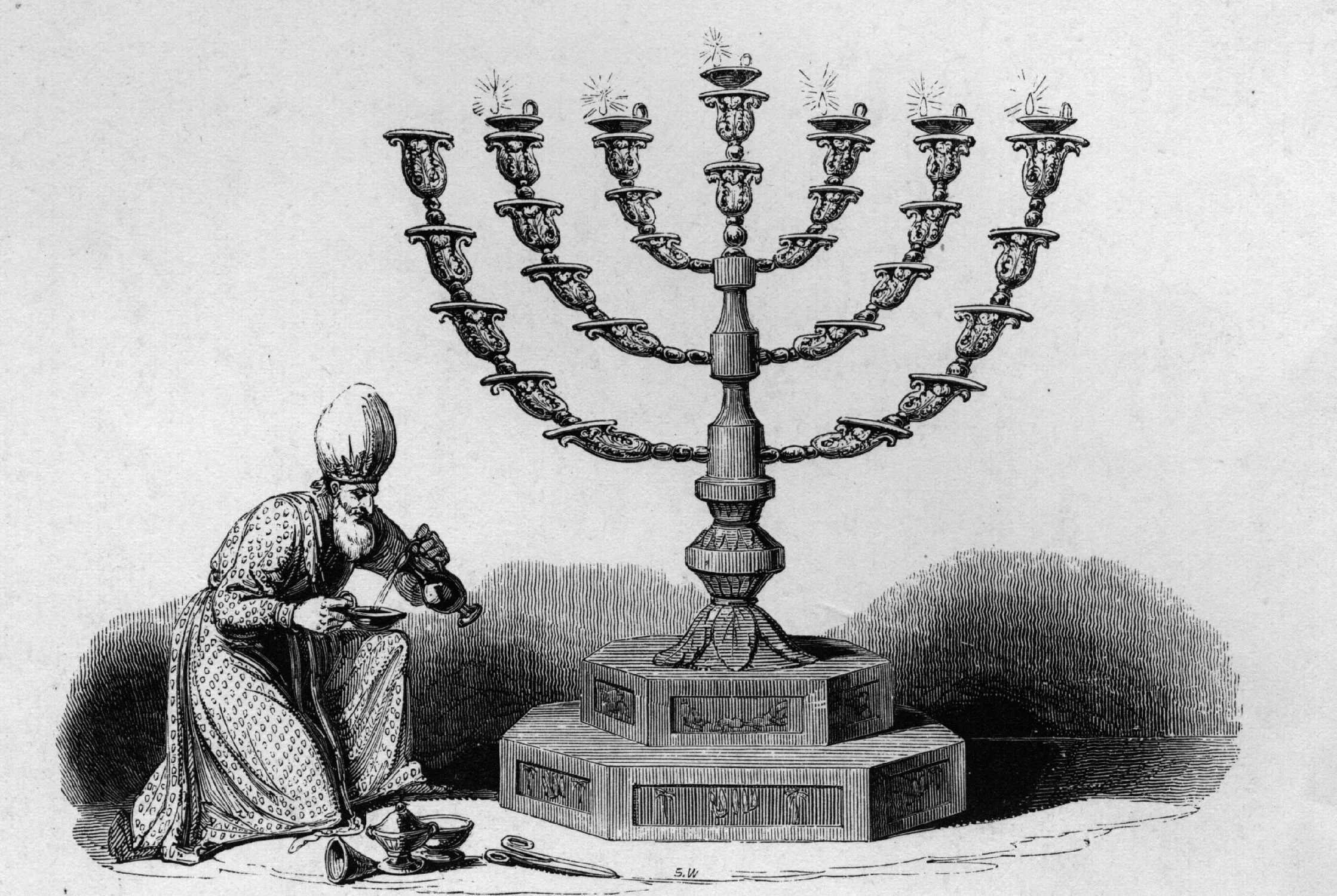
The Jews remembered it too. The Lord had them put it in the temple—the place of His presence. If you could bring up the slide.
This is the lampstand of the temple. Imagine it lit, and you can see what it would have looked like—a burning bush that never burned up. God wanted Israel to remember His presence. He is a fire who purifies or destroys. Go with purifies.
The Lord would purify Moses. “Moses, Moses,” He said. This is likely a repetition of endearment—a sign of love like we see with Jesus with, “Martha, Martha.” The God of the burning bush loves Moses. The God who Moses thought forgot him, loved him. The God who had cast him off the map loved him. That is part of what it is like to be a fallen person in a fallen world loved by the God of fire.
This God of fire loves Moses and so told Moses to keep His distance. “Do not come any closer,” God said. “Take off your sandals, for the place where you are standing is holy ground.” Now, there was nothing supernatural about that ground. It’s not as if it was radioactive then or would be today. It was holy in that moment because God manifested His presence there and to be near God is no simple matter. That’s one reason God took it upon Himself to come near to us in the incarnation. It is the safest way it could happen and so He puts His Spirit in us after removing our sin. The Lord calls Moses near, but there will always be a separation between He and Moses and He and us. He is holy and we are not Him.
The Lord who meets Moses identifies Himself with Moses; verse 6, “I am the God of your father, the God of Abraham, the God of Isaac and the God of Jacob.” God identified Himself as the God of Moses’ father and the God of Moses’ people. Moses had been rejected by the children of Abraham but not by the God of Abraham. God is the ultimate identity giver. That is true for you and me as well—people will think of us what they will but that doesn’t determine our identity. The Lord determines our identity.
We will see that Moses has much to learn about the Lord—as we all do. Decades living in Egypt and Midian had paganized Moses. Hearing from God shows each of us just how pagan we’ve become. Moses still, however, had the good sense to cover his face because, as verse 6 puts it, “he was afraid to look at God.” The fear of the Lord is the beginning of wisdom. It’s worth asking whether we have this same fear or whether we presume upon the Lord as if we were anywhere near equals.
Moses set out with those sheep assuming he could no longer find his bearings. The Lord found him. That’s how it happens. It is grace. Humanity didn’t go looking for Jesus. Jesus came looking for us. Now that Moses and the Lord have met, there is a mission. That’s our second point: the mission.
This mission is the Exodus. “I have indeed seen the misery of my people in Egypt,” as the Lord puts it in verse 7, and, “I have come down to rescue them from the hand of the Egyptians and to bring them up out of that land into a good and spacious land,” as verse 8 puts it. This is what God has been preparing. Last time we saw that the Lord knew what was going on. He knew the troubles. Now we see what He knows what to do about it.
The Lord came down to bring His people up. That’s how He phrases it, “I have come down to rescue them from the hand of the Egyptians and to bring them up out of that land into a good and spacious land.” God comes down into our mess to bring us up out it. That’s the story of Jesus. He comes down to bring us. That’s how salvation works—not us working up to Him but Him coming down to us.
This was good news to Moses’ ears, but verse 10 was the sticking point; “So now, go. I am sending you to Pharaoh to bring my people the Israelites out of Egypt.” It is all the Lord’s work but Moses had a role to play. This is the divine sovereignty and human responsibility at work, which again and again in this study. “I have come down to rescue them from the hand of the Egyptians,” and, “So now, go. I am sending you to Pharaoh to bring my people the Israelites out of Egypt.” The Lord does it all and our skin is completely in it. He works in history, but we live in history. He likes to write His perfect plan into history with imperfect pens like Moses and you and me. It can be fearful because our power is never equal to the occasion, but this fear is an invitation to faith. It’s in acts of faith that we learn to further trust God. Acts of faith can be daunting, though. We see how daunting it is in our third point: who am I?
Moses thought it was wonderful that the Lord was going to save His people, but Moses had given such a mission a try before and it had all but ruined him. He was more hesitant now as verse 11 shows, ‘But Moses said to God, “Who am I, that I should go to Pharaoh and bring the Israelites out of Egypt?”’
There is none of heroics we saw from Moses last week. He now knows that he is nothing. He will ask God five questions indicating his reservations. We will cover two this week and the next three next time. This first question—“who am I?”—has to do with Moses’ self-understanding. At one time he did consider himself up to the task of salvation, but no longer. Now it’s, “Who am I, that I should go to Pharaoh and bring the Israelites out of Egypt?”
We, today, live in an often carelessly affirming culture, meaning that were this event to happen today and Moses were to post on Facebook, “Who am I, that I should go to Pharaoh and bring the Israelites out of Egypt?”’ friend after friend would tell him all his good qualities and reasons why he certainly is more than adequate to bring Israel out of Egypt. Moses, though, is right. He isn’t up to the task. Now he knows it, and that’s why he is now up to the task. Thinking you can do God’s will without God’s will is a surefire way to cause trouble and get into trouble. You need to realize that you can’t do God’s will without God before you can do it.
Name one person who, in their own strength, could go to the sole ruler of the superpower of their day and make their ruler do anything he didn’t want to do. “Who am I, that I should go to Pharaoh and bring the Israelites out of Egypt?” is a reasonable question. This is an impossible task, but God often calls people to tasks that in their own power would prove impossible.
The Lord knows that Moses can’t change Pharaoh but He isn’t expecting him to succeed as Moses would understand success. The Israelites expect Moses to change Pharaoh, but the Lord never does what they want either. The Lord is up to something completely different, and we see what in God’s answer to Moses’ concerns; verse 12, ‘And God said, “I will be with you.”’
The Lord doesn’t say one word about Moses’ inadequacies. He simply says, “I will be with you.” That’s what matters. Our own adequacy is completely irrelevant. What’s relevant is God. Moses must simply do as the Lord says and trust the Lord do with that what He will and so must we. Moses must throw his staff down as instructed but only the Lord can turn it into a snake. Moses must strike the Nile with his staff as instructed but only the Lord can turn it to blood. Moses must strike the rock with his staff as instructed but only the Lord can make water come forth.
This point is that this isn’t about Moses. It isn’t about me. It isn’t about you. It is about the Lord. That’s the certainty behind the sign in verse 12, “And this will be the sign to you that it is I who have sent you: when you have brought the people out of Egypt, you will worship God on this mountain.” The Lord gave this sign that would come in the future—the people return to Sinai together—to make clear that He believed not in Moses’ ability but in His own. God doesn’t choose any of us for His purposes because He believes in any of us. He chooses us because He believes in Himself so much that He can use people like Moses, people like me, people like you in His plan. “Who Moses is not at all as important as who God is,” as one commentator put it. It’s not about us. It’s about the Lord, but who is the Lord. That’s the last point for this morning: who are You?
This is the second of Moses’ five questions. This one arises out his concern that the Israelites wouldn’t want help. They had, after all, already rejected his help once. You see his fear in verse 13, ‘Suppose I go to the Israelites and say to them, “The God of your fathers has sent me to you,” and they ask me, “What is His name?” Then what shall I tell them?’
It’s worth noting that this, like so many of our fears, never comes to fruition. The people never once ask Moses to provide the name of God as proof that he was sent. “Maybe, like some of us, Moses excels at raising problems and issues that never emerge as problems and issues,” as one teacher put it.
The Lord knew that His name wouldn’t be an issue, but He took this opportunity to make Himself known to Moses by way of His name. ‘He told Moses, “I AM WHO I AM.” This is what you are to say to the Israelites: “I AM has sent me to you.”’ The name LORD—all capital letters in our Bibles—is likely the third person of “I am.” God calls Himself, “I am who I am.” We call Him, “He is who He is”—or YHWH—written in our Bible as “LORD” in capital letters.
There are endless debates on all this name entails but it is all but certain that the thrust of it has to do with presence. That’s what this whole section is about. It is about God coming near. It’s about Him coming near a lost man and a lost people. The repetition of “I am” in “I am who I am” emphasizes His existence and nearness. He is real and He is here. It’s the same word in verse 12’s, “I will be with you.” Who are you, God? “I’m the one who is and I’m the one who is with you.” Psalm 23 is structured around this divine name in the Hebrew and in the very center are the words, “for You are with me.” When God gives us a name for Himself, He wants to be known as the one who will be there. I would do well to take that more seriously. I would be more joyful and hopeful if I did; perhaps you would as well.
Jesus uses this name for himself too—the “I am.” “I am the bread of life.” “I am the light of the world.” “I am the good shepherd.” I am the way, the truth, and the life.” “Before Abraham was, I am,” and the Jews took up rocks to kill him for blasphemy. Jesus considers himself to be this same God who comes near lost people. Jesus knows who he is. His confidence to help is quite different from what we saw in Moses last week. It is quite different from the pride of you and I who need to learn that we aren’t God. We are not the rescuer, judge, or savior. We are servants who are to do as we are told as Moses, despite his questions, will come to do. He, like we, will do so because the Lord is with us.
The rest of the Exodus is proof that the Lord is with His people—Moses and the Israelites and us. Pharoah will scoff at it. He will scoff at God’s name, “who is YHWH that I should obey him and let Israel go?” he will say. “I do not know YWH and I will not let Israel go.” The Lord will show him who He is. That is one way to look at the rest of Exodus—it is God showing everyone what His name means by what He does to Egypt and what He does for His people.
That’s where He is to be found. We tend to look for God everywhere else than where He reveals Himself. We, like Moses, tend to look our situation, our lostness, and we are distressed. We, like Moses, tend to look at ourselves, and wind up depressed. God is telling you what He told Moses. He is telling you where to find Him. He’ll be there. He’ll be with you. “If you look at the world, you’ll be distressed,” said Corrie TenBoom. “If you look within, you’ll be depressed. If you look at God, you’ll be at rest.” Amen.