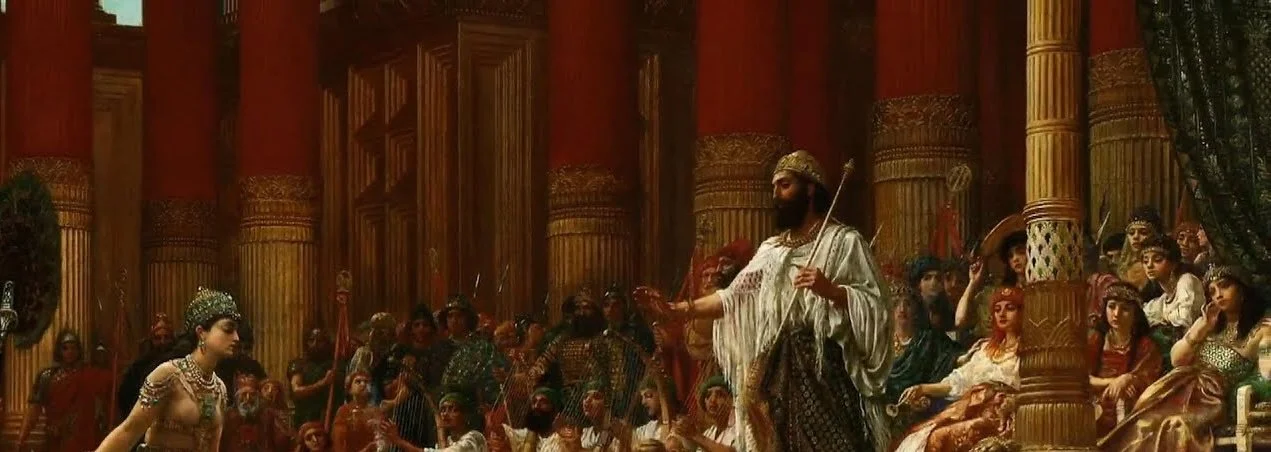
“13 Now Adonijah, the son of Haggith, went to Bathsheba, Solomon’s mother. Bathsheba asked him, “Do you come peacefully?” He answered, “Yes, peacefully.” 14 Then he added, “I have something to say to you.” “You may say it,” she replied. 15 “As you know,” he said, “the kingdom was mine. All Israel looked to me as their king. But things changed, and the kingdom has gone to my brother; for it has come to him from the LORD. 16 Now I have one request to
make of you. Do not refuse me.” “You may make it,” she said. 17 So he continued, “Please ask King Solomon—he will not refuse you—to give me Abishag the Shunammite as my wife.”
18 “Very well,” Bathsheba replied, “I will speak to the king for you.” 19 When Bathsheba went to King Solomon to speak to him for Adonijah, the king stood up to meet her, bowed down to her and sat down on his throne. He had a throne brought for the king’s mother, and she sat down
at his right hand. 20 “I have one small request to make of you,” she said. “Do not refuse me.”
The king replied, “Make it, my mother; I will not refuse you.” 21 So she said, “Let Abishag the Shunammite be given in marriage to your brother Adonijah.” 22 King Solomon answered his mother, “Why do you request Abishag the Shunammite for Adonijah? You might as well request the kingdom for him—after all, he is my older brother—yes, for him and for Abiathar the priest and Joab son of Zeruiah!” 23 Then King Solomon swore by the LORD: “May God deal with me, be it ever so severely, if Adonijah does not pay with his life for this request! 24 And now, as surely as the LORD lives—he who has established me securely on the throne of my father David and has founded a dynasty for me as he promised—Adonijah shall be put to death today!” 25 So King Solomon gave orders to Benaiah son of Jehoiada, and he struck down Adonijah and he died.
26 To Abiathar the priest the king said, “Go back to your fields in Anathoth. You deserve to die, but I will not put you to death now, because you carried the ark of the Sovereign LORD before my father David and shared all my father’s hardships.” 27 So Solomon removed Abiathar from the priesthood of the LORD, fulfilling the word the LORD had spoken at Shiloh about the house of Eli.
28 When the news reached Joab, who had conspired with Adonijah though not with Absalom, he fled to the tent of the LORD and took hold of the horns of the altar. 29 King Solomon was told that Joab had fled to the tent of the LORD and was beside the altar. Then Solomon ordered Benaiah son of Jehoiada, “Go, strike him down!” 30 So Benaiah entered the tent of the LORD and said to Joab, “The king says, ‘Come out!’ ” But he answered, “No, I will die here.” Benaiah reported to the king, “This is how Joab answered me.” 31 Then the king commanded Benaiah, “Do as he says. Strike him down and bury him, and so clear me and my father’s house of the guilt of the innocent blood that Joab shed. 32 The LORD will repay him for the blood he shed, because without the knowledge of my father David he attacked two men and killed them with the sword. Both of them—Abner son of Ner, commander of Israel’s army, and Amasa son of Jether, commander of Judah’s army—were better men and more upright than he. 33 May the guilt of their blood rest on the head of Joab and his descendants forever. But on David and his descendants, his house and his throne, may there be the LORD’s peace forever.” 34 So Benaiah son of Jehoiada went up and struck down Joab and killed him, and he was buried on his own land a in the desert. 35 The king put Benaiah son of Jehoiada over the army in Joab’s position and replaced Abiathar with Zadok the priest.
36 Then the king sent for Shimei and said to him, “Build yourself a house in Jerusalem and live there, but do not go anywhere else. 37 The day you leave and cross the Kidron Valley, you can be sure you will die; your blood will be on your own head.” 38 Shimei answered the king, “What you say is good. Your servant will do as my lord the king has said.” And Shimei stayed in Jerusalem for a long time. 39 But three years later, two of Shimei’s slaves ran off to Achish son of Maacah, king of Gath, and Shimei was told, “Your slaves are in Gath.” 40 At this, he saddled his donkey and went to Achish at Gath in search of his slaves. So Shimei went away and brought the slaves back from Gath. 41 When Solomon was told that Shimei had gone from Jerusalem to Gath and had returned, 42 the king summoned Shimei and said to him, “Did I not make you swear by the Lord and warn you, ‘On the day you leave to go anywhere else, you can be sure you will die’? At that time you said to me, ‘What you say is good. I will obey.’ 43 Why then did you not keep your oath to the LORD and obey the command I gave you?” 44 The king also said to Shimei, “You know in your heart all the wrong you did to my father David. Now the LORD will repay you for your wrongdoing. 45 But King Solomon will be blessed, and David’s throne will remain secure before the LORD forever.” 46 Then the king gave the order to Benaiah son of Jehoiada, and he went out and struck Shimei down and killed him. The kingdom was now firmly established in Solomon’s hands.”
“Trust men and they will be true to you; treat them greatly and they will show themselves great.” That’s Emerson, but is what he’s sharing wisdom? Sometimes. That’s how it goes with wisdom. It’s rarely rigid and frequently fluid. It’s much more art than science. “Trust men and they will be true to you,” is true… sometimes. “Trust men and they will be false to you,” is true… sometimes. Sizing up the sometimes is wisdom.
That’s what we will see with Solomon this evening. If Emerson practiced what he preached in the events of this chapter, he would have left his wife a widow and his children fatherless. That doesn’t sound wise. Wisdom is, like Solomon, knowing what to do in which circumstance and that’s the claim of this sermon.
We will see this differentiating wisdom in four circumstances—four points. First: assessing Adonijah. Second: annulling Abiathar. Third: justice upon Joab. Fourth: shutting out Shimei. First, in verses 13-25, assessing Adonijah. Second, in verses 26-28, annulling Abiathar. Third, in verses 29-35, justice upon Joab. Fourth, in verses 36-46, shutting out Shimei.
We see the first circumstance requiring wisdom in our first point: assessing Adonijah. We don’t know how long David been in the grave before verse 13’s, “Now Adonijah, the son of Haggith, went to Bathsheba, Solomon’s mother,” but this account in placed directly after David’s death to give you the sense that Adonijah didn’t wait long. That tells you something about David’s son. King Solomon had said of this brother, “If he shows himself to be worthy, not a hair of his head will fall to the ground.” Adonijah is showing himself to be unworthy. We’ve seen the beginnings of Solomon’s wisdom. Here we see the continuation of Adonijah’s foolishness.
Adonijah is responding in precisely the opposite way of what James advised last week regarding dealing with setbacks. Having, in his mind, lost the throne, Adonijah is foolishly trying to make up for this loss by sin. He is so foolish that he assumes that Solomon’s mother will help with his plan. She’s suspicious of him from the beginning; that’s verse 13’s, ‘Bathsheba asked him, “Do you come peacefully?”’ Naivety would take his response, “Yes, peacefully,” at face value. We’ll see whether Bathsheba is naïve.
Adonijah’s almost unbelievable interpretation of recent events show telegraph his lack of understanding. “As you know,” he tells the new king’s mother, “the kingdom was mine. All Israel looked to me as their king. But things changed, and the kingdom has gone to my brother; for it has come to him from the Lord.” This is oozing with trickiness. Starting with “as you know” tries to maneuver her into agreement. Claiming, “the kingdom was mine,” is gross exaggeration. Saying, “things changed,” cloaks his seething sense of injustice. Pulling the Lord into his schemes with, “it has come to him from the Lord,” is the opposite of piety. “I have one request to make of you. Do not refuse me,” ends where his attempt at manipulation began—trying to force her into agreement. Adonijah thinks he’s slick, but he’s showing himself to be incapable of governing anything including the kingdom.
The manipulation culminates in his request, “Please ask King Solomon—he will not refuse you—to give me Abishag the Shunammite as my wife.” Fascinatingly Bathsheba agrees to help him in this foolishness. ‘“Very well,” Bathsheba replied, “I will speak to the king for you.”’ Adonijah thought he roped the Queen Mother into his next run at the throne. Taking David’s last lady as his wife would renew Adonijah’s claim to David’s throne. Bathsheba who seemed so wise a few weeks ago, now seems to be playing the fool. She takes Adonijah’s request word for word to Solomon who blows up saying, “Why do you request Abishag the Shunammite for Adonijah? You might as well request the kingdom for him—after all, he is my older brother!”
Bathsheba seems pretty unaware of the power play, but on reflection she only seems that way. Adonijah thinks he’s playing her but she’s playing him. She knows that by taking Adonijah’s request to Solomon, she is handing over the manipulator’s death warrant signed by himself. She knows that her son will now eliminate this threat to his throne and she’s wanted that for a while now. She puts Solomon on guard with the words, “I have one small request to make of you.” Ever have someone ask you for a small request? You’re suddenly moving couches up two flights of stairs in an apartment complex for eight hours on a Saturday. Bathsheba who along with Nathan saved the throne from Adonijah for Solomon hasn’t suddenly lost any of her savvy. Adoniah thinks he is very clever, but he is the only one who thinks so; so it goes for the proud and foolish.
Solomon understands that Adonijah is taking a run at him by asking for David’s last lady. He also suspects that those who backed Adonijah’s power grab are waiting in the wings of this plot; that’s, “You might as well request the kingdom for him—after all, he is my older brother—yes, for him and for Abiathar the priest and Joab.”
Solomon’s deduction regarding this plat sets the agenda for the rest of this chapter. Last week David warned Solomon that he would need to be shrewd to keep the throne and now Solomon has just cause to begin cleaning house. He begins with Adonijah; “So King Solomon gave orders to Benaiah son of Jehoiada, and he struck down Adonijah and he died.” You see no hesitation on Solomon’s part. You also see how different our government is from his. They had no separation of powers—executive, legislative, judicial. We don’t want to impose the pattern of our government’s system on them, but rather we are to understand that this was the government’s decision regarding Adonijah for treason because it was the king’s decision.
In his pride, Adonijah assumed that no one knew what he was up to. That’s how proud people fall. In their pride, they believe everyone else is dumb. Others aren’t. Solomon wasn’t. Bathsheba wasn’t. This was all God’s plan. Solomon had given Adonijah a chance. Adonijah had only himself to blame.
Solomon is even more securely on the throne thanks to Adonijah’s foolishness. It worked the same with Jesus. The authorities’ foolish attempts to keep their power led to his enthronement. The priests’ attempts to stop his temple cleaning led to you being cleansed from your sin by his cross. God is willing to let people carry out their choices because He will guide the consequences of those choices for our good. If He is for you, it doesn’t matter who is against you. If He’s against you, it doesn’t matter who is for you. So passes Adonijah, son of David.
Having started, Solomon works swiftly and we so we come to our next point: annulling Abiathar. Abiathar was a close associate of David’s. He was the only survivor of King Saul’s slaughter of the priests who helped David. David took Abiathar under his wing after that slaughter. The priest should have known better than to disregard David’s vow that Solomon would become king. Abiathar should have been loyal to David as David was loyal to him, but “Trust men and they will be true to you,” isn’t always how it goes. Abiathar has already been involved in one grasp at power and Solomon suspects that his fingerprints are somewhere on Adonijah’s most recent attempt.
Solomon, however, will not kill him; ‘To Abiathar the priest the king said, “Go back to your fields in Anathoth. You deserve to die, but I will not put you to death now, because you carried the ark of the Sovereign Lord before my father David and shared all my father’s hardships.”’ Solomon, like his father David, has respect for spirituality. Unlike King Saul, King Solomon will not kill a priest. He does annul Abiathar’s authority, though. He exiles him out of the capitol and away from influence.
This marks the end of the priestly line of Eli. Eli was judge before Samuel. He was inattentive and the Lord told him his line was coming to an end. Ironically, Abiathar’s attempt to retain priestly power by throwing in his lot with Adonijah is what lost Eli’s line priestly power. That is how it goes. Our attempts to force God’s hand recoil upon ourselves. It’s far different for Jesus who is willing to give up everything, even his own life, rather than try to force the Father’s hand. It’s now Jesus’ priesthood from which we benefit—his sacrifice, his prayers. Abiathar has no idea any of this underway. He just knew David did him right and he did David wrong. We would be wise to be careful to attend to what we do know because far more can be at stake than we realize. Joab is about to realize that and that’s our third point: justice upon Joab.
If anyone has wondered whether Solomon has been too hard on these men by suspecting a plot, Joab’s response to the king’s cleaning house will open your eyes; “When the news reached Joab, who had conspired with Adonijah though not with Absalom, he fled.” Joab fled because he knew he was a conspirator.
Joab runs to the exact place where Adonijah ran and found temporary safety; “he fled to the tent of the Lord and took hold of the horns of the altar,” and then we read the same words we read weeks ago regarding Adonijah, “King Solomon was told that Joab had fled to the tent of the Lord and was beside the altar.” Solomon gave Adonijah at the altar another chance. Joab knew that. Joab thought he’s put Solomon on the horns of a dilemma. He thought he had Solomon’s number. Joab, though, doesn’t know that King David had told his son to execute him. Joab thought Solomon is soft. Joab is about to find out that Solomon is just as tough as he is.
Wisdom is knowing when to be tender and when to be tough. Naivety wants universals. It wants to reduce relationships to equations. Sometimes, though, parents will be tender and sometimes they will be tough. Try to manipulate them into tenderness and you’ll just make them tougher in their response. People are not objects upon a board game to be played. That’s what Joab was trying to do. “You didn’t kill Adonijah when he fled to the altar, how can be a man of consistency if you kill me?” Joab is trying to manipulate Solomon by way of spirituality—fleeing to the altar. Watch out for that. The religious leaders regularly tried to manipulate Jesus by way of spirituality—questions of taxes to Caesar, healing on the Sabbath. Jesus had and has no patience for that.
Solomon had no patience for that it in this situation. King Solomon ordered Benaiah to execute Joab by the altar. Benaiah told Joab to let go of the altar and come outside. Joab refused saying, “No, I will die here.” Benaiah brought that response back to Solomon who basically says, “well give him what he asked for. He said, “I will die here,” let him die there.’
General Joab had killed two generals. Solomon makes the man who executed him general. Divine justice is far more poetic than we will ever exhaust even though we will have eternity to look back upon it. Solomon is cleaning house of conspiracy and is also taking care of his supporters by making Benaiah general. In other words, he is wise.
He is carrying out his divinely instituted calling; “the one in authority is God’s servant for your good,” we read in Romans 13. “But if you do wrong, be afraid, for rulers do not bear the sword for no reason. They are God’s servants, agents of wrath to bring punishment on the wrongdoer,” and so the sword swings and so passes Joab son of Zeruiah. Solomon has one more matter of business to which to attend and that’s our last point: shutting out Shimei.
Shimei is another man of whom David had warned his son, Solomon. Shimei was not trying to take power like Adonijah or Joab. He was, rather, a threat to uniting the kingdom. The Davidic kingship was still a new institution. Solomon is only the second. Saul was from Benjamin. There were always many fractures in the kingdom as we will see after Solomon dies. Someone like Shimei would hammer away at those fractures until everything collapsed. He was the sort of person who would pull the whole house down everyone including himself just to prove he’s right.
Solomon tried to contain this threat by putting Shimei under a sort of house arrest. Shimei could go anywhere in Jerusalem but not leave. As with Adonijah, Solomon put Shimei’s fate in his own hands. Shimei wasn’t to cross the Kidron Valley. The incident with the runaway slave shows him disregarding this condition. Shimei might have obeyed the letter of the law by taking a way out of Jerusalem other than crossing the Kidron Valley but if so he behaved like a child told to stay in his room who is now laying outside his room with his toe still in. He’s pushing the boundaries to see what he can get away with.
He’ll get away with nothing. Shimei seems to thinks he’s wiser than Solomon. He’s about to find out he’s not. King Solomon summoned Shimei and explained that he’s broken their agreement. “Why then did you not keep your oath to the Lord and obey the command I gave you?” Solomon’s wisdom was to give Shimei a chance. Shimei wasted it and now Solomon makes clear that he’s guiltier than infraction; “You know in your heart all the wrong you did to my father David. Now the Lord will repay you for your wrongdoing.”
Solomon sees Shimei’s death as decades in the making. David had offered mercy. Shimei continued in venom spewing. Solomon had offered safety and Shimei pushed boundaries. Now Solomon executes justice and executes Shimei—so passes Shimei son of Gera.
Solomon handled each situation differently because that’s how wisdom works and so it is with Jesus who is the wisdom of God. He’s exactly what’s needed for the contours of our situation. Accept him as that wisdom and live. Refuse him as that wisdom and die. We guilty sinners need forgiveness and he offers mercy. We dying sinners need resurrection and he dies and rises again offering to bring us in his wake. He’s precisely the medicine our malady requires. This chapter gives you a picture of what happens when you refuse the wisdom of God.
We have been offered mercy and safety by King Jesus. If we, like Shimei, persist in rebellion and disobedience, we must ask with Hebrews, “how shall we escape if we ignore so great a salvation?” If we, like Abiathar and Joab, abuse the trust given us by the Davidic King, we must ask with Paul, “should we continue in sin so that grace may increase?” If we like Adonijah, try to take the Davidic King’s place, we will find King Jesus swifter than King Solomon.
King Jesus will brook no continued conspiracy against his rule in this world in your life or in mine. We are to be wise before it’s judgment day for us as it was at that time for the men we studied tonight. Be sensible. Be wise. Accept God’s wisdom. Amen.