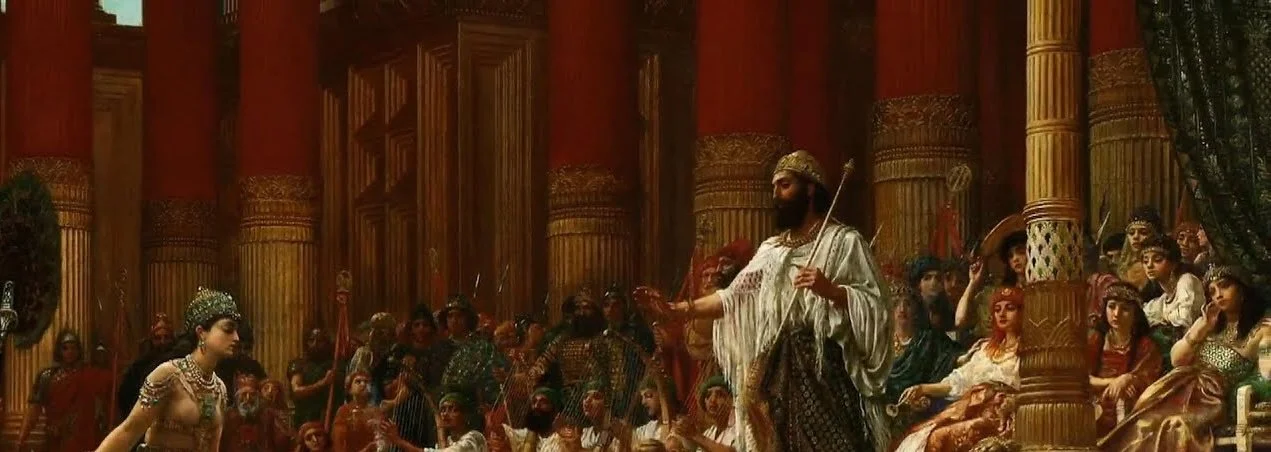
“1 So King Solomon ruled over all Israel. 2 And these were his chief officials: Azariah son of Zadok—the priest; 3 Elihoreph and Ahijah, sons of Shisha—secretaries; Jehoshaphat son of Ahilud—recorder; 4 Benaiah son of Jehoiada—commander in chief; Zadok and Abiathar priests; 5 Azariah son of Nathan—in charge of the district officers; Zabud son of Nathan—a priest and personal adviser to the king; 6 Ahishar—in charge of the palace; Adoniram son of Abda—in charge of forced labor.
7 Solomon also had twelve district governors over all Israel, who supplied provisions for the king and the royal household. Each one had to provide supplies for one month in the year. 8 These are their names: Ben-Hur—in the hill country of Ephraim; 9 Ben-Deker—in Makaz, Shaalbim, Beth Shemesh and Elon Bethhanan; 10 Ben-Hesed—in Arubboth (Socoh and all the land of Hepher were his); 11 Ben-Abinadab—in Naphoth Dora (he was married to Taphath daughter of Solomon); 12 Baana son of Ahilud—in Taanach and Megiddo, and in all of Beth Shan next to Zarethan below Jezreel, from Beth Shan to Abel Meholah across to Jokmeam; 13 Ben-Geber—in Ramoth Gilead (the settlements of Jair son of Manasseh in Gilead were his, as well as the district of Argob in Bashan and its sixty large walled cities with bronze gate bars); 14 Ahinadab son of Iddo—in Mahanaim; 15 Ahimaaz—in Naphtali (he had married Basemath daughter of Solomon); 16 Baana son of Hushai—in Asher and in Aloth; 17 Jehoshaphat son of Paruah—in Issachar; 18 Shimei son of Ela—in Benjamin; 19 Geber son of Uri—in Gilead (the country of Sihon king of the Amorites and the country of Og king of Bashan). He was the only governor over the district.
20 The people of Judah and Israel were as numerous as the sand on the seashore; they ate, they drank and they were happy. 21 And Solomon ruled over all the kingdoms from the River to the land of the Philistines, as far as the border of Egypt. These countries brought tribute and were Solomon’s subjects all his life. 22 Solomon’s daily provisions were thirty cors of fine flour and sixty cors of meal, 23 ten head of stall-fed cattle, twenty of pasture-fed cattle and a hundred sheep and goats, as well as deer, gazelles, roebucks and choice fowl. 24 For he ruled over all the kingdoms west of the River, from Tiphsah to Gaza, and had peace on all sides. 25 During Solomon’s lifetime Judah and Israel, from Dan to Beersheba, lived in safety, each man under his own vine and fig tree. 26 Solomon had four thousand stalls for chariot horses, and twelve thousand horses. 27 The district officers, each in his month, supplied provisions for King Solomon and all who came to the king’s table. They saw to it that nothing was lacking. 28 They also brought to the proper place their quotas of barley and straw for the chariot horses and the other horses.”
Recalling the good old days is very normal experience. You remember when gas was 79 cents a gallon or when the children were at home or when your friend lived down the street. Recalling the good old days is normal; the trick is recognizing that you are in the good old days while it is the good old days. That’s the rare experience and this evening we see a picture of it.
Solomon’s kingdom was a golden age and the people enjoyed the radiance. “It seems to me sometimes as though the Lord breathes on this poor gray ember of Creation and turns it to radiance—for a moment or a year or the span of a life,” as one writer wondered, “and then it sinks back into itself again, and to look at it no one would know it had anything to do with fire or light.”
The trick is to know that you are in the flash of fire and light. The trick is to know that you are in the good old days while it is the good old days; that’s the glimpses of the kingdom that is to come but the kingdom to come is more marvelous than the in-breakings along the way; that’s the claim of this sermon.
We will see this in two points. First: the kingdom’s key players. Second: the kingdom’s prosperity. First, in verses 1-19, the kingdom’s key players. Second, in verses 20-28, the kingdom’s prosperity.
We see the beginning of the details of this in our first point: the kingdom’s key players. Last week we saw that the dream turned reality; the king had wisdom to make life sing. This week we see that taken into politics; “So King Solomon ruled over all Israel.” To understand that, you need to remember that 1 Kings was written in a future in which no king ruled all Israel anymore. Solomon’s reign was that sparkle of order after David had united the kingdom and before it fell apart under Rehoboam. It was that moment of glory.
Solomon governed it all and he did so shoulder to shoulder with other men of skill; that’s this list of names, “And these were his chief officials: Azariah son of Zadok—the priest,” and then in verse 4, “Zadok and Abiathar priests,” and then in verse 5, “Zabud son of Nathan—a priest and personal adviser to the king.” The inclusion of all these priests indicates that the priesthood was important in the way Solomon structured his government. The first listed, Azariah, is likely the high priest. We have what may be a blast from the past with Abiathar whom we saw exiled weeks ago. Perhaps he changed his stripes and proved his worth to Solomon or perhaps it is another of the same name. Either way, the focus with priests listed three times is that spirituality dovetailed nicely with what we today would call the secular. There was no thought that there was a religious way and a real-world way; they were one in the same. “There is a wideness in biblical wisdom,” as Davis comments here. “It is not only concerned with moral and accurate judgments but also with efficient and orderly structure that keeps chaos and waste from running life.”
Jesus is the perfection of this. Listen to him and you’ll see that there is no difference between the religious way forward and the real-world way forward. In other words, Jesus—as the Catechism teaches—is our prophet, priest, and king—all of it in one because it is one. That unity is worth considering if you suspect that you are dividing your loyalties in life.
You see this unity continued in verse 5 with, “Azariah son of Nathan—in charge of the district officers.” This is almost certainly the son of Nathan the prophet who helped Solomon secure the throne. You also see Zadok on this list who stood with Solomon rather than Adonijah and you see general Benaiah who helped muscle Adonijah out of the way. The message is that Solomon listened to his father, David, who advised him to reward the loyal and exclude the treacherous. Solomon, the wisest man alive, had the humility to recognize that decades on the throne taught his father lessons he would do well to follow and so he followed them; humility and wisdom always walk hand in hand. That’s worth considering if you still have parents or are being mentored or hopefully consider yourself a disciple—one who learns from someone whose mastered an art.
Solomon wasn’t slavishly following his father, though, and David would not have wanted him to do so. David was a man of war—conquering the kingdom—and so his similar list of officials was quite militant. Solomon’s is different. The military isn’t listed here until the fourth grouping. Solomon was king during a different season and had the wisdom to recognize that and pivot accordingly. You don’t want to be using today’s tools to fulfill yesterday’s goals. Solomon’s kingdom required order and direction and so you see secretaries and recorders. The people would have been proud of this growth. “The regime must have been enormously successful and deeply impressive to Israelites who were only two generations removed from hill-country subsistence living,” as one scholar put it.
With this structure came outside voices. Elihoreph and Shisha seem to be Egyptian names. Here you see the influence of Solomon’s alliance with Egypt. It’s not all bad but neither is it all good. From the line of Cain to the exclusions from the heavenly Jerusalem—from Genesis to Revelation—that the Bible tells you to be judicious in what you take from the world—what methods, what motivations, what goals, what goods. That’s part of why you were given a mind—to wisely say “yes” and “no.”
These names likely seemed monotonous as we read them and understandably so because we don’t know these men; the point, though, is that they and Solomon did it together. If Solomon had a twenty-five-year celebration of his reign he would have said, “come up here Zabud. I would haven’t gotten very far with you. Ahishar, thanks for keeping everything running smoothly—even this tonight; it’s wonderful. Benaiah, thank you. Thank you for everything.” The point of all the names is that they did it together.
That’s how Christians become more like Christ—we do it together. “Just as a body, though one, has many parts, but all its many parts form one body, so it is with Christ,” as Paul explained. “If the whole body were an eye, where would the sense of hearing be? If the whole body were an ear, where would the sense of smell be?” Everyone has their part. It wouldn’t be good to not do it together.
You see the repetition of this togetherness in verse 7’s repetition, “Solomon also had twelve district governors over all Israel.” There again is the phrase “over all Israel.” If you could please bring up our first map.
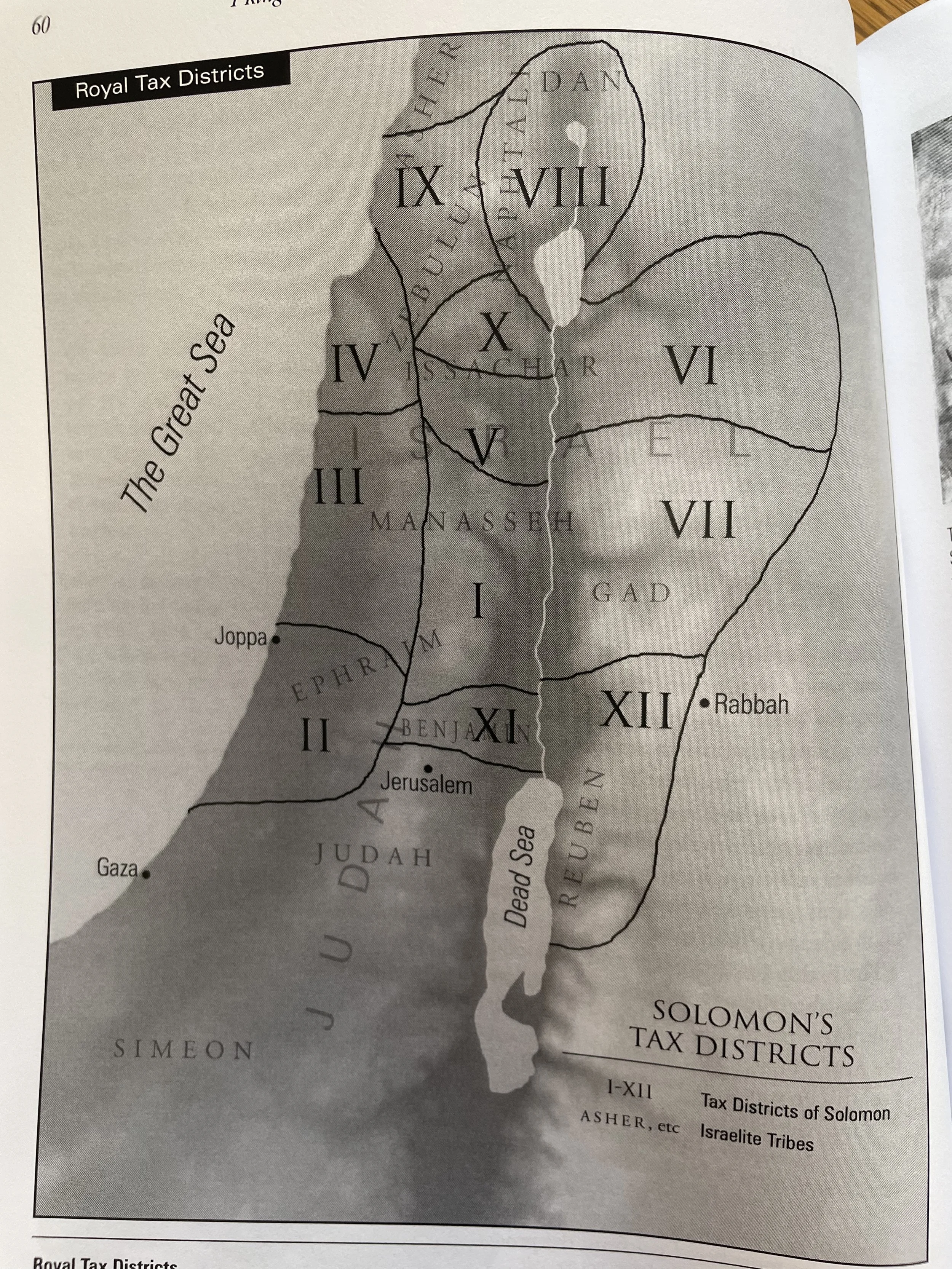
Here you see the geography of “Solomon also had twelve district governors over all Israel, who supplied provisions for the king and the royal household. Each one had to provide supplies for one month in the year.” Here are the twelve districts. Fix it in your mind and please bring up the second map.
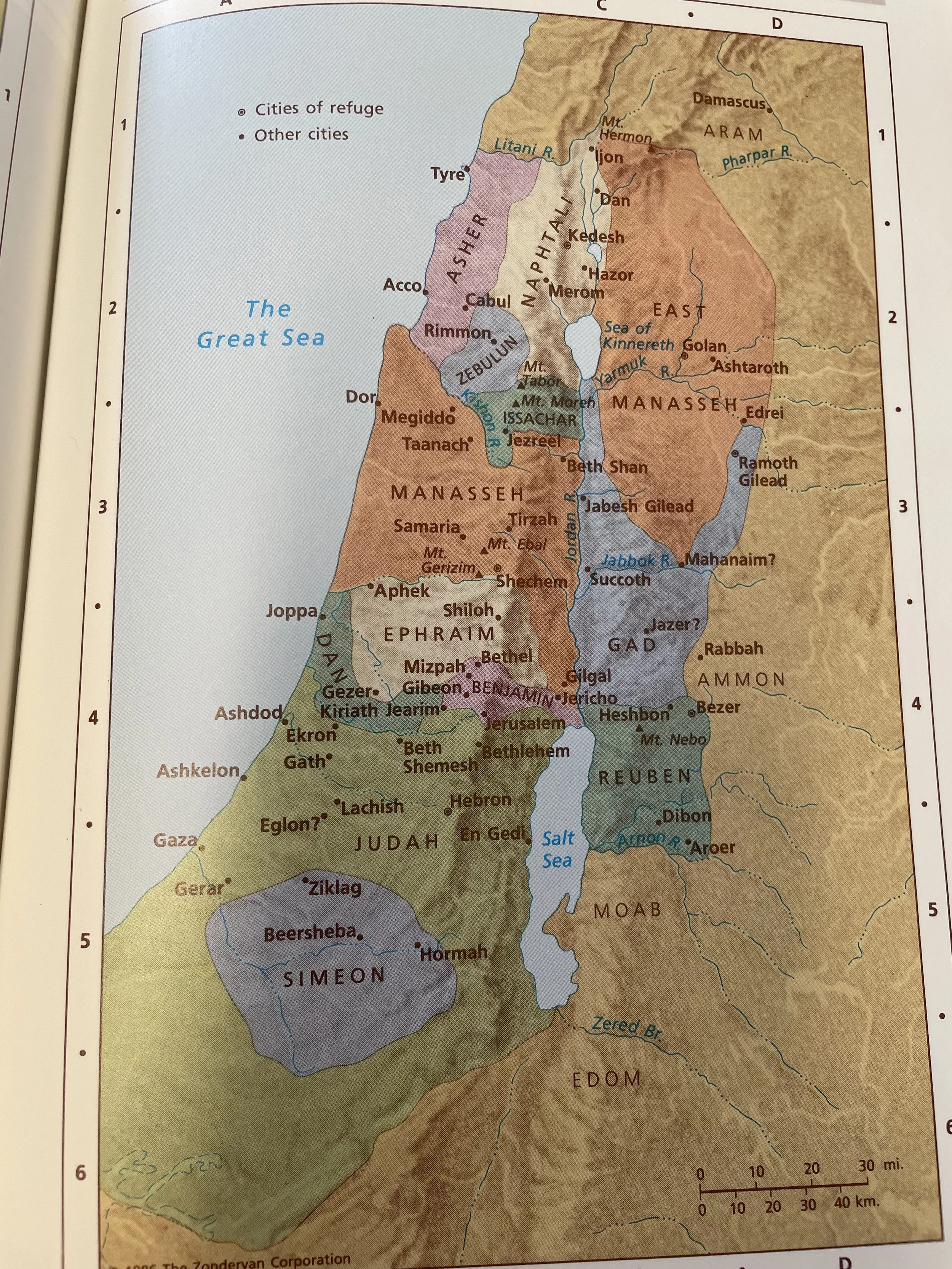
Notice the difference? The twelve districts did not correspond to the twelve tribes.
In the course of becoming wealthy and powerful, Israel changed from a tribal arrangement to a federal arrangement. Solomon had his reasons for these districts. He was likely trying to balance out tribes which had bad blood with each other. He was also likely trying to neutralize regions which were hostile to his dynasty. We don’t know all that Solomon was thinking but if this chapter is designed to teach you anything, it’s destined to teach you that he was always thinking.
So is king Jesus. He, like Solomon, reworked the twelve tribes. Early in his ministry, he spent all night praying and then we read, “When morning came, he called his disciples to him and chose twelve of them, whom he also designated apostles.” He intentionally chose twelve because he wanted the people to see that he too was reworking the kingdom along the lines of his own wisdom and it would be a kingdom as different from Solomon’s as Solomon’s was different from David’s. King Jesus chose men to change. He chose them as exhibits—“look at what grace did for Matthew.” “Look what faith did for Peter.” “Look what pride did for Judas.” King Jesus’ is wiser than even Solomon and his kingdom is even more impressive. You can still see it at work every day with town hall meetings every Sunday.
As for Solomon’s kingdom, it’s now just a map and in museums. At the time, though, it was glorious. “The reader is intended to marvel at the complexity of a kingdom requiring such a sophisticated system,” as Nelson put it. “It’s the sort of kingdom one would expect, when a king has been gifted by God to rule,” Provan adds. These were the good old days and they were good. I recently finished Tom Brokaw’s The Greatest Generation about the generation which fought in World War Two. They went from the destitution of the Great Depression to the supremacy the United States held after the war. It was a remarkable experience and it’s a bit like what happened to these people who lived during the time of Solomon.
It wasn’t all good though as always in this life. This list of names and regions tells you that many resources were being drained from the country for the capitol. When the people wanted a king, Samuel warned them that this would happen. You see that most clearly in the last name back in verse 6, “Adoniram son of Abda—in charge of forced labor.” Adoniram would later be assassinated trying to carry out his role in the government. The people would come to resent the cost of this grandeur. The author of Kings already knew that. He knew that when he wrote these words about the glory. There are lessons about excess here, but the more fundamental lesson is that in this world, there is no way to get it completely right forever in this life. The radiance will “sink back into itself again, and to look at it no one would know it had anything to do with fire or light,” or as Frost put it in a poem you might know; “Nature’s first green is gold, her hardest hue to hold. Her early leaf’s a flower; but only so an hour. Then leaf subsides to leaf. So Eden sank to grief, so dawn goes down to day. Nothing gold can stay.” Perhaps… and that’s what we will consider in our second point: the kingdom’s prosperity.
If you have particular political leanings, you were likely wondering whether the changes in our last point could lead to government sprawl. Many in the population in that day were too but prosperity covers over a multitude of concerns and those days were particularly prosperous; verse 20, “The people of Judah and Israel were as numerous as the sand on the seashore; they ate, they drank and they were happy.”
Eating, drinking, and being happy was shorthand for prosperity. The people being more numerous than sand on the seashore was shorthand for the promise to Abraham, “I will surely bless you and make your descendants as numerous as the stars in the sky and as the sand on the seashore.” The geography of, “And Solomon ruled over all the kingdoms from the River to the land of the Philistines, as far as the border of Egypt,” is further fulfillment. This is inclusive of the dimensions mentioned regarding Eden. What comes next in the text is yet another fulfillment, “These countries brought tribute and were Solomon’s subjects all his life.” That’s God’s promises to the people in Deuteronomy, “The Lord will make you the head, not the tail.” This section is fulfillment upon fulfillment. These are the good days.
That’s important to note. It’s important to note that the Lord has kept His grand promises. It’s important to note that trust was rewarded. It’s important to note that obedience was rewarded. We’ve been hearing James on the difficulties of when life doesn’t go that way; the reminder here is that it has gone right and will go right in the end. If Abraham could see Solomon’s kingdom, he’d be comforted. If Moses could see Solomon’s kingdom, he’d be happy. If Adam and Eve after the fall could see Solomon’s kingdom, they’d be hopeful.
We are to see this fulfillment too and take it forward. We are to recognize that if these promises were kept, all promises will be kept for us too. That’s Jesus, “until heaven and earth disappear, not the smallest letter, not the least stroke of a pen, will by any means disappear from the [Torah] until everything is accomplished,” and Jesus is the best disclosure of that fulfillment of God’s word. He’s better than the Promised Land just as Abraham loved Isaac more than he loved the land. Jesus is better than Eden just as after the fall Adam and Eve would have rather walked with God anywhere than been without Him in Eden. If you have Jesus, you have him now and will have it all. That’s why he’s often connected with inheritance in the New Testament. It’s worth considering whether you want the good old days without wanting Jesus.
The next section of the text shows the grandeur of the good old days. These daily provisions wheat and meat are indications of how good it was. This was the GDP indicator. The most obvious indicator is verse 25, “During Solomon’s lifetime Judah and Israel, from Dan to Beersheba, lived in safety, each man under his own vine and fig tree.” They were safe. They were well off. They had property and prosperity. Things were good.
They had adequate defense; verse 26, “Solomon had four thousand stalls for chariot horses, and twelve thousand horses.” They had the superweapons of that day—the chariot. That might be a bit of a mixed indicator, though, because the people were quick to trust chariots over trusting the Lord. That’s us as humans; we are quick to trust anything that’s not ultimate. We are quicker to trust people’s opinion than the Lord’s perspective. We are quicker to trust a bird in the hand or two in the bush than whatever is in the Lord’s hand. We are slow to trust the Lord when there is little and just as slow to trust the Lord when there is plenty. Slow to trust in the bad days. Slow to trust in the good days. Moses warns us about this. “Man does not live by bread alone but every word that comes from the mouth of God.” That was Jesus’ focus in temptation in want; it is to be ours in want and in plenty.
Solomon’s prayer has been answered; he had asked, “So give Your servant a discerning heart to govern your people and to distinguish between right and wrong. For who is able to govern this great people of Yours?” This passage tells you that the Lord gave all that and more to Solomon. These are the good days.
The prosperity of the king and of the kingdom went together. The king and kingdom were blessed together and so it is for us in the kingdom. King Jesus and we are blessed together. We rise with him… that is provided we identify with him. How foolish anyone listed in this chapter would be to turn on Solomon and think their position would improve. That’s how foolish any of us would be to turn on Jesus and think our position will improve.
Unlike Solomon, though, Jesus knows how to keep it gold. Solomon’s kingdom carried the seeds of its own destruction—forced labor, intertribal conflict. Not so with Jesus. Even if he was a wiser man than all, Solomon was only a man. Not so with Jesus. He is beyond nature. He’s beyond, “Nature’s first green is gold, her hardest hue to hold.” Those who hope in him will see that in the kingdom. We will see how much greater his kingdom is than Solomon’s.
Then and only then it will always be the good old days and the good new days and on every day of it, we’ll know that we are in it. That’s not yet, though, so don’t ruin now by wanting it to be then. That’s the end of the serenity prayer, “that I may be reasonably happy in this life and supremely happy with Him forever in the next.” Enjoy whatever flashes of fire and light, glory and grace, you experience in this life. Know that the best, though, is yet to come. Amen.
—
First map from Walter Bruggemann 1 and 2 Kings Smyth and Helwys Bible Commentary
Second map from NIV Study BIble