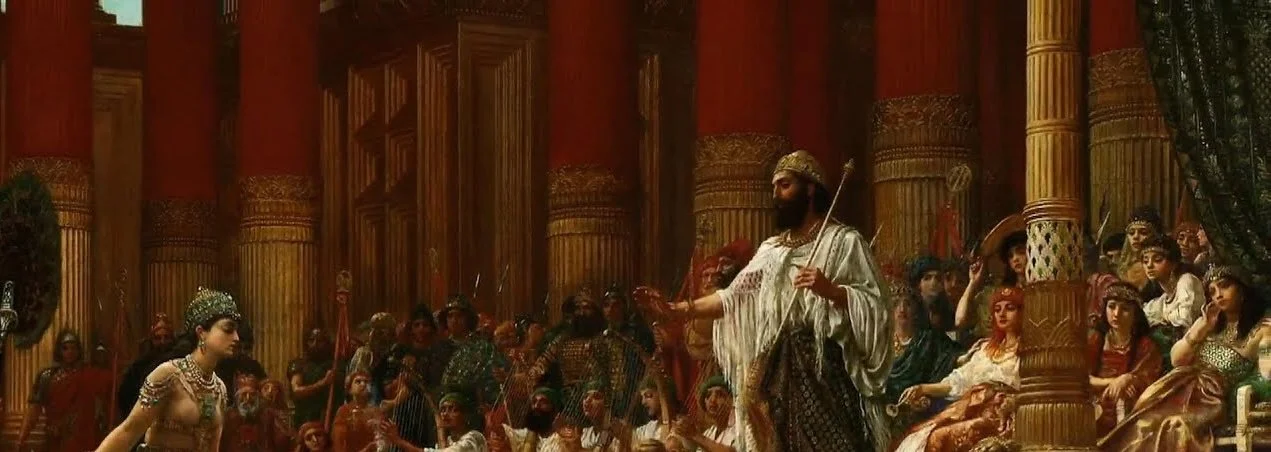
“16 Now two prostitutes came to the king and stood before him. 17 One of them said, “My lord, this woman and I live in the same house. I had a baby while she was there with me. 18 The third day after my child was born, this woman also had a baby. We were alone; there was no one in the house but the two of us. 19 During the night this woman’s son died because she lay on him. 20 So she got up in the middle of the night and took my son from my side while I your servant was asleep. She put him by her breast and put her dead son by my breast. 21 The next morning, I got up to nurse my son—and he was dead! But when I looked at him closely in the morning light, I saw that it wasn’t the son I had borne.” 22 The other woman said, “No! The living one is my son; the dead one is yours.” But the first one insisted, “No! The dead one is yours; the living one is mine.” And so they argued before the king. 23The king said, “This one says, ‘My son is alive and your son is dead,’ while that one says, ‘No! Your son is dead and mine is alive.’”
24 Then the king said, “Bring me a sword.” So they brought a sword for the king. 25 He then gave an order: “Cut the living child in two and give half to one and half to the other.” 26 The woman whose son was alive was filled with compassion for her son and said to the king, “Please, my lord, give her the living baby! Don’t kill him!” But the other said, “Neither I nor you shall have him. Cut him in two!” 27 Then the king gave his ruling: “Give the living baby to the first woman. Do not kill him; she is his mother.” 28 When all Israel heard the verdict the king had given, they held the king in awe, because they saw that he had wisdom from God to administer justice.”
Naivety is very good at knowing what to do in a perfect world. You tell your sister what you would like to do together and, of course, she agrees; it’s what she wants to do as well, but if it wasn’t, she would honor you above herself and do so gladly. Does it always work that way when girls are ten? Does it always work that way when girls are forty?
Naivety won’t feel comfortable until we live in a world in which no one needs to draw boundaries. Naivety won’t feel safe until we live in a world in which no one needs locks. Naivety is good at imagining the ideal—“Imagine no possessions. I wonder if you can. No need for greed or hunger; a brotherhood of man.” Naivety has no idea, though, how to move from the real toward that ideal. It doesn’t want to learn the lessons needed to live in a mess because that would imply that we’re in a mess.
But we are in a mess. The Bible has 1,189 chapters. By number 3 of those 1,189 we are told that this world is now cursed, we are corrupted, and the devil is unleashed. “You need to deal with that. Don’t deny it,” the Bible says and then shows you how to deal with it. That’s wisdom rather than naivety. It learns the skills to draw lines, install locks, and negotiate with your sister. It’s what we see Solomon showing in this evening’s sermon. Wisdom finds and walks the path forward through this twisted life; that’s the claim of this sermon.
We will study this in two points. First: the challenging case. Second: the wise verdict. First, in verses 16-23, the challenging case. Second, in verses 24-28, the wise verdict.
We see the twistedness in our first point: the challenging case. This is one of the most famous accounts in the Bible. It is the follow up to last week’s passage in which the Lord offered Solomon anything he wanted and Solomon asked for wisdom. Will it happen? That’s the burden of this week’s passage. It’s a move from the promise to the reality. It’s a move from that dream to the day to day.
It begins with the day-to-day work of the king; verse 1, “Now two prostitutes came to the king and stood before him.” This is legal language. These women stood before him with a legal suit for him to resolve. “The king is the hub around which the whole legal process revolves,” as Provan explains to us who live a very different legal world. The king was the final say in difficult cases in that culture. If you’ve read 2 Samuel, you’ve seen that with David and Absolom. David was the final arbiter of legal disputes which couldn’t be resolved up to that point—the Supreme Court so to speak—and Absolom wanted that role.
The king was to write out the law of Moses in his own hand and review it regularly so he would know the law by which he was to make judgments. Solomon had asked the Lord for “a discerning heart to govern Your people and to distinguish between right and wrong.” Here is his chance to see if he has the wisdom he was promised.
Justice is what being king was all about. We tend to think of the pomp and circumstances but that’s not the office. “Does it make you a king to have more and more cedar?” the Lord asked a king wrapped up in pomp. “Did not your father have food and drink? He did what was right and just, so all went well with him. Is that not what it means to know me?” Knowing the Lord and fulfilling His calling upon your life are inextricably linked for the king and for us.
“To search out a matter is the glory of kings,” Proverbs 25:2 tells us and Solomon has a matter to search out. Before we see how he does, consider how the most glorious of all kings—the king of kings—does. How well does Jesus search out matters? Ask Nicodemus. Ask the woman at the well. Ask Peter. Ask Judas. How committed to justice is king Jesus? Ask Pilate. Ask Paul. Ask yourself.
The matter before Solomon involves two prostitutes each of whom had recently had a baby. That’s not all that uncommon given their trade; verse 17, ‘One of them said, “My lord, this woman and I live in the same house. I had a baby while she was there with me. The third day after my child was born, this woman also had a baby. We were alone; there was no one in the house but the two of us. During the night this woman’s son died because she lay on him. So she got up in the middle of the night and took my son from my side while I your servant was asleep. She put him by her breast and put her dead son by my breast. The next morning, I got up to nurse my son—and he was dead! But when I looked at him closely in the morning light, I saw that it wasn’t the son I had borne.”’ We know the story well but be shocked yet again by such a situation. Thinking your child was dead would be awful. Discovering that he wasn’t your child would be shocking. Concluding that this other woman living in the house could do such a thing would be disturbing… if she’s telling the truth.
The king doesn’t know if she is telling the truth; he knows is verse 22, ‘The other woman said, “No! The living one is my son; the dead one is yours,”’ and he knows, ‘the first one insisted, “No! The dead one is yours; the living one is mine.”’ That’s as much evidence as the king has; that’s, ‘And so they argued before the king. The king said, “This one says, ‘My son is alive and your son is dead,’ while that one says, ‘No! Your son is dead and mine is alive.’”’ Those words of Solomon were recorded to give you a sense of “the apparent insolubility of the case,” as Oswalt describes it. It is a “she said-she said” situation with no outside witnesses to consult; that’s verse 18, “We were alone; there was no one in the house but the two of us.”
Without knowing the rest of the story, what would you do if you were king? You are dealing with a grave accusation either way—stealing a baby or being falsely accused of stealing a baby. It is up to you to render the judgment and these women and this child will need to live with your decision for the rest of their lives. If you don’t feel the weight of that, you would do well to be reticent about accepting positions in which you bear the weight of that.
Naivety won’t bear the weight of it. Naivety will plead with these women to tell the truth because that’s what they are supposed to do. Naivety will chide these women for becoming prostitutes and putting themselves and the king in this situation in the first place. Naivety doesn’t want to assume wrong-doing on anyone’s part.
Wisdom accepts that at least one of these women is lying. Wisdom requires you to understand the ways of lying just like a locksmith needs to understand the ways of a thief. The wise would rather not need to know the wisdom they’ve discovered. Police officers would rather not need to know the ways people manipulate but they do if they are to serve and protect. Doctors would rather not need to know the signs of an arm broken by domestic violence but they do need to know if they are to do no harm.
Wisdom understands that people are exceedingly complicated. No two are the same and that many of these people are not at all like you. Maybe you couldn’t live with telling a lie. Many people can’t imagine living without telling them and thinking of the best of their intentions means you are lying to yourself. This is an area of growth for people of faith. Many of the good virtues instilled by faith easily lead to us toward naivety and so Jesus says, “the children of this world are in their generation wiser than the children of light.” Let’s see if Solomon understands better than the world; that’s our second point: the wise verdict.
King Solomon only has conflicting testimony with which to work. He has no other evidence and so he will provoke evidence to help him decide; ‘then the king said, “Bring me a sword.” So they brought a sword for the king. He then gave an order: “Cut the living child in two and give half to one and half to the other.”’ Solomon leans into wwhat as likely his reputation early in his reign—bloodshed. He had recently executed his brother, his father’s general, arrested and later executed a venomous critic, and exiled the high priest. King Solomon was a man who took swift, decisive action. The people knew that. Solomon knew that the people knew that and these women knew that. They knew he was capable of killing.
Solomon has no interest in killing this baby, though; he has great interest in what we’ve seen dozens upon dozens of times together in God’s word—that people’s responses reveal what’s going on inside them at that moment. ‘The woman whose son was alive was filled with compassion for her son and said to the king, “Please, my lord, give her the living baby! Don’t kill him!” But the other said, “Neither I nor you shall have him. Cut him in two!”
The first woman wanted what was good for the child. Her “compassions warmed” if you want a literal translation. She would rather see the baby live without her than die and be hers. The second woman was quite willing to see this baby die so that her testimony wouldn’t be disproven.
The king now has new evidence with which to work. He knows what he needs to made a just decision. “To search out a matter is the glory of kings.” ‘Then the king gave his ruling: “Give the living baby to the first woman. Do not kill him; she is his mother.”’ Solomon didn’t know everything that happened on that night, but he did know mothers. He knew all that his own mother Bathsheba had done to safeguard his own life when Adonijah made two runs at it.
Solomon didn’t know exactly how the situation would unfold when he called for that sword. You need to beware of stories in which the protagonist has such an understanding of human nature that he—and it is usually he—can predict exactly what people will do. People are far more complicated than that. Both these women are prostitutes. That doesn’t mean that both are liars. Beware of assuming that you’ve got someone figured out because they are a housewife, a Ford owner, a football player, or retired. Wisdom takes reality as it is and considers how to work with it. It takes people as they are and considers how to take moves towards what should be rather than taking people as they should be so you won’t need to move forward.
Solomon understands human nature. He understand that people lie. He understands that people tell the truth. He understands mothers. He understands how to leverage his authority as king. He is also willing to take action. Some people have understanding but don’t take action. They watch and consider but never pull the trigger on anything consequential. Perhaps they’ve lack power; perhaps they lack courage; perhaps they lack interest; perhaps they lack kindness; perhaps they enjoy being right more than seeing progress; perhaps they’ve tried time after time and never seen progress; again, people are complicated. It’s worth your consideration this evening whether you are content to consider but will not act.
Other people fail to consider but never fail to act. The foolishly rush in where angels fear to tread. They don’t feel the weight of the responsibility but enjoy the rush of exercising whatever power they have or think they have. Perhaps they lack the emotional regulation needed for patience; perhaps they lack the curiosity needed to discover; perhaps they lack the humility needed to come to terms with what they don’t know; perhaps they lack the wherewithal to consider how to learn what they don’t know; perhaps they’ve never faced consequences or had sympathy for the effects of consequences they’ve dished out. Good governance—good decision making—requires both consideration and the will to act. The point is that Solomon has both.
This judgment is held out as the exhibition of the storied wisdom of Solomon. Don’t imagine, though, that this is the only such demonstration. It’s not as if he made this one shrewd move and then coasted off his reputation. The point is that Solomon is the gifted to thread these sorts of needles. He can turn it on whenever he wants.
Michael Jordan played college basketball for three seasons with UNC before Coach Smith encouraged him to go pro. That was a caring and humble move on Smith’s part. Talking about Jordan, Coach Smith said, “Michael Jordan is the only player who could ever turn it on and off... and he never turned it off.” That’s what that poster of Jordan dunking from the free throw line is about. It’s not about that one jump. It’s about all else that he could do if he could do that sort of jump. That’s what recording Solomon’s decision is about. “Solomon is a case study of shrewdness that permits his ruling to be generative and constructive,” as one scholar put it. Solomon could turn wisdom on and deal with infrastructure, piety, international relations, delegation; he could make it all sing. That’s part of this golden age in Israel’s history.
Solomon is the sort of leader you’d want and we have someone better. The gospel of John records Jesus’ wisdom and wonders—telling people healing secrets about themselves, healing their bodies, forgiving their sins, explaining the why to their question about life. The point isn’t merely that he said those teachings although that matters. The point is all else that he can do if he could do that and that’s how John ends his good news about King Jesus. “Jesus did many other things as well. If every one of them were written down, I suppose that even the whole world would not have room for the books that would be written.”
Anyone with any sense would do well to hold Jesus in awe; that’s what God thinks; verse 28, “When all Israel heard the verdict the king had given, they held the king in awe, because they saw that he had wisdom from God to administer justice.” King Jesus has even more wisdom and anyone who disagrees with consigned to the eternity of fools. This life matters just as the situation those two women brought to Solomon mattered. If you think your situations matter, bring them to King Jesus.
So Solomon has received the wisdom God promised. He received shrewdness to administer justice. He received what was needed to fulfill his calling. God equipped the called and He did so for a purpose. He didn’t give Solomon wisdom so that we thousands of years later could talk about how wise Solomon was. He did it so that Solomon could help that mother whose baby was stolen. He did it so that Solomon could build a temple where people could worship. He did it so that untold generations would find encouragement and direction in the book of Proverbs. Yes, wisdom was to Solomon but it was to Solomon for the sake of others. That’s how gifts from God work. They are to you for the sake of others.
That’s how it works with Jesus. I doubt that anyone here this evening is here simply to admire Jesus for being wise. You are here because Jesus deals with you. I doubt anyone has ever entered this sanctuary to simply appreciate the fact Jesus is into mercy. People come because they’ve received his mercy and know they need more. It is Jesus’ wisdom, mercy, justice, and love and it is for us and that’s why it matters to us. It is his gifts for our sake.
That’s how you deal with this fallen life as a fallen person. That’s how you deal with living in world under a curse. That’s how you live in a mess. Jesus’ gifts for your sake. That’s how you move forward through this twisted life. You trust the one who was died and rose again, the one who is God, because only he knows what else he can do. Amen.