We can’t do justice to what matters most. Imagine that you have one hour left with someone you love and when that hour is over, are they. You will never see them again in this life. You’re down to fifty-nine minutes and fifty seconds already; after that sentence, you have fifty-nine minutes and forty-five seconds left. Express what they mean to you soon because soon you won’t be able to—fifty-nine minutes and forty seconds left.
We can’t do justice to what matters most and so we make a cup of coffee for someone we love, or we check on them in bed to make sure they are asleep or we just say, “good morning.” It’s the old Louie Armstrong song, ‘I see friends shaking hands saying, “how do you?” They’re really saying, “I love you.”’ That’s how we try to do justice to what matters most when we realize we can’t.
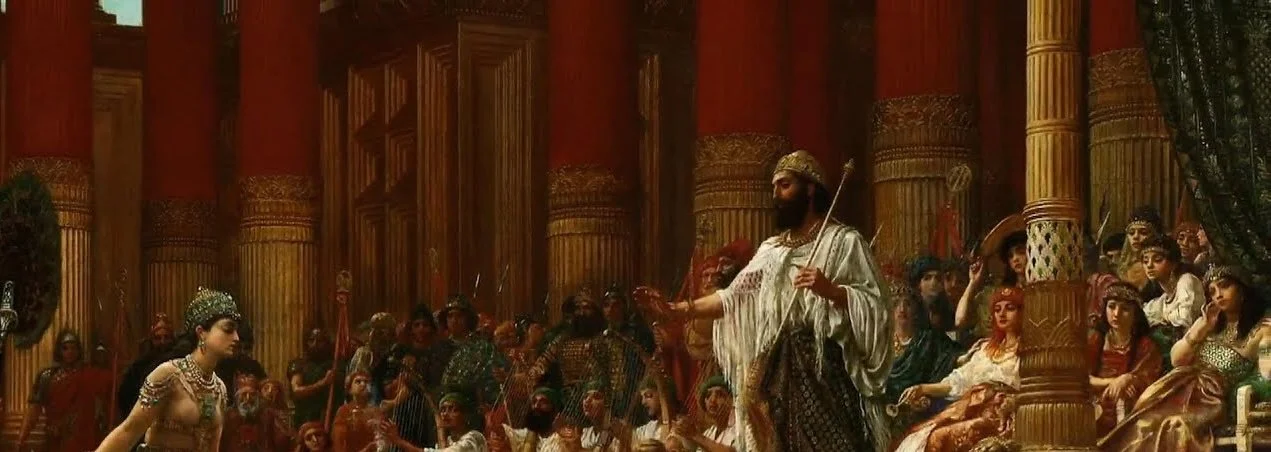
That’s what we see in this the construction of this temple. How do you do justice to God? It’s not going to seem like much more than shaking hands and saying, “how do you do?” but, as with those handshakes, there is more going on. Israel throws all the wisdom they have into this and then there’s another side too. Their wisdom expresses but never exhausts God’s worth. That’s what our best is like too and that’ s the claim of this sermon.
We will study this in two points. First: building the temple. Second: building the palace. First, in verses 1-38 of chapter 6, building the temple. Second, in verses 1-12 of chapter 7, building the palace.
We see this first in our first point: the building of the temple. This account of the construction of the temple begins with an unexpected time stamp; verse 1, “In the four hundred and eightieth year after the Israelites had come out of Egypt…” We don’t tend to measure time by that metric. I’ve never written on a medical form, “In the four hundred and eightieth year after the Spanish mapped the coastline of Venezuela, I was born.” I haven’t done that yet, at least. So why measure this event by four hundred and eighty years from the Exodus?
The time stamp on the temple goes all the way back to the Exodus as a sign that this temple meant they were truly home now. They no longer used the tabernacle in worship which could move from place to place. This permanent worship site marked this land as theirs. It’s like a foster child realizing that he’s now in his forever home.
Every step along the way from the Exodus to this temple took longer than people thought it would. Moses didn’t expect to spend the rest of his life wandering in the wilderness. Each of the judges died only for the same sad cycle repeat itself. This long-promised worship site project never seemed to go anywhere and then all of a sudden, it’s happening in this passage and then it’s done as we will see in the next chapter. That’s how it goes with God’s work. “There are three stages to every great work of God,” Hudson Taylor explained; “first it is impossible, then it is difficult, then it is done. That’s worth considering in your life. “The Lord is not slow in keeping his promise, as some understand slowness,” as Peter put it.
This temple Solomon built was twice as big as the tabernacle—ninety feet long by thirty feet wide by forty-five feet high. That’s pretty close to the dimensions of this area of the sanctuary. Solomon’s temple could fit within our sanctuary. That’s a reason to pause and be grateful for our facility. Remember, though, most of the people did their worship outside in the courts.
The author continues to detail different dimensions and then offers this fascinating bit of temple trivia in verse 7, “In building the temple, only blocks dressed at the quarry were used, and no hammer, chisel or any other iron tool was heard at the temple site while it was being
built.” They didn’t want the racket that goes with stonework near what would be the Holy of Holies. They wanted to express what God was worth to them not only with what they would build but with how they would built it.
This was one of the verses my mother wanted for my father’s funeral. She remembered a sermon she had heard years ago on this verse likening the temple to heaven and the construction site to earth. We get what’s unneeded cut away while in this life. Pride, impatience, manipulation, disbelief has no place in the next life and so it is being cut away now. We have our rough edges smoothed now so we are fit for heaven. “If your hand causes you to stumble, cut it off and throw it away. It is better for you to enter life maimed than to have two hands and be thrown into eternal fire,” as Jesus put it. This life is a carving away. This life is the quarry. The next is the temple. Those workmen didn’t confuse the two; let’s not confuse them either.
The people wanted to express God’s worth and we see His startling response in verse 11, ‘The word of the Lord came to Solomon: “As for this temple you are building…”’ and then the Lord goes on to say nothing about the temple but rather tells Solomon to obey His word. It’s as if the Lord has little interest in the building project. The Lord “has no strong feelings one way or the other about this activity. What He is concerned with is the manner of life of Solomon and the people of Israel,” as one commentator explains. What matters is their lives. What matters is their relationship. No building project could replace that or make up for its lack.
The Lord is not disparaging the temple. He’s saying it’s not sufficient to express His worth. The people need to keep listening to Him and trusting Him all their lives. I need to keep listening to Him and trusting Him. That’s how we express God’s worth—not with just one offering.
Imagine a man is into woodworking. He’s making a bench for his wife and he puts all his skill into it. Would that bench suffice as a replacement for holding her hand? Would that bench—no matter how magnificent—make up for a lack of love? That is what Israel will come to do with the temple. In this moment, they are trying to show God what He is worth to them but soon they will turn it into a sign that they’ve already showed Him what He’s worth and so now they don’t need to listen or trust or love. Any correction in this regard will just lead to them push back saying, “The temple of the Lord, the temple of the Lord, the temple of the Lord,” as Jeremiah puts it before this temple is turned to rubble because that’s what it had become to God.
The Lord can get rid of buildings or make new ones with no loss to Him. He can replace kings just as easily and the same goes for all people. He can create whatever He wants whenever He wants. Wisdom is not expressing what you think God is worth once and done. The Jews who did that missed God in the flesh when he came. Wisdom is expressing God’s worth realizing that you’ll never exhaust it and so you keep expressing it and experiencing it. That’s what it means to meet Jesus and keep meeting him.
The Israelites, at this time, did want to give God their best. You see that in the gold and the cedar all over this description; it is a sign that nothing is too good for God. You see this increase as you reach the Holy of Holies—“twenty cubits long, twenty wide and twenty high,” as verse 20 puts it. This is where the author wants us to put our attention because this is where they Lord’s presence would manifest. You may have noticed from its dimensions that it is a cube—perfectly symmetrical. God’s presence is the order in contrast to the chaos of this life. Everything else might be a mess but this place is perfect. It is good like creation was before the fall. It is as it ought to be.
It’s a picture of heaven. Please turn in your Bibles to Revelation 21:16. Our 1 Kings passage is a tour of the temple. This Revelation passage is a tour of the New Jerusalem. “The city was laid out like a square, as long as it was wide. He measured the city with the rod and found it to be 12,000 stadia in length, and as wide and high as it is long.” In other words, it is a cube. It’s the Holy of Holies but 1,400 miles, rather than 30 feet, long, wide, and high. That’s where you’ll live if you hear, trust and love this God. You’ll live in the permanent Holy of Holies, which is to say that you’ll live with God. ‘I heard a loud voice from the throne saying, ‘“Look! God’s dwelling place is now with men, and He will dwell with them. They will be His people, and God himself will be with them and be their God. He will wipe every tear from their eyes. There will be no more death or mourning or crying or pain, for the old order of things has passed away. He who was seated on the throne said, “I am making everything new!”’ This temple points to that. Is your life pointing to that?
You see this is what it’s about as well with the flowers and palm trees. This is likely a throwback to the Garden of Eden. The Garden is where God and people dwelt together. You have two cherubim over the ark in the Holy of Holies just like cherubim guarded Eden to keep from us re-entering. Good architecture communicates and this communicates that the temple was the meeting place between God and people. It is the way back to Eden.
Jesus says the same about himself. “Destroy this temple, and I will raise it again in three days.” He’s saying that he’s the meeting place of God and humanity and he surely is. He’s better that this temple in every way. Ask yourself whether you’d rather meet God in a building or in the flesh? Would you rather have Him as obviously unpredictable as you find in Jesus who can speak as well as hear or further clinically removed by way of ritual? The people of Jesus’ day made their choice. Each of us makes ours as well.
In this tour, we are now in the heart of the temple, in the Holy of Holies We have the décor of Eden and the cherubim described in great detail but what do we not have? What do we not see in the Holy of Holies? It’s obvious once you don’t see it. You see nothing to represent the Lord. That’s how it was on Sinai as well. “You heard the sound of words but saw no form; there was only a voice.” “Of all the gods,” Oswalt explains, “[the Lord] alone was different; He could not be localized, captured in an image made of creature materials, formed by created hands.” You see nothing and are allowed to craft nothing in hopes of expressing God’s essence because any attempt will do Him dirty. You can’t exhaust who God is or what He is like and so you are forbidden from trying to capture Him by any representation.
He has his own representation—Jesus. “The Son is the radiance of God’s glory and the exact representation of his being,” Hebrews 1:3. Put any attempt you’ve ever made to get your mind around God and compare it with Jesus. Which one is better? Idolaters go with their own imaginations even if it means crucifying Jesus, ignoring Jesus, rejecting Jesus, or giving mere-lip service to him. Christians go with Jesus or rather those who go with Jesus are Christians. Jesus does justice to God. Our best barely expresses that and will never exhaust it. We see that from a very different angle in our second point: building the palace.
And all of a sudden, we are touring a palace. That’s strange—especially if you scan down at the rest of chapter 7 and see the attention returns to the temple. This section about the palace interrupts the construction of the temple. The medium is the message her because the building of the palace was as jarring in experience as its intrusion is here in the text. The temple was about the Lord. The palace was about Solomon. The first is expressing God’s worth without exhausting it. The second expresses Solomon’s worth and it more than exhausts that. That’s how pride works; in seeking to make itself look big, it shows itself small.
Solomon’s house was big—about twice as big as God’s house. Solomon’s palace also took also twice as long to complete as the temple; that’s the contrast of verse 1 of chapter 7, “It took Solomon thirteen years, however, to complete the construction of his palace.” That word “however” is a choice the NIV made. The New King James says, “But Solomon took thirteen years to build his own house.” In the Hebrew it is just the one letter that is used as so many different conjunctions. It’s an interpretive choice and the author wants you to interpret. The author rarely gives clear interpretive comments on Solomon’s behavior. He wants you to consider whether you think this palace of Solomon’s is a sign of blessing upon him or self-regard by him or a mixture of the two. We are to consider that about our own expressions of our lives.
You see Solomon’s self-regard in the cedar. The temple had cedar but this palace is sprouting with it. It has so much that it is called “Palace of the Forest of Lebanon.” Our focus in the first point was on the temple in which the grandeur of God was put forth. Now we see the grandeur Solomon ascribed to Solomon. Solomon “did everything imaginable to show that, as [the Lord] was a great God, he was a great king,” as DeVries put it.
Consider the contrast with Jesus who unlike Solomon is as great as God. What’s his house like? “Foxes have dens and birds have nests, but the Son of Man has no place to lay his head.” Jesus doesn’t seem to need what Solomon needs to think himself a king. The same went for the Lord when David wanted to build him a temple. He told David, “I have not dwelt in a house from the day I brought the Israelites up out of Egypt to this day.” The Lord doesn’t need a house. He doesn’t need anything. That’s worth considering if you want to serve Him. He doesn’t need anything from you?
Solomon seems to need something, though. What is that makes us worthy? Is it cedar? Is it gold? Is it expressing our own worth? Our attempts to display our worth only prove how exhaustible and exhausting our own worth is. Trying to express the Lord’s worth shows how very beyond worth He is.
This contrast is set up by the sacred-secular-sacred sandwich of the temple-palace-temple in chapters 6-7. You see at as well in the troublesome end of verse 8, “Solomon also made a palace like this hall for Pharaoh’s daughter, whom he had married.” Solomon’s prioritization of himself comes at the expense of his prioritization of the Lord as seen by his wives and, as we will see, his acceptance of their gods. It’s easy to imagine how that could happen in the push and pull of marriage. It’s easy to see how this pride-project of the palace could happen in the push and pull of a king’s growing wealth. None of that makes it wise though, which is wise for us to consider in the push and pull of our own lives.
Here we have quite an irony. The king who falls into foreign worship is the one the Lord chose to build His temple. The lesson is that the Lord doesn’t need our perfection for His plans. He is able to complete them in ways that are quite ironic to us because how could it be otherwise given how ridiculous sin has made us? Who do we think we are that we could actually in any sense add any glory to God? All we can do is express it without exhausting it. That’s worship.
Worship will get the last word. The author sees to that by returning, as we will see next week, to the temple. Solomon may have spent almost twice as long on the palace but that palace only takes up 1/10th of the space in these two chapters. The rest is devoted to the temple. My guess is that you’ve heard about Solomon’s temple far more often than you’ve heard about his Palace of the Forest of Lebanon. Our pride-projects—Solomon, mine, and yours—are of little interest to the Lord or anyone else in the end. What’s interesting is God. You can express His worth without ever exhausting it. That’s what life is about. Amen.