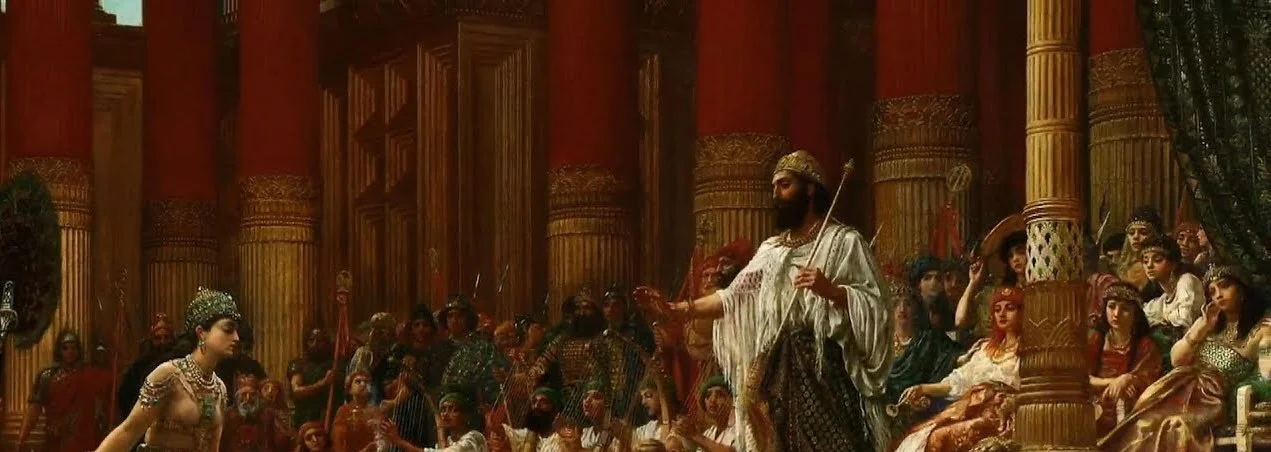
“13 King Solomon sent to Tyre and brought Huram, 14 whose mother was a widow from the tribe of Naphtali and whose father was a man of Tyre and a craftsman in bronze. Huram was highly skilled and experienced in all kinds of bronze work. He came to King Solomon and did all the work assigned to him.
15 He cast two bronze pillars, each eighteen cubits high and twelve cubits around, by line. 16 He also made two capitals of cast bronze to set on the tops of the pillars; each capital was five cubits high. 17 A network of interwoven chains festooned the capitals on top of the pillars, seven for each capital. 18 He made pomegranates in two rows encircling each network to decorate the capitals on top of the pillars. He did the same for each capital. 19 The capitals on top of the pillars in the portico were in the shape of lilies, four cubits high. 20 On the capitals of both pillars, above the bowl-shaped part next to the network, were the two hundred pomegranates in rows all around. 21 He erected the pillars at the portico of the temple. The pillar to the south he named Jakin and the one to the north Boaz. 22 The capitals on top were in the shape of lilies. And so the work on the pillars was completed.
23 He made the Sea of cast metal, circular in shape, measuring ten cubits from rim to rim and five cubits high. It took a line of thirty cubits to measure around it. 24 Below the rim, gourds encircled it—ten to a cubit. The gourds were cast in two rows in one piece with the Sea. 25 The Sea stood on twelve bulls, three facing north, three facing west, three facing south and three facing east. The Sea rested on top of them, and their hindquarters were toward the center. 26 It was a handbreadth in thickness, and its rim was like the rim of a cup, like a lily blossom. It held two thousand baths.
27 He also made ten movable stands of bronze; each was four cubits long, four wide and three high. 28 This is how the stands were made: They had side panels attached to uprights. 29 On the panels between the uprights were lions, bulls and cherubim—and on the uprights as well. Above and below the lions and bulls were wreaths of hammered work. 30 Each stand had four
bronze wheels with bronze axles, and each had a basin resting on four supports, cast with wreaths on each side. 31 On the inside of the stand there was an opening that had a circular frame one cubit deep. This opening was round, and with its basework it measured a cubit and a half. Around its opening there was engraving. The panels of the stands were square, not round. 32 The four wheels were under the panels, and the axles of the wheels were attached to the stand. The diameter of each wheel was a cubit and a half. 33 The wheels were made like chariot wheels; the axles, rims, spokes and hubs were all of cast metal. 34 Each stand had four handles, one on each corner, projecting from the stand. 35 At the top of the stand there was a circular band half a cubit deep. The supports and panels were attached to the top of the stand. 36 He engraved cherubim, lions and palm trees on the surfaces of the supports and on the panels, in every available space, with wreaths all around. 37 This is the way he made the ten stands. They were all cast in the same molds and were identical in size and shape.
38 He then made ten bronze basins, each holding forty baths and measuring four cubits across, one basin to go on each of the ten stands. 39 He placed five of the stands on the south side of the temple and five on the north. He placed the Sea on the south side, at the southeast corner of the temple.
40 He also made the basins and shovels and sprinkling bowls.
So Huram finished all the work he had undertaken for King Solomon in the temple of the LORD: 41 the two pillars; the two bowl-shaped capitals on top of the pillars; the two sets of network decorating the two bowl-shaped capitals on top of the pillars; 42 the four hundred pomegranates for the two sets of network (two rows of pomegranates for each network, decorating the bowl-shaped capitals on top of the pillars); 43 the ten stands with their ten basins; 44 the Sea and the twelve bulls under it; 45 the pots, shovels and sprinkling bowls.
All these objects that Huram made for King Solomon for the temple of the LORD were of burnished bronze. 46 The king had them cast in clay molds in the plain of the Jordan between Succoth and Zarethan. 47 Solomon left all these things unweighed, because there were so many; the weight of the bronze was not determined.
48 Solomon also made all the furnishings that were in the LORD’s temple: the golden altar;
the golden table on which was the bread of the Presence; 49 the lampstands of pure gold (five on the right and five on the left, in front of the inner sanctuary); the gold floral work and lamps and tongs; 50 the pure gold basins, wick trimmers, sprinkling bowls, dishes and censers; and the gold sockets for the doors of the innermost room, the Most Holy Place, and also for the doors of the main hall of the temple.
51 When all the work King Solomon had done for the temple of the LORD was finished, he brought in the things his father David had dedicated—the silver and gold and the furnishings and he placed them in the treasuries of the LORD’s temple.”
Legend has it that Pablo Picasso was doodling on a napkin at a café in Paris. A woman recognized him and asked if she could buy that napkin rather him just throw it away. “Sure,” he replied, “for $10,000.” She was taken aback and said, “It only took you thirty seconds to make that.” “No, madame,” Picasso replied. “It took me forty years to make this.”
That’s likely an only a legend but the insight is as real as it gets. Genius is expressed in a moment but it takes decades to develop. It takes effort to make it seem effortless.
It is a joy to behold. It is a joy to express. It is godly—in that it is like God. It is like God in His craftsmanship. That’s what we will see with décor of the temple this evening. Wisdom expresses and appreciates skill; that’s the claim of this sermon.
We will study this in three points. First: the craftsman. Second: the craftsmanship. Third: the conclusion. First, in verses 13-14, the craftsman. Second, in verses 15-40a, the craftsmanship. Third, in verses 40b-51, the conclusion.
We see this first in a skilled individual; that’s our first point: the craftsman. We are continuing our tour of the temple which was interrupted, as we experienced last week, by the palace. That interruption was doubtlessly how the people experienced that palace. It’s one thing to help with a grand project for God’s glory. It’s something else entirely to fund a king’s pride-project and another one altogether to fund a palace for one of his wives. That being said, though, this grand project for God’s glory was meaningful and people found meaning in doing the work.
We see this in Huram, or “Hiram” as you see his name in the footnote of verse 1, “King Solomon sent to Tyre and brought Huram.” This name is confusing because the Hebrew clearly reads “Hiram” just like the name of the king, Solomon’s ally. There is no “Huram” in any of the manuscripts we have. So, why is he called Huram, here? Well, the Hebrew manuscripts did not include vowels. They only included consonants and the consonants of the parallel account in Chronicles require “Huram.” Now, you might be thinking, “wait, I thought the Hebrew didn’t include vowels. How could that text require a “u” rather than an “i”? Well, there are Hebrew consonants which sound almost silent to us but could be distinguished by a native speaker and the relevant consonant in the Chronicles account of this craftsman is paired with the “u” vowel—hence “Huram.” It’s possible that, that same consonant dropped out of this manuscript with copying or it was a variant of the same name.
We rarely bring such analysis into sermons, which is wise. There’s always more that’s decided in the study than makes it into the sermon, but from time to time I think it wise to point out footnotes like this one. I want you to see that far more work has gone into that English translation you hold in your hands than you might know. That editorial board considered those vowels and consonants and far more than I mentioned or understand when they decided to go with the name “Huram.” I think such respect for our English translations helps guard against the sort of dogmatism that acts as if you only know the Bible if you know the original languages. Original languages help with a responsibility like mine, but if your goal in Bible reading is to better know the mind of God and o live for Him, a good translation like we have in the pews will do a world of good for you. You can trust it.
So, now let’s consider this Huram, “ whose mother was a widow from the tribe of Naphtali and whose father was a man of Tyre and a craftsman in bronze. Huram was highly skilled and experienced in all kinds of bronze work.” These comments about his genealogy mattered more in that culture than in ours. The point is that the Huram was an Israelite through his mother’s side. He also learned bronze work from a young age from his father and is, therefore, the best of the best in that whole region. So you’ve got the best craftsman available anywhere and he’s an Israelite. He’s ideally suited to work on the temple of the God of Israel. He’s a “unicorn” as they say in headhunting circles.
The key point that the author wants us to know is that Huram is extraordinarily skilled at this sort of work. He’s God’s choice and has gifts from God. He makes difficult craftsmanship look easy. If you asked me to cast a bronze pillar with rows of bronze pomegranates like Huram made, you might—at best—get a mound of bronze which Huram would mistake for scrap metal. Huram’s bronze work looked like his intention. That’s remarkable skill. Part of humility is being properly impressed with skill and humility is part of wisdom.
This word for “skill” in “Huram was highly skilled and experienced in all kinds of bronze work,” is the same word used for wisdom. Huram was wise with bronze. Some teachers are wise with teenagers. Some authors are wise with words. Some managers are wise with staff. Such skill, such wisdom, deserves to honored. It is honored by the inclusion of Huram in Scripture. You or I could imagine a Bible without Huram. God didn’t. I doubt any of us has ever wondered who did the metal work in the temple. God wanted the man remembered. We did that this morning when we prayed for our buildings and grounds committee. We are to be thankful for those with these skills, this wisdom.
God has more than anyone. We don’t have any details of Jesus’ carpentry anywhere in Scripture or any tables or chairs he crafted in a museum, which is probably good because someone in church history would likely prescribe that sort of table as the only proper table for Christians. I think it’s fair to say, though, from the general drift of Scripture that Jesus produced some quality tables. God likes quality work. The same goes for you and I who do our sort of work. Luther is right, “The Christian shoemaker does his duty not by putting little crosses on the shoes, but by making good shoes, because God is interested in good craftsmanship.” You see that right here with Huram. “He came to King Solomon and did all the work assigned to him.” Let’s see that work in our second point: the craftsmanship.
What follows has little to do with blueprints. It’s much more of an eyewitness account recalling the wonder of the artistry. It’s like listening to a friend tell you about an art exhibit. This year, Chihuly’s glass art is back at the Fredrick Meijer Gardens. People will tour that and give the exact sort of report you read about here in the rest of chapter 7. They will express admiration rather than give their friends blueprints as to how to make their own glass orbs. The point is the wonder. This chapter tells you that it’s worth considering how long it’s been since you had a sense of wonder.
This eyewitness first tells you about the massive bronze pillars. These pillars don’t seem to bear any weight. They are freestanding; so what’s the point of massive supports that don’t support? You see the point in their names in verse 21, “The pillar to the south he named Jakin and the one to the north Boaz”—Jakin meaning, “He establishes,” and Boaz meaning, “in Him is strength.” What is the hope of sinners like us when we walk into a temple like that? Our only hope is God. “He establishes… in Him is hope.” That’s who supports the real weight of the temple and of life—the Lord. The artistry of those pillars convey that truth in a way words can’t. That’s how art works. The medium is part of the message. You can’t say what a good poem says in anyway other that poetry. You can’t say, “that cupcake would have been a lot better as an essay.” They communicate experience by their own medium. Art appreciation is learning how to receive. The temple communicated gracious receiving from God. It’s worth considering whether you seek to do that yourself.
Atop this strength is fertility; that’s likely what’s going on with verse 18, “He made pomegranates in two rows encircling each network to decorate the capitals on top of the pillars.” If you’ve ever had a pomegranate, you can see what they have to do with fertility. You slice one open and there’s seeds everywhere. They are watery seeds which, given the arid climate, is another symbol of life. So, you walk into the temple and see strength crowned with life. That’s a pretty good way to approach God.
Next we have the molten sea. This was a gargantuan bowl. We humans are impressed by size and something this size had to be difficult to make. “The casting of this huge tank… was an amazing accomplishment,” as Oswalt explains. Some estimate that it could hold 10,000 gallons of water. Growing up, I was into aquariums. I had a ten-gallon, and then a twenty-nine-gallon, and then a fifty-five-gallon. When my uncle Gary built a new house, he had an aquarium that made up most of one his walls. My fifty-five-gallon suddenly didn’t seem so big. Compare that aquarium with this sea and it suddenly doesn’t seem like anything at all. Just consider its name. It was so big, they called it “the sea.”
It was the sea contained. That is likely part of the meaning here. The sea was chaos to the ancient near eastern mind. You can’t build on the sea. You can sink and disappear into it. Some of you might have similar fears of such large bodies of water. This is why the new creation in Revelation is described as, “there was no longer any sea.” The chaos will be gone. Here, though, with the temple, the sea is contained—the chaos is contained. It was held up by twelve oxen, the strongest animals in that culture. The art is showing strength containing the chaos. That is what we want in our worship experience. We want to know, “God’s got this.” That’s this molten sea.
The priests would clean their hands in this sea before and after their priestly work. The blood and guilt would be washed away and disappear. “He will come back and comfort us again. He will throw all our sins into the deep sea,” as Micah 7:19 puts it. God makes our sins as done as death itself with Jesus. All this illustrates that the Lord is more interested in forgiving our sins than we are in having them forgiven and if you know your sin, you know you would do anything to have it forgiven.
The last of the big three projects mentioned here is the ten movable stands of bronze. These movable water tanks were used to wash the offerings. They were functional and they were beautiful. Twice we are told that “lions, bulls and cherubim,” were carved all over them. Functional and beautiful was also what Steve Jobs demanded at Apple and it’s largely why Apple is worth nearly $5 billion today. Steve Jobs echoed the same wisdom of Huram and God.
My guess, though, is hearing these verses on these water tanks may was a bit tedious. I’m not under any illusion that any of us will go to the DMV tomorrow to get the vanity plate reading—1 Kings 7:33 as in, “The wheels were made like chariot wheels; the axles, rims, spokes and hubs were all of cast metal.” My hope, though, is that the detail that here seems monotonous seems fascinating when applied to Jesus. “Because of his great love for us, God, who is rich in mercy, made us alive with Christ even when we were dead in transgressions—it is by grace you have been saved,” sort of detail. The sticking point isn’t the detail. It’s the object which is being detailed. Here in this passage, it’s the temple. So it is in the New Testament too—Jesus is now where and how we meet God and so his work is described in the same level of detail as the temple. If you want more on that, read the book of Hebrews. It will take you 45 minutes. That’s our art appreciation—appreciation what Jesus did, does, and will do for us and in us.
We wrap up our art appreciation in the form of a list in our last point: the conclusion. This is something of an itemized work list for services rendered. It’s the sort of project list you receive when you get your car repaired—“two pillars; the two bowl-shaped capitals on top of the pillars; the two sets of network decorating the two bowl-shaped capitals on top of the pillars… pots, shovels and sprinkling bowls.” Those last three, “pots, shovels and sprinkling bowls,” show up together in Exodus 27, 38, 2 Kings 25, 2 Chronicles 4, and Jeremiah 52. They were clearly meaningful and yet they seem normal to the point of being boring; that’s probably the point. At Bethany’s grandmother’s funeral, Bethany’s uncle talked about his mother’s hands. He said they weren’t beautiful but they made much beauty. They were no longer beautiful because they made much beauty. That’s a bit of what’s going with these “pots, shovels and sprinkling bowls.” They don’t seem like much. They aren’t awe inspiring like the sea or decorated like the water basins. They get the job done. That’s why they are remembered. The Old Rugged Cross works with those same themes. “O that old rugged cross, so despised by the world, has a wondrous attraction for me; for the dear Lamb of God left his glory above to bear it to dark Calvary.”
On the other end of the artistic spectrum, you have the interesting inclusion of verse 50, “and the gold sockets for the doors of the innermost room, the Most Holy Place.” So the door hinges which were almost always went unnoticed were made of gold. The temple has rugged shovels and royal hinges.
I have no idea how the itemizing of these costs went. It didn’t seem to be a concern for Solomon. Perhaps that is part of the point. It’s hard to know what’s too much and what’s not enough in a project like this and so it has gone for houses of worship since. Many moderns lament the cost of cathedrals and yet it gave generations of Europeans a way to honor God. It’s hard to know what’s too much and what’s not enough when it comes to any of us offering anything to God. How do you navigate that? God tells us how and we’d be wise to listen to Him through Paul in 2 Corinthians 9:7, “Each of you should give what you have decided in your heart to give, not reluctantly or under compulsion, for God loves a cheerful giver.”
We come to the end of this itemized list and read in verse 51, “When all the work King Solomon had done for the temple of the Lord was finished…” Wait, who did all this work? Didn’t Huram do all this work? Yes. So, why do we read, “When all the work King Solomon had done for the temple of the Lord was finished…” Well, this is Solomon’s project. He did the whole as Huram did his part. It is still called Solomon’s temple. Solomon is one of the most confusing people in all of Scripture—a later idolater who build the temple of the Lord, the wisest man who makes the most foolish decisions, a man of excess who wanted God’s temple to express God’s inexhaustible worth. He is the Lord’s man for this moment because it is the Lord’s temple even more than it’s Solomon’s.
And the Lord will be fine abandoning this temple when the time comes just as He was fine inspiring Solomon to build it. This art isn’t all that needful to God. It doesn’t impressive Him in such a way that He excuses its later abuses. “In the Bible the beauty of temples is never any guarantee that God will not leave them or bring judgment upon them,” as Provan puts it. The Lord gave Huram the skill to do this work but Huram’s work didn’t obligate the Lord to do what Huram or anyone else wanted. The same goes for you and I and us as a church as God’s temple. Let me read it again and let’s think about ourselves, “In the Bible the beauty of temples is never any guarantee that God will not leave them or bring judgment upon them.”
What matters is faithfulness—expressing faith. That’s the sort of beauty this gold and artistry point to. It’s about, “the proven genuineness of your faith—of greater worth than gold, which perishes even though refined by fire,” as Peter puts it. The question is whether this beauty is being worked into you. That’s craftsmanship well beyond Huram’s, well beyond Steve Job’s. That’s craftsmanship only God can do. Amen.