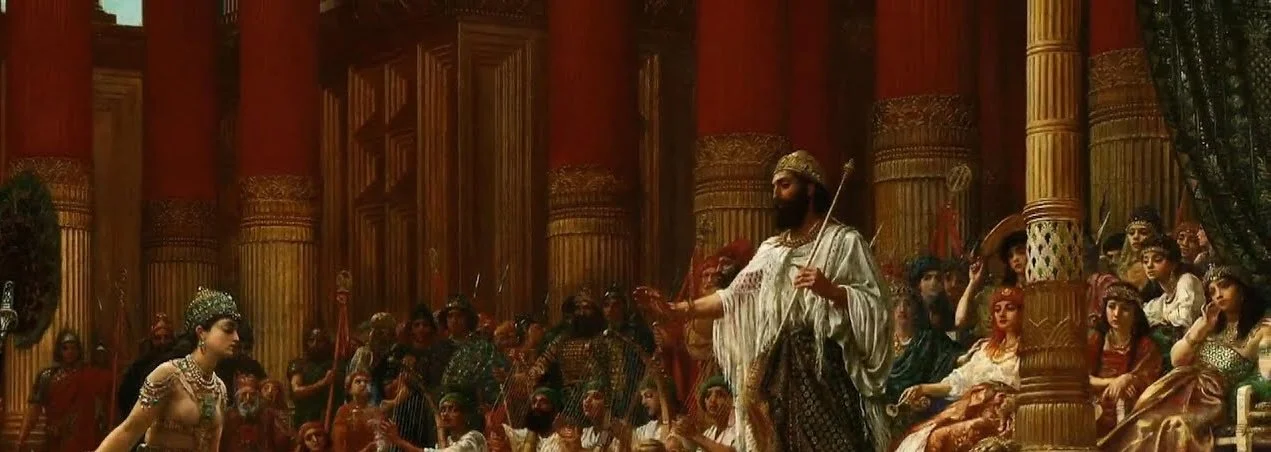
“1 Then King Solomon summoned into his presence at Jerusalem the elders of Israel, all the heads of the tribes and the chiefs of the Israelite families, to bring up the ark of the LORD’s covenant from Zion, the City of David. 2 All the men of Israel came together to King Solomon at the time of the festival in the month of Ethanim, the seventh month.
3 When all the elders of Israel had arrived, the priests took up the ark, 4 and they brought up the ark of the LORD and the Tent of Meeting and all the sacred furnishings in it. The priests and Levites carried them up, 5 and King Solomon and the entire assembly of Israel that had gathered about him were before the ark, sacrificing so many sheep and cattle that they could not be recorded or counted.
6 The priests then brought the ark of the LORD’s covenant to its place in the inner sanctuary of the temple, the Most Holy Place, and put it beneath the wings of the cherubim. 7 The cherubim spread their wings over the place of the ark and overshadowed the ark and its carrying poles. 8 These poles were so long that their ends could be seen from the Holy Place in front of the
inner sanctuary, but not from outside the Holy Place; and they are still there today. 9 There was nothing in the ark except the two stone tablets that Moses had placed in it at Horeb, where the LORD made a covenant with the Israelites after they came out of Egypt.
10 When the priests withdrew from the Holy Place, the cloud filled the temple of the LORD.
11 And the priests could not perform their service because of the cloud, for the glory of the LORD filled his temple. 12 Then Solomon said, “The LORD has said that He would dwell in a dark cloud; 13 I have indeed built a magnificent temple for you, a place for you to dwell forever.”
14 While the whole assembly of Israel was standing here, the king turned around and blessed them. 15 Then he said: “Praise be to the LORD, the God of Israel, who with his own hand has fulfilled what He promised with his own mouth to my father David. For he said, 16 ‘Since the day I brought my people Israel out of Egypt, I have not chosen a city in any tribe of Israel to have a temple built for my Name to be there, but I have chosen David to rule my people Israel.’
17 “My father David had it in his heart to build a temple for the Name of the LORD, the God of Israel. 18 But the LORD said to my father David, ‘Because it was in your heart to build a temple for my Name, you did well to have this in your heart. 19 Nevertheless, you are not the one to build the temple, but your son, who is your own flesh and blood—he is the one who will build the temple for my Name.’ 20 “The LORD has kept the promise He made: I have succeeded David my father and now I sit on the throne of Israel, just as the LORD promised, and I have built the temple for the Name of the LORD, the God of Israel. 21 I have provided a place there for the ark, in which is the covenant of the LORD that He made with our fathers when he brought them out of Egypt.””
“3, 2, 1, Happy New Year!” That was always a disappointing for me. Everyone else seemed so excited and I could never tell what was really changing at midnight. I wanted, and still want, self-transcendence—to experience something beyond myself—and a new year never seemed to deliver.
My wedding day delivered. Bethany, her parents, and I put thought and intentionality into the ceremony and reception. It was a delight to experience. We saw all sorts of people we hadn’t seen for years. It was over too soon. For as good as it was, it was not an open-ended experience. Your wedding day is only one day.
The experience could go on last Saturday. We want to a beach south of South Haven. We made a water pool and to protect it I brought in slabs of concrete to build a sea wall. The weather was perfect. The children were happy. Eventually, though, it was time to go—not because we needed to but because even though the experience could go on, it had run its course inside and I wanted to do something different.
So, to combine these three experiences it seems that I want something that, unlike New Years Eve, delivers self-transcendence for me—to be part of something bigger that changes me. Unlike my wedding day, I want it to go on and on—to be open ended. Unlike, that day at the beach, I want it to be so comprehensively satisfying that it never runs its course. That’s a tall order. I think that’s everyone wants, though, and that is what our passage evening is all about. It exceeds our expectations. It is open-ended. It is comprehensive enough to go on happily forever. The Lord’s continued presence is the longing of our hearts; that’s the claim of this sermon.
We will study this in two points. First: gathering together. Second: blessings abound. First, in verses 1-13, we see everyone gather together. Second, in verses 14-21, we see blessings abound.
We’ll spend most of our time considering this with our first point: gathering together. The beginning of this chapter marks a pivot; it’s still the temple so it is not a new section, but it is a new focus. We’ve studied the meaning of the architecture and art of the temple. Now we consider temple worship with its dedication. The dedication happened during the festival in the seventh month, which is the Feast of Booths. This feast commemorates the wilderness wanderings. God had guided the people by the pillar of cloud and fire which would settle over the tabernacle. With this dedication, that tabernacle is superseded by the temple. Wisdom discloses meaning so that those who experience it can discover further truths.
God is still disclosing meaning so that we who experience can discover further truth. We enjoy the next temple fulfillment, which is not the tabernacle to the temple but the temple to Jesus. Jesus is how we experience God’s presence today. “The Word became flesh and tabernacled among us,” John wrote. “We have seen his glory, the glory of the one and only Son, who came from the Father, full of grace and truth.” That is the self-transcending, open-ended experience comprehensive enough to keep us engaged forever as the book of Revelation details.
The people gathered for this festival. They gathered in accord with responsibility—they are listed from more responsibility to less—“the elders of Israel, all the heads of the tribes and the chiefs of the Israelite families.” Everyone else joined as well but responsibility is made explicit because it describes who is leading these people. They are to be leading them toward God’s presence. All will go well as long as they continue to do so and everything will begin to unravel when they begin to do otherwise. So it is for the church as well. Pray for your elders, your deacons, your leaders.
It is the priests not those leaders who carried the ark. There’s a differentiation of roles and so it is in the church today. The elders and heads of tribes and chiefs had their roles. The priests had theirs. The priests highlighted the mediation between God and humanity—carrying the ark. The elders, heads, and chiefs governed the people. They had their own division of roles like we have ministers, elders, and deacons. This is, “a picture of respectful, solemn people. Each person accepts a proper role.”
That solemnity is seen in “sacrificing so many sheep and cattle that they could not be recorded or counted,” as verse 5 puts it. Solomon knew what happened when the ark was brought thoughtlessly and presumptuously—a priest died and the experience ended. If you treat the sacred thoughtlessly and presumptuously, you’ll find that you’ve been playing with sacred fire. Don’t do that.
The ark was placed “in the inner sanctuary of the temple, the Most Holy Place, and put it beneath the wings of the cherubim,” as verse 6 tells us. That Most Holy Place is a representation of heaven. There is no representation of God in it. What we have is the ark of the covenant—a sign of God’s promise of relationship. That ark is the only historic piece in the temple. The rest was new. The message is that it was still and God’s revealing Himself at Sinai through words recorded for all generations that mattered; that’s verse 9, “There was nothing in the ark except the two stone tablets that Moses had placed in it at Horeb, where the Lord made a covenant with the Israelites after they came out of Egypt.”
God’s words were and are the medium of clarity between us and God—not an image, not an item, not an action, but words. Don’t try to be part of something greater than yourself by way of anything but words—God’s words. That’s how He makes His presence clear and so it is with us too. We relate most deeply with each other by words. It’s not coincidental that Jesus is called the word made flesh. He’s God speaking with bones and muscle on and blood shed. Find God where He reveals Himself or you’ll never find Him at all.
You see the mysterious nature of meeting this God in His manifestation of the cloud; verse 10, “When the priests withdrew from the Holy Place, the cloud filled the temple of the Lord.” This is the glory cloud which led the people by pillar of cloud by day and fire by night during the wilderness wanderings—the very festival they were there to commemorate. It was now settling in the temple as a sign of God’s presence among them. It’s a cloud because it’s there and it’s not. You know that by experience if you’ve ever tried to grab fog. You can see it, it can leave your hand wet, but you can’t get your hands on it. That’s God’s presence—among us but never contained by us.
We this cloud when the Israelites finished the tabernacle in the wilderness. In Exodus 40, we read, “the cloud covered the tent of meeting, and the glory of the Lord filled the tabernacle. Moses could not enter the tent of meeting because the cloud had settled on it, and the glory of the Lord filled the tabernacle.” Take a look at our verse 11, “And the priests could not perform their service because of the cloud, for the glory of the Lord filled His temple.” No Israelite at the dedication who knew their Torah would have missed that. Also, no Pharisee teaching on the law and the prophets would have missed that. They missed Jesus, though. People can see connections in the Bible and miss Jesus. People can see connections in experiences and miss Jesus. You can make a real Biblical point and miss the point. Don’t do that. Find that open-ended, comprehensive, self-transcending experience of knowing God and keep on keeping on with it forever, or as Jesus put to people he met, “follow me.”
Solomon experienced this cloud and said, “The Lord has said that He would dwell in a dark cloud; I have indeed built a magnificent temple for You, a place for You to dwell forever.” Here you see that this experience “both reveals and conceals,” as Davis put it. This cloud revealed the Lord’s presence—it displayed that He was among them at this dedication and that the temple would be a nexus where He and people intersect. It also concealed, which is what cloud do when you look at the sky—“He would dwell in a dark cloud.” Jesus reveals even more. “No one has ever seen God, but the only God, who is at the Father’s side, he has made Him known.”
Do you know Jesus? Do you know God? Do you have a relationship with Him? That’s what verse 13 is all about, “I have indeed built a magnificent temple for You, a place for You to dwell forever.” Solomon wanted to meet God there as long as he lived. He wanted the people to meet God in this temple for generations. The author of 1 Kings knows that this wasn’t going to happen. Solomon is going to get wrapped up in foreign gods. The people are going to follow suit. They are going to exchange this comprehensive, open-ended, self-transcendence of knowing God for the nothingness of lies. That’s a warning for us lest we think we’re wiser than Solomon. Keep knowing God and don’t let anything pull you away. This temple is about knowing God—use it or lose it. Jesus is about knowing God—use it or lose it. Your soul is about knowing God—use it or lose it.
Everything you could ever want forever is yours for the taking if you’ll only trust Him and that’s our second point: blessings abound. As we transition into this second point, we’re moving to a new section in chapter 8 and so we are going to consider the structure of this chapter. This chapter is one of the most important in the entirety of 1 and 2 Kings. It’s one of the most important in the collection of all the chapters beginning in Deuteronomy running through Jeremiah. This chapter is broken into five sections. If we could please have our outline on the screen.
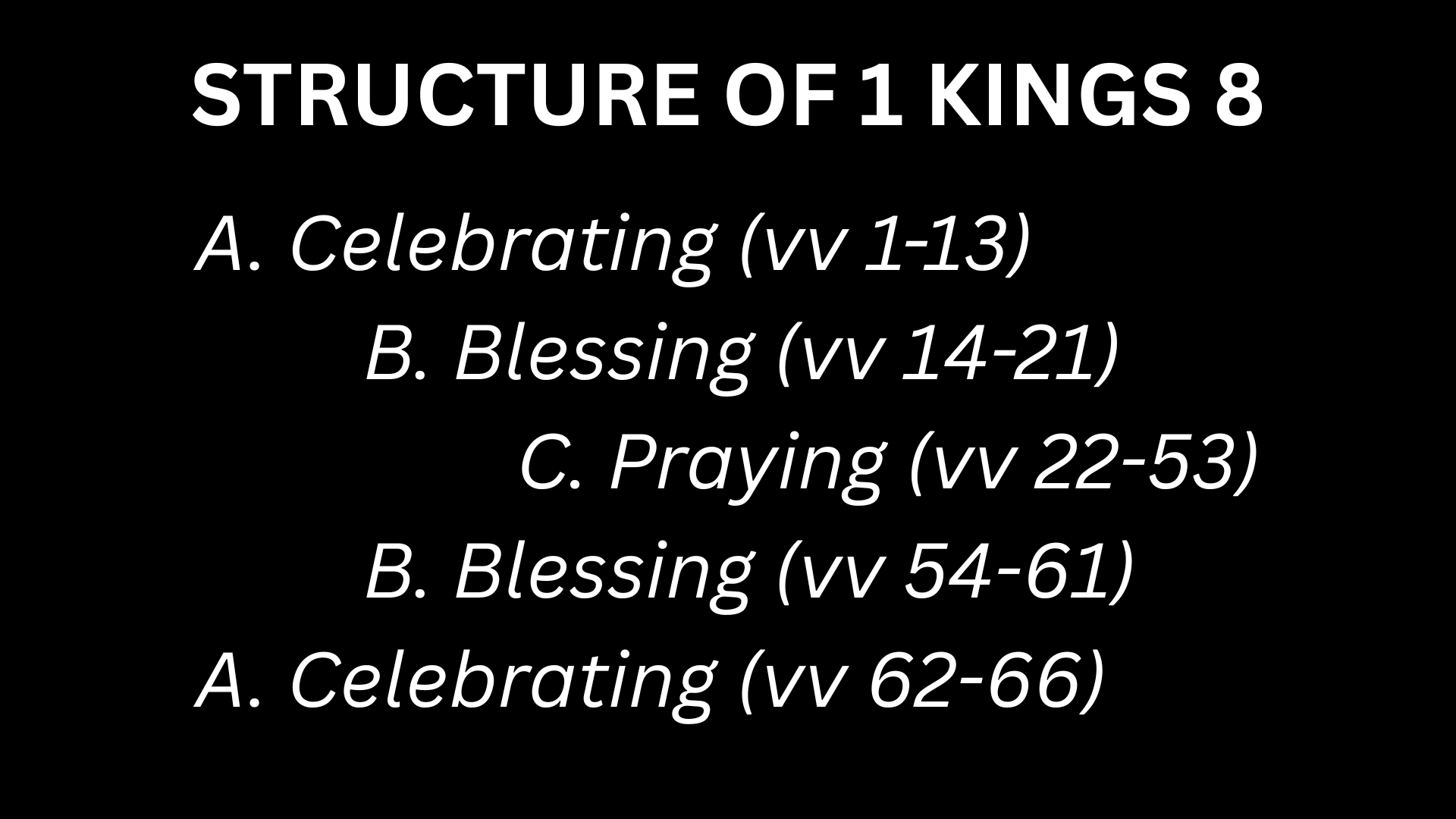
Given this chapter’s importance, we will give it five sermons for these five sections but not in this arrangement. The structure you see here is called a chiasm. It’s a mirror reflection in which the middle is the most important. You see A—celebrating—in verses 1-13 and A in 62-66, the beginning and the end of the chapter. You then see B—blessing—in verses 14-21 and B’ in 54-61. You then see C—praying—in verses 22-53.
We will spend three weeks on the prayer because the author puts it in the middle because it’s the most important. We’re combining A and B in today’s sermon and we’ll end with another sermon with the ending A, B. I’m detailing this in advance because part of sermons is Biblical literacy and structure is a necessary part of that. Some of you are in Bible studies or lead Bible studies. I don’t want you to hear a thousand sermons without learning a bit about structure. It’s as essential for understanding the Bible as knowing where to turn is essential for reaching your destination.
So, now, in verse 14, we come to blessings, “While the whole assembly of Israel was standing here, the king turned around and blessed them.” We aren’t as explicit with our blessings as they were. My guess is that the only time you are ever told that you are about to be blessed is in this sanctuary with the parting blessing. We do bless others, though, quite regularly—a meal for someone in grief, a card, a visit. A soul that enjoys blessing and being blessed is blessed. If you don’t enjoy blessing others or being blessed, please consider whether you are blessed.
We see Solomon bless the people and bless the Lord. First in this verse, he blesses the people. This blessing is the inauguration of the temple—a place where they can meet with God. It’s similar to the moment in a wedding when the pastor declares, “I now present to you for the first time, Mr. and Mrs. John Smith. John, you may kiss your bride,” and everyone claps with glee. Here the groom is God, the bride is the people, the kiss is the two meeting at the temple, and the applause is this blessing. This blessing is a way of putting that sense of, “isn’t this good?” on the people.
We ask to enter that glee when we pray silently before our time of worship. We are asking to enter into the reality of what God has made possible. We are asking to transcend ourselves by way of meeting God.
So Solomon blessed the people and then he blessed the Lord; that begins in verse 15, ‘Then he said: “Praise be to the Lord, the God of Israel…” or as more literal transitions put it, ‘he said, “Blessed be the Lord, the God of Israel…”’ Of course, Solomon blessing the Lord is different from him blessing the people. The Lord blessing us is different from us blessing Him. The Lord can give to us. We can’t really give to Him. The blessing up on the Lord is the same as the people’s blessing—it is the coming together and God and us. That’s what begins with, “Blessed be to the Lord, the God of Israel, who with His own hand has fulfilled what He promised with his own mouth to my father David,” and then Solomon goes on to speak of the promise and the building of this very temple—this meeting place of God and humanity. The idea is that the Lord delights in this relationship too. He’s blessed by it. He’s blessed by you. He’s blessed by me.
The Lord thinks that’s the case. He wants this. He suffers pain for it. You can imagine that He does so begrudgingly out of obligation secretly wishing that He never made us in the first place let alone saved us or you can accept what He says—that He’s blessed by us. If you have children, you have a living parable as to how you as a formerly independent person can be blessed by having a dependent much like God with us. You know how you can be blessed by someone who for years can offer you nothing and then can offer you a lot of hurt and joy but you delight in them because they are yours. Your joy in that relationship isn’t about the perfection of you children but about your experienced being increased by their sheer existence. That’s what it is to have a child. As one father put it to his son, “I’m writing this in part to tell you that if you ever wonder what you’ve done in your life, and everyone does wonder sooner or later, you have been God’s grace to me, a miracle, something more than a miracle.” That’s what you give God the Father or rather that’s what God gave Himself by giving you life, meeting these people in the temple, and meeting us in Jesus Christ.
That’s the faith of relationship with delivers on transcending your self, your flesh. It’s open-ended, it’s comprehensive enough to interest, transform, and motivate you through this whole life and to enjoy forever. It will deliver. Use it or lose it. Amen.
Given this chapter’s importance, we will give it five sermons for these five sections but not in this arrangement. The structure you see here is called a chiasm. It’s a mirror reflection in which the middle is the most important. You see A—celebrating—in verses 1-13 and A in 62-66, the beginning and the end of the chapter. You then see B—blessing—in verses 14-21 and B’ in 54-61. You then see C—praying—in verses 22-53.
We will spend three weeks on the prayer because the author puts it in the middle because it’s the most important. We’re combining A and B in today’s sermon and we’ll end with another sermon with the ending A, B. I’m detailing this in advance because part of sermons is Biblical literacy and structure is a necessary part of that. Some of you are in Bible studies or lead Bible studies. I don’t want you to hear a thousand sermons without learning a bit about structure. It’s as essential for understanding the Bible as knowing where to turn is essential for reaching your destination.
So, now, in verse 14, we come to blessings, “While the whole assembly of Israel was standing here, the king turned around and blessed them.” We aren’t as explicit with our blessings as they were. My guess is that the only time you are ever told that you are about to be blessed is in this sanctuary with the parting blessing. We do bless others, though, quite regularly—a meal for someone in grief, a card, a visit. A soul that enjoys blessing and being blessed is blessed. If you don’t enjoy blessing others or being blessed, please consider whether you are blessed.
We see Solomon bless the people and bless the Lord. First in this verse, he blesses the people. This blessing is the inauguration of the temple—a place where they can meet with God. It’s similar to the moment in a wedding when the pastor declares, “I now present to you for the first time, Mr. and Mrs. John Smith. John, you may kiss your bride,” and everyone claps with glee. Here the groom is God, the bride is the people, the kiss is the two meeting at the temple, and the applause is this blessing. This blessing is a way of putting that sense of, “isn’t this good?” on the people.
We ask to enter that glee when we pray silently before our time of worship. We are asking to enter into the reality of what God has made possible. We are asking to transcend ourselves by way of meeting God.
So Solomon blessed the people and then he blessed the Lord; that begins in verse 15, ‘Then he said: “Praise be to the Lord, the God of Israel…” or as more literal transitions put it, ‘he said, “Blessed be the Lord, the God of Israel…”’ Of course, Solomon blessing the Lord is different from him blessing the people. The Lord blessing us is different from us blessing Him. The Lord can give to us. We can’t really give to Him. The blessing up on the Lord is the same as the people’s blessing—it is the coming together and God and us. That’s what begins with, “Blessed be to the Lord, the God of Israel, who with His own hand has fulfilled what He promised with his own mouth to my father David,” and then Solomon goes on to speak of the promise and the building of this very temple—this meeting place of God and humanity. The idea is that the Lord delights in this relationship too. He’s blessed by it. He’s blessed by you. He’s blessed by me.
The Lord thinks that’s the case. He wants this. He suffers pain for it. You can imagine that He does so begrudgingly out of obligation secretly wishing that He never made us in the first place let alone saved us or you can accept what He says—that He’s blessed by us. If you have children, you have a living parable as to how you as a formerly independent person can be blessed by having a dependent much like God with us. You know how you can be blessed by someone who for years can offer you nothing and then can offer you a lot of hurt and joy but you delight in them because they are yours. Your joy in that relationship isn’t about the perfection of you children but about your experienced being increased by their sheer existence. That’s what it is to have a child. As one father put it to his son, “I’m writing this in part to tell you that if you ever wonder what you’ve done in your life, and everyone does wonder sooner or later, you have been God’s grace to me, a miracle, something more than a miracle.” That’s what you give God the Father or rather that’s what God gave Himself by giving you life, meeting these people in the temple, and meeting us in Jesus Christ.
That’s the faith of relationship with delivers on transcending your self, your flesh. It’s open-ended, it’s comprehensive enough to interest, transform, and motivate you through this whole life and to enjoy forever. It will deliver. Use it or lose it. Amen.