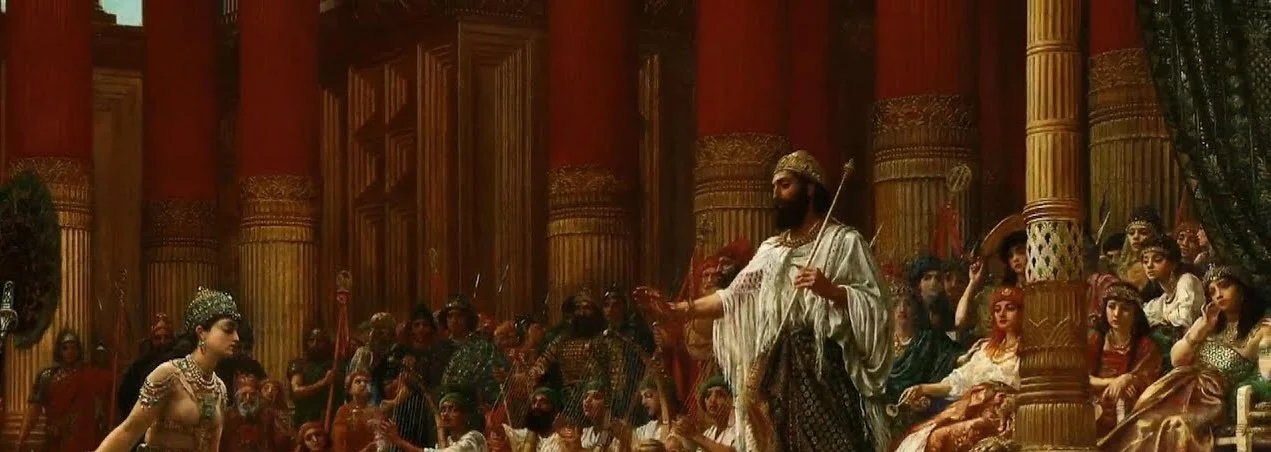
“22 Then Solomon stood before the altar of the LORD in front of the whole assembly of Israel, spread out his hands toward heaven 23 and said: “O LORD, God of Israel, there is no God like You in heaven above or on earth below—You who keep Your covenant of love with Your servants who continue wholeheartedly in Your way. 24 You have kept Your promise to Your servant David my father; with Your mouth You have promised and with Your hand You have fulfilled it—as it is today.
25 Now LORD, God of Israel, keep for Your servant David my father the promises You made to him when You said, ‘You shall never fail to have a man to sit before me on the throne of Israel, if only your sons are careful in all they do to walk before me as You have done.’ 26 And now, O God of Israel, let Your word that You promised Your servant David my father come true.
27 But will God really dwell on earth? The heavens, even the highest heaven, cannot contain You. How much less this temple I have built! 28 Yet give attention to Your servant’s prayer and his plea for mercy, O LORD my God. Hear the cry and the prayer that Your servant is praying in Your presence this day. 29 May Your eyes be open toward this temple night and day, this place of which You said, ‘My Name shall be there,’ so that You will hear the prayer Your servant prays toward this place. 30 Hear the supplication of Your servant and of Your people Israel when they pray toward this place. Hear from heaven, Your dwelling place, and when You hear, forgive.”
My mom’s father was a big personality. He threw his weight around at work and at home. He could be intimidating. He was also a lot of fun. So, how do you approach Grandpa? I thought about that as an eight-year-old boy.
When I was fourteen, I thought a lot about how to approach girls. I could tell there was now a difference between them and me and a difference between them now and a few years before. Other boys seemed to know the apparent rules on approaching girls but I didn’t get the pamphlet. How do you approach girls?
How do you approach God? He’s more different from us than a fourteen-year-old girl is from a boy. He has more gravity to him than the most intimidating grandpa. We give plenty of thought to how we approach people. Do we give as much thought as to how we approach God? If not, why not? Tonight we will because that’s what we see at the beginning of Solomon’s prayer. We approach our faithful God by faith. That’s the claim of this sermon.
We will study this in two points. First: promise and fulfillment. Second: beyond and near. First, in verses 22-26, promise and fulfillment. Second, in verses 27-30, beyond and near.
We see the basis for faith in our first point: promise and fulfillment. If Solomon’s prayer is a highway, what we begin with today is the onramp. It’s not an add-on any more than an onramp to a highway is a bonus. It’s needed but it’s a got its own purpose.
You see this first in terms of location in verse 22, “Then Solomon stood before the altar of the Lord in front of the whole assembly of Israel, spread out his hands toward heaven…” Before we hear the prayer, we are told where Solomon stood because that mattered. The altar was between the Solomon and the temple Solomon stood between the altar and the people. There were buffers. That communicates something. Before Bethany and I began dating, she came to a conference at the church I was serving. She came with her brother and whenever I tried to sit by her, her brother would jump in that seat before I could sit down. He was trying to act as a buffer. Solomon was a buffer between the people and the altar. The altar was a buffer between Solomon and the temple. The temple was a buffer between us and God.
God is a sacred and to approached as such. We can be far too familiar with God. We dismiss some of the formality of the past to our detriment. Today we act as if we’ve somehow domesticated the Almighty. Buffers between the people and the Lord tell us to be careful; they tell us to approach but to approach with caution. Jesus tells us the same. All can approach but don’t presume.
This caution has nothing to do with the Lord being hazardous. It has to do with Him being other. He’s more other than a girl is other to a tween boy. He’s as other as we see in verse 23, “O Lord, God of Israel, there is no god like You in heaven above or on earth below.”
He’s different from us. He’s different from any gods they knew. He’s different from all the other gods that would entangle Solomon’s affections. He’s different from the other hopes that entangle our affections. He delivers. He delivers faithfully. That’s what make Him different and that’s verse 24, “there is no god like You in heaven above or on earth below—You who keep Your covenant of love with Your servants who continue wholeheartedly in Your way.”
The Lord was steadfast. The gods of the Ancient Near East were fickle. They were for you and then against you. Their moods were as changeable as the weather their moods governed. The singer Rod Stewart was fickle like that. His girlfriend caught him with another woman and Rod felt the only way to win her back to was to prove he was serious by proposing marriage. He rented a plan with a banner asking her to marry him. Before the plane took off, though, Rod met another woman and asked her out. He tried to cancel the plane, but he couldn’t do it in time. That’s the sort of fickleness you see in the gods of the Ancient Near East and in the Greek gods. As he begins this prayer, Solomon says the Lord is different, “You who keep Your covenant of love with Your servants who continue wholeheartedly in Your way.”
You can’t approach the ancient near eastern gods in faith because they aren’t faithful. You can approach the Lord in faith because He is faithful. Faith in someone who is faithless is meaningless. Faith in someone who is faithful is meaningful. The question of life—and of prayer—is, “do you think the Lord is faithful?” If so, put faith in Him. If so, approach Him in prayer as if you are speaking to someone is more faithful than Yourself. That’s how you approach the Lord.
Like us, Solomon only knew this faithful God because the Lord had revealed Himself. This unique God had chosen one people to be unique like He was unique. He had chosen Israel. “He has done this for no other nation,” as Psalm 147 puts it. God produces what’s like Him. He’s unique. Knowing us makes us unique. So it goes for the unique way of salvation—faith in Jesus. Salvation by faith in Christ alone is not an arbitrary limitation like deciding that your deck is safe in a game of tag. It’s the logical consequence of, “there is no God like You in heaven above or on earth below.” You can dismiss that, dismiss Jesus, and go with the fickle, faithless hopes of the ancient or the modern world, but they won’t deliver like the Lord. They won’t be faithful to You even if you are faithful to them. Only the Lord warrants the words, “You who keep Your covenant of love with Your servants who continue wholeheartedly in Your way.” That’s why we are here to praise Him. That’s why Solomon prayed to Him. Approach Him as if He’s faithful because He is.
You see this faithfulness expressed in terms of relationship in verse 23 as, “a covenant of love.” That one word “love” is all over Scripture. Whatever word you’d use to typify a relationship tells you a great deal about it. What word would you use to typify Romeo’s relationship with Juliet? Shakespeare calls it “star-crossed.” It’s ill-fated. What word would you use to typify a relationship with the Lord? Solomon used the word “love”—“You who keep Your covenant of love…” That’s what the Lord is into. He’s more into love than Napoleon was into glory, Elizabeth Taylor was into drama, or Michael Jordan was into winning.
That’s a blessing. The Lord could be into drama. He could be into winning. He could be into and about whatever He wants and there is nothing we could do to change Him. “Now I know that you can do all things and no plan of Yours can be thwarted,” as Job confessed. Praise God that He’s into love. Pound for pound the highest frequency for love is found in 1 John which gives us the pre-eminent example of this love upon which the church is founded and why we can approach our God. “This is how God showed his love among us: He sent his one and only Son into the world that we might live through him.” The Lord is into that. Are we?
You see His love in His promise keeping. You see promises kept in verses 24, 25, and 26. It’s the promise of love to David, a dynasty for David, and the temple David wanted to build. The Lord made promises to David and kept them all. There is so much focus on David because David’s life shows the grace of God and the promise keeping of God. David’s biography in the Bible is so long to convince you to trust David’s God like David did. The Lord shepherded David. He’ll shepherd you. Solomon was approaching Him that way in this prayer. He later wouldn’t. That’s a warning for us who are approaching Him in faith tonight—persevere.
The Lord will. He’ll continue keeping His promises. The question is whether we’ll be putting faith in them. You see the Lord’s reliability in verse 24, “with Your mouth You have promised and with Your hand You have fulfilled it.” Whatever the Lord says, He will do. That can be said about any of us like it can be said of Him. That’s why we are to trust Him more than we trust ourselves. That’s the necessary trust of faith because without trust there is no relationship.
You see the back and forth of this relationship in verse 23 with, “You who keep Your covenant of love with Your servants who continue wholeheartedly in Your way.” You see it in verse 25 with, “You shall never fail to have a man to sit before me on the throne of Israel, if only your sons are careful in all they do to walk before me as You have done.” There’s the Lord’s side and ours. That’s relationship. The pamphlet explaining the rules of this relationship is the end of Deuteronomy in which the Lord lists the blessings for keeping the covenant and the curses for breaking it. We’ll see it all over this prayer. The same dynamic as it work with us and God. The question is whether we’ll abide by it. The question is whether we’re building our houses on sand or rock as Jesus asked.
So you are to approach God in prayer and life as if He’s a promise keeper, as if He’s loving, and as if He’s unique. To honor God is just telling the truth about Him in action. Live by faith as if God is for you. That’s how you honor Him for promising to be for you. Now we see that this God of ours is both beyond us and near us; that’s our second point.
To better understand this prayer and this temple, we need to understand that we don’t natively understand. We need to accept that we think quite differently from the ancients. The ancients assumed that symbols—like this temple—and what they represented were intertwined. This is why if you fed an idol by putting food by its stone mouth, you fed that god and so that god would feed you. If you learned the name of a god, you had some sort of claim on that god. Remember the Philistines thinking they had put one over on the Lord by capturing His ark. They believed that the symbol and the reality were linked and you could control the reality by acting upon the symbol. Building a temple, a house, for your god not only honored that god but domesticated him to your wishes. Solomon thought about it quite differently; “But will God really dwell on earth? The heavens, even the highest heaven, cannot contain You. How much less this temple I have built!”
The Lord is never domesticated. That’s why after renaming Jacob “Israel”, the Lord refuses to tell Jacob His name. The Lord knows that Jacob wants to know His name as an attempt to get on over on Him. The Lord is not going to be tamed. He’s not going to be housed in Solomon’s temple like a parakeet in a cage or a bluebird moving into a birdhouse you’ve built in your yard. He’s wilder than even that. He’s not just wild, He’s beyond. It’s not just that you can’t pin God down, you can’t even pin Him down with language. In verse 13 Solomon prayed, “I have indeed built a magnificent temple for you, a place for you to dwell forever.” Now he says, “The heavens, even the highest heaven, cannot contain You. How much less this temple I have built!” Which is it? Both and beyond.
Solomon is obviously struggling to speak intelligently about the Lord and if that’s true for Solomon, any assumption on our part that we’ve got God figured out is pride in the extreme. We know the faintest faintness about the Lord. What we know is true—He’s loving, He’s faithful, He’s approachable, He’s beyond—all that is true, but He’s far more than that. He’s far more than we will ever understand. We can cut Him down to a size we understand, and turn into intellectual idolaters, or we can take seriously all we know and be just as serious about humility in our not knowing.
So God is beyond and He’s interested in us. That’s what makes relationship possible. That’s what makes prayer meaningful. The Lord isn’t interested in us because we are by nature interesting, though. Don’t imagine that we’re the center. The Lord is interested in us because He’s the center and He’s promised to take an interest; that’s verse 28, “Yet give attention to Your servant’s prayer and his plea for mercy, O Lord my God. Hear the cry and the prayer that Your servant is praying in Your presence this day.”
The last sub-point was about the Lord being beyond. This is about Him coming near. If you want theological terms, the last sub-point was about His transcendence. This is about His imminence. That’s what this temple represents in stone—the God beyond come near. That’s what this prayer seeks to put into words. That’s what Jesus demonstrates in the flesh. He’s the beyond God come near. You can know God in Jesus. That’s the point of life. That’s what gets you out of yourself and gives you back yourself. If you are doing that, you are truly living. If you are not, you are not.
Prayer is the breathing of this life. Prayer is an expression of the point of life. It’s an expression of you and God. It’s worth considering what your prayers are like.
Prayer matters. You see that in the fact that there are three different Hebrew words for prayer used in verse 28. Different words capture different nuances and so it is for us. It’s a bit like different shades of a color at the paint store—there’s not just blue there’s “cool aqua”, “misty surf,” “cloudless,” and “sapphire.” Different names are needed to capture different shades. That matters if you need to pain. Similar differentiation happens when you are really praying. You find that you’ve got different needs and different desires and so different words come to describe these. It’s trying to put into words something that’s beyond words. That’s prayer. That’s Romans 8, “the Spirit helps us in our weakness. We do not know what we ought to pray for, but the Spirit himself intercedes for us through wordless groans. And He who searches our hearts knows the mind of the Spirit, because the Spirit intercedes for God’s people in accordance with the will of God.” God within us calling out to God. “I sought the Lord, and afterward I knew He moved my soul to seek Him, seeking me,” as the hymn puts it. That’s how much we need God even to pray or be saved. We need Him in everything.
You see the complexity again with location in verse 29, ‘May Your eyes be open toward this temple night and day, this place of which You said, “My Name shall be there,” so that You will hear the prayer Your servant prays toward this place.’ So God looks at this temple and the people pray toward this temple. This temple seems to be the intersection between God and people. Jesus is the perfection of this intersection. He’s as human as you. He’s as divine as the Father. You’ll never find a better place to meet God so if you have, stop looking for fulfillment elsewhere.
The temple was part of the Lord’s way of keeping it simple. It’s a bit like, “I’ll meet you at the bike rack by the gym after school.” Pray toward the temple. The people needed it that simple and as we will see, they made it complicated to their own destruction. We make it complicated to our own destruction. God has made it simple for us. Keep coming to Jesus. Pray toward this temple. Pray in Jesus’ name.
It’s blatantly obvious that the Lord is happy to be approached. This whole passage helps you understand the angle of approach. Your whole life is about learning to approach and approaching God. That’s what it means for this life to be a preparation for glory. So approach the Lord. Amen.