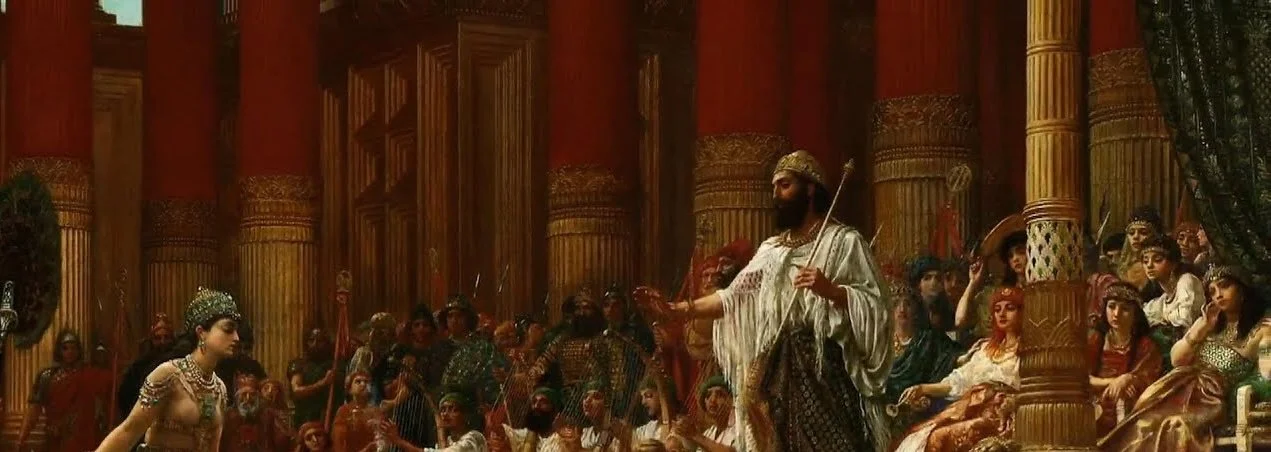
“1 When the queen of Sheba heard about the fame of Solomon and his relation to the name of the LORD, she came to test him with hard questions. 2 Arriving at Jerusalem with a very great caravan—with camels carrying spices, large quantities of gold, and precious stones—she came to Solomon and talked with him about all that she had on her mind. 3 Solomon answered all her questions; nothing was too hard for the king to explain to her. 4 When the queen of Sheba saw all
the wisdom of Solomon and the palace he had built, 5 the food on his table, the seating of his officials, the attending servants in their robes, his cupbearers, and the burnt offerings he made at the temple of the LORD, she was overwhelmed.
6 She said to the king, “The report I heard in my own country about your achievements and your wisdom is true. 7 But I did not believe these things until I came and saw with my own eyes. Indeed, not even half was told me; in wisdom and wealth you have far exceeded the report I heard. 8 How happy your men must be! How happy your officials, who continually stand before you and hear your wisdom! 9 Praise be to the LORD your God, who has delighted in you and placed you on the throne of Israel. Because of the LORD’s eternal love for Israel, He has made you king, to maintain justice and righteousness.”
10 And she gave the king 120 talents of gold, large quantities of spices, and precious stones. Never again were so many spices brought in as those the queen of Sheba gave to King Solomon. 11 (Hiram’s ships brought gold from Ophir; and from there they brought great cargoes of almugwood and precious stones. 12 The king used the almugwood to make supports for the temple of the LORD and for the royal palace, and to make harps and lyres for the musicians. So much almugwood has never been imported or seen since that day.) 13 King Solomon gave the queen of Sheba all she desired and asked for, besides what he had given her out of his royal bounty. Then she left and returned with her retinue to her own country.”
After graduating college, I backpacked across Europe with friends. We started in Vienna. Please bring up our first picture. This is Vindobona which was the Roman military camp located in what later became Vienna. What you see here are its remains. I thought that was amazing when I saw it—real ruins from the time of the Romans.
Later we went to Rome. Please bring up our next picture. This is Arch of Titus from about the same time as Vindobona. It commemorates the destruction of Jerusalem in 70 AD. You can see the soldiers carrying away a menorah. Please bring up our next picture. This is the Pantheon in Rome—a bit more glorious than Vindobona, huh? Let’s go back to that first picture. When I was in Vienna, I was amazed by just this one bit of Roman ruins. What a gift to see any remainder from that time. Let’s go to our last picture. That’s the forum in Rome. It would take a lifetime to do justice to all those; now imagine if they were still as pristine as the Pantheon.
That’s the experience of this passage. What the Queen of Sheba heard of Solomon was a bit like Vindobona—truly impressive until you saw Rome; rumors about Solomon were impressive until you met Solomon; he’s overwhelming like the forum in Rome and he points to something even more overwhelming. The best rumors about God don’t do Him justice; that’s the claim of this sermon.
We will see this in three points. First: the queen experiences. Second: the queen praises. Third: the queen exchanges. First, in verses 1-5, the queen experiences. Second, in verses 6-9, the queen praises. Third, in verses 10-13, the queen exchanges.
We see the rumor and reality in our first point: the queen experiences. Last week was overview of twenty years of building projects and ventures. It was the view from 30,000 feet. This week is ground level and experienced through the eyes of one woman—the queen of Sheba. She reigned in what is today either Yemen or Ethiopia. Either way, she came a long way to meet Solomon—perhaps 1,500 miles; verse 1, “When the queen of Sheba heard about the fame of Solomon and his relation to the name of the Lord, she came to test him with hard questions.”
That “testing him with hard questions” can make it sound as if she travelled months to ask Solomon, “why did the man throw the clock out the window?” It’s not. She didn’t take a break from ruling her kingdom to see if Solomon could handle The New York Times crossword puzzle. She didn’t come to see if she could come up with a riddle that would stump him.
She had questions regarding life, politics, and getting projects done; she wanted answers for living; that’s the end of verse 2, “she came to Solomon and talked with him about all that she had on her mind.” The queen of Sheba was wise enough to be able to formulate the questions which were really hers; that’s no small skill. She was wise enough, then, to think through her best answers until she realized she needed a wiser mind. All this tells us that she is someone with a fair bit of wisdom. She’s not unlike Solomon.
She’s heard “about the fame Solomon and,” as verse 1 continues, “his relation to the name of the Lord,” or “Solomon’s reputation with the Lord,” as the ISV puts it, or “Solomon’s fame connected with the name of” the Lord as the Holman puts it, or “the fame of Solomon concerning the name of the Lord,” as the ESV puts it. The Hebrew puts the “fame of Solomon” and “name of the Lord” together with a very flexible preposition which leads to a very open-ended translation. That’s also the thrust of this whole story—what is the connection between “the fame of Solomon” and “the name of the Lord”?
Everything awe-inspiring about Solomon comes from his connection with the name of the Lord. What matters about him is that he has God’s favor. The queen of Sheba realized that. Everything he touches seems to turn to gold not because of himself but because of the Lord. That’s why he’s so compelling. What, then, would be the most foolish move Solomon could make? Turn his back on the Lord and that’s what we’ll see him do.
What makes Jesus so compelling? He has the favor of the Lord. He is the Lord favoring himself. Everything he touches doesn’t turn to gold—it becomes new. Unlike with Solomon, none of this goes to Jesus’ head. Fascinatingly enough, God in the flesh is humbler than a mere mortal. That’s something for us mortals to ponder regarding whatever is impressive within us.
So we’ve seen that the queen of Sheba is a force with whom to be reckoned. She’s the sort of ruler you’d want; now we see Solomon run circles around her; verse 3, “Solomon answered all her questions; nothing was too hard for the king to explain to her.” The queen of Sheba had questions substantial enough to drive her to travel months for an answer and Solomon handled her questions like he was showing her how to replace a light bulb. That’s extreme wisdom.
Experiencing extreme wisdom is a rare treat; the queen of Sheba experienced it with Solomon’s answers and then in action; verse 4, “When the queen of Sheba saw all the wisdom of Solomon and the palace he had built, the food on his table, the seating of his officials, the attending servants in their robes, his cupbearers, and the burnt offerings he made at the temple of the Lord, she was overwhelmed.” Her speaking with Solomon would be like us reading the book of Proverbs. Her touring his home, workplace, and house of worship would be like us visiting a village in which Proverbs was put into action. It’s a good experience to hear Proverbs 17:6, “Children’s children are a crown to the aged, and parents are the pride of their children.” It’s something else to see it spring up spontaneously at a family gathering. Solomon’s home, workplace, and kingdom was wisdom in action. When the queen of Sheba experienced that, “she was overwhelmed,” as verse puts it.
That’s the experience in the gospels for anyone with eyes to see. The people were overwhelmed by Jesus—his words, his works, his wisdom in action. King Jesus was far better at this than King Solomon. The proof is in the followers. The king who followed Solomon ignored the wisdom of Proverbs and made a mess of his kingdom. The apostles who followed Jesus followed Jesus’ wisdom and we are told “When [their opponents] saw the courage of Peter and John and realized that they were unschooled, ordinary men, they were astonished and they took note that these men had been with Jesus.” Just being with Solomon was enough to overwhelm the queen of Sheba with his wisdom. Just being with Jesus, though, is enough to become wise yourself. That’s the experience. We see the response in our second point: the queen praises.
We don’t always choose our experiences in life. We do, however, choose our response. We continue to see the queen of Sheba’s wisdom in her response. She experiences Solomon’s glory; she could have been jealous; she could have felt shamed; she could have been bitter; instead she praised. She rejoiced with Solomon in his success and that is no small virtue; “the report I heard in my own country about your achievements and your wisdom is true. But I did not believe these things until I came and saw with my own eyes. Indeed, not even half was told me; in wisdom and wealth you have far exceeded the report I heard.”
She left home doubting whether Solomon would live up to the hype; she now knows that he far exceeds the hype. She was in awe of what he was doing; “How happy your men must be! How happy your officials, who continually stand before you and hear your wisdom!” That seems in conflict with what we studied last week with Solomon’s desires getting out of control. That is true and this passage is true. That’s how life works. You can say living in America right now is great and it is—plenty to eat, goods and services previous generations couldn’t imagine, entertainment and education at the touch of your fingertips. You can also say it’s a tremendous struggle to live in America right now—people struggling to buy their first home, the rising cost of health care, broken relationships, media echo chambers. “It was the best of times, it was the worst of times,” as Dickens put it and so everything we studied last week about Solomon’s out of control desires is true and “How happy your men must be! How happy your officials, who continually stand before you and hear your wisdom!” is true.
The queen of Sheba doesn’t see every angle but what she sees is legitimate and so she gives legitimate praise to Solomon and to his God; “Praise be to the Lord your God, who has delighted in you and placed you on the throne of Israel. Because of the Lord eternal love for Israel, He has made you king, to maintain justice and righteousness.” This praise for the Lord doesn’t necessarily mean that she came to know the Lord. Perhaps she did. Perhaps she reflected on what she saw and recognized that she would do well to walk in the Lord’s ways. Perhaps, though, she was behaving like a typical ancient and seeing the local gods’ hands behind events. We aren’t told enough to assess. The Lord knows enough to assess.
We are told enough, though, to recognize that she realizes more in this moment than most of the kings who sit on Solomon’s throne will. She recognizes that, “Because of the Lord’s eternal love for Israel, He has made you king, to maintain justice and righteousness.” Rehoboam won’t recognize that. Asa will. Ahaz won’t. Hezekiah will. Manasseh won’t. This Gentile queen saw that the king ruled by the leave of the King of Kings.
The queen of Sheba travelled months to experience the king and was enough to recognize the genuine article. Jesus traveled from heaven to earth but few in his day could recognize he was more genuine than the genuine article. That’s why he said, “The Queen of the South will rise at the judgment with this generation and condemn it; for she came from the ends of the earth to listen to Solomon’s wisdom, and now something greater than Solomon is here.” Do you recognize that? How far would go to hear Jesus?
Think back to pictures of Rome. You don’t want to be the sort of person who can stand in the Pantheon and remain unimpressed. You don’t want to be the sort of person who can meet Solomon and remain unimpressed. You certainly don’t want to be the sort of person who can meet God in the flesh and remain unmoved. There is a place for people who can meet God and remain unmoved. It’s a place for the unrepentantly proud. It’s a place for the unrepentantly foolish. If the best all experiences—God Himself—isn’t enough for you, then you will get what could you satisfy you eternally, which is nothing. You don’t want that.
The queen of Sheba could recognize that something beyond her understanding was underway. In Solomon’s Israel we see part of the fulfillment of the promise given to Abraham—that his seed would be a blessing to the world. We see the role of Israel done right—being a light to the nations. Where it will go wrong—as we will see—is that Solomon begins to think that he himself is the light. “If everything I touch turns to gold, I must be the magic.” It’s as Os Guinness puts it in his wonderful book The Call, ‘to be called is to hear God whisper three things to you in a hundred intimate ways—“you are chosen; you are gifted; you are special.” Let those three things sink in for longer than the first precious moments and you will inevitably hear another voice, honeyed and smooth: “yes, you really are chosen… gifted… special.” All too soon, if you are anything like most of us, you will find yourself saying in response to the devil’s echo of God—to yourself, of course, never out loud: “I’m chosen. I’m gifted. I must really be special.” And before you know it, the wonder of calling has grown into the horror of conceit.’ That’s what seems to happen Solomon. He forgets that whatever favor and giftings he has is only of the Lord. He just happens to be chosen because the Lord wanted it that way. It’s not about him. It’s about the Lord. That’s the light of the nations—the Lord, not Solomon. Let’s not forget that whatever giftings God gives us. We’re not done yet, though. Let’s bid farewell to the queen of Sheba in our final point: the queen exchanges.
The queen of Sheba had other reasons for her visit; she almost certainly was interested in trade with Solomon; that’s verse 10, “And she gave the king 120 talents of gold, large quantities of spices, and precious stones,” and the camels carrying them up in verse 3. Given its geographical positioning, Israel was a natural trading route and partner. She wanted in on the golden age of Israel. A rising tide lifts all boats and she wanted the boat of her people lifted by the rising tide so she established trading relations.
That’s wise leadership. The fact that the queen of Sheba came to secure a trading alliance, though, doesn’t take anything away from her interest in wisdom. There are powerful currents of thought in our culture which assume that people only have one reason for everything or anything they do. People who fall into this error are forever trying to see through everyone else. Once they find any sin, or even any self-interest, they think they’ve figured you out. It’s a small and sad way to think and live. People don’t make decisions on one factor alone. We make decisions—like leaving Sheba for Jerusalem, like moving to Ludington, like becoming a nurse—for a constellation of reasons: desire, boredom, the good of our children, convenience, challenge, worry, wisdom, foolishness all mixed together; we are complicated people and so the queen of Sheba came for many reasons; this point just points out that trade was just one of them.
The author no sooner tells us about this trading than he returns to Solomon’s commercial arrangement with Hiram; “Hiram’s ships brought gold from Ophir and from there they brought great cargoes of almugwood and precious stones.” This reminder of Hiram alongside the queen of Sheba shows everything seeming to come up in Solomon’s favor.
That’s the importance of the almugwood; it seems to be a rare and precious timber of the day—a bit like mahogany, teak, or Australian cypress. The message is that this is the best—the best was used for the temple and for the musical instruments; commerce, civilization, culture—so much of what we enjoy in this nation was underway their; it was a golden age; “so much almugwood has never been imported or seen since that day.”
Life was so good that Solomon let the queen of Sheba have whatever she wants. He was generous; “King Solomon gave the queen of Sheba all she desired and asked for,” and there’s that word “desire” yet again. It’s an ambiguous word. Is it good? Is it bad? Is it both?
Solomon seems as openhanded with the queen of Sheba as he was manipulative with Hiram last week. This week’s passage is as encouraging as last week’s was cautionary. Solomon’s reign was a mixture—best of times and the worst of times. Solomon was a mixture. That’s how it is for us in this fallen world. Given all that we’re learning about Solomon, how would you judge him? We ought to be very happy that we are not the final judge of Solomon. We ought to be very happy that we are not the final judge of anyone including ourselves.
That role is given to King Jesus who exceeds Solomon as Solomon exceeds the rumors about him. If King Solomon was the real deal, King Jesus is realer than real. Do you know that? Do you know him? That’s the way to become a bit more genuine yourself. Amen.