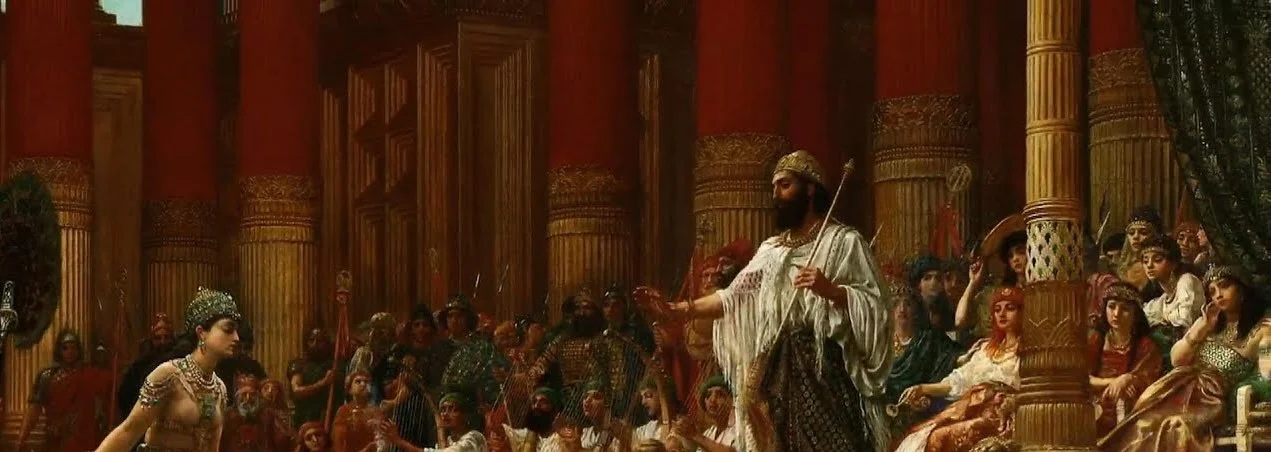
“14 The weight of the gold that Solomon received yearly was 666 talents, 15 not including the revenues from merchants and traders and from all the Arabian kings and the governors of the land.
16 King Solomon made two hundred large shields of hammered gold; six hundred bekas of gold went into each shield. 17 He also made three hundred small shields of hammered gold, with three minas of gold in each shield. The king put them in the Palace of the Forest of Lebanon.
18 Then the king made a great throne inlaid with ivory and overlaid with fine gold. 19 The throne had six steps, and its back had a rounded top. On both sides of the seat were armrests, with a lion standing beside each of them. 20 Twelve lions stood on the six steps, one at either end of each step. Nothing like it had ever been made for any other kingdom.
21 All King Solomon’s goblets were gold, and all the household articles in the Palace of the Forest of Lebanon were pure gold. Nothing was made of silver, because silver was considered of little value in Solomon’s days. 22 The king had a fleet of trading ships at sea along with the ships of Hiram. Once every three years it returned, carrying gold, silver and ivory, and apes and baboons.
23 King Solomon was greater in riches and wisdom than all the other kings of the earth. 24 The whole world sought audience with Solomon to hear the wisdom God had put in his heart. 25 Year after year, everyone who came brought a gift—articles of silver and gold, robes, weapons and spices, and horses and mules.
26 Solomon accumulated chariots and horses; he had fourteen hundred chariots and twelve thousand horses, which he kept in the chariot cities and also with him in Jerusalem. 27 The king made silver as common in Jerusalem as stones, and cedar as plentiful as sycamore-fig trees in the foothills. 28 Solomon’s horses were imported from Egypt and from Kue—the royal merchants purchased them from Kue. 29 They imported a chariot from Egypt for six hundred shekels of silver, and a horse for a hundred and fifty. They also exported them to all the kings of the Hittites and of the Arameans.”
“Oh dear Lord, you made many, many poor people. I realize, of course, that it’s no shame to be poor. But it’s no great honor either. So what would have been so terrible if I had a small fortune?” That’s the milkman Tevye, the main character of The Fiddler on the Roof.
He imagines what it would like to be wealthy—for himself and his sore body, for his tired wife. He then considers the community; ‘The most important men in town would come to fawn on me. They will ask me to advise them like Solomon the wise. “If you please, Reb Tevye...” “Pardon me, Reb Tevye...” Posing problems that would cross a rabbi’s eyes…’ Then Tevye realizes that he wouldn’t know how to handle all the questions they’d bring but he has an answer for that too; “And it won’t make one bit of difference if I answer right or wrong. When you’re rich, they think you really know…”
Solomon the wise is rich. Does he really know? That’s what we’ll consider this evening. “Lord, who made the lion and the lamb you decreed I should be what I am. Would it spoil some vast eternal plan if I were a wealthy man?” That’s Tevye’s question; the answer comes from Paul, “the love of money is the root of all kinds of evil.” It’s the love of money that’s the root of all kinds of evil; that’s the claim of this sermon.
We will study this in two points. First: the golden age. Second: a worldwide wonder. First, in verses 14-22, the golden age. Second, in verses 23-29, a worldwide wonder.
We see the gold of wealth in our first point: the golden age. A number of times now we’ve referred to Solomon’s reign as the golden age of Israel. He lived in the peace won by his father David. The surrounding nations were relatively weak which gave Israel an opportunity to expand. That’s a golden age; there was also the gold of this golden age; verse 1, “The weight of the gold that Solomon received yearly was 666 talents, not including the revenues from merchants and traders and from all the Arabian kings and the governors of the land.”
That’s literal tons of gold coming in every year not including the revenue of the sort of trade deals that we studied last week. It’s a bewildering amount of gold. It also may be an ominous amount. The number 666 likely jumped out to some of you. It is the number of the beast in Revelation, the number of a man—a man in defiance to God. The author of 1 Kings, however, does not have the book of Revelation in mind. Revelation was written long after 1 Kings. John knew his Old Testament, though; no New Testament book deals more with the Old Testament than Revelation, and so it is very possible that the 666 in Revelation comes, in part, from the absurd amount of gold Solomon had flowing in every year. G.K Beale, who for my gold, has the best commentary on Revelation writes, “The 666 talents are mentioned immediately after Solomon has reached the peak of his kingship. After telling of such greatness, 1 Kings immediately tells how Solomon broke a series of God’s laws…” So John, looking back, may see the beastly attitude in Solomon thinking he can stand alone given all his gold. That is one of the dangers of money. It makes you think you can stand alone. It makes you think you don’t need help. It makes you think you really know.
It’s all over this passage. Gold is all over this passage; we see that with the shields; verse 16, “King Solomon made two hundred large shields of hammered gold; six hundred bekas of gold went into each shield. He also made three hundred small shields of hammered gold, with three minas of gold in each shield. The king put them in the Palace of the Forest of Lebanon.” These shields were useless for battle. They were probably used for ceremonies—like certain swords in Europe. They were intimidating. If you could bring up our photo.
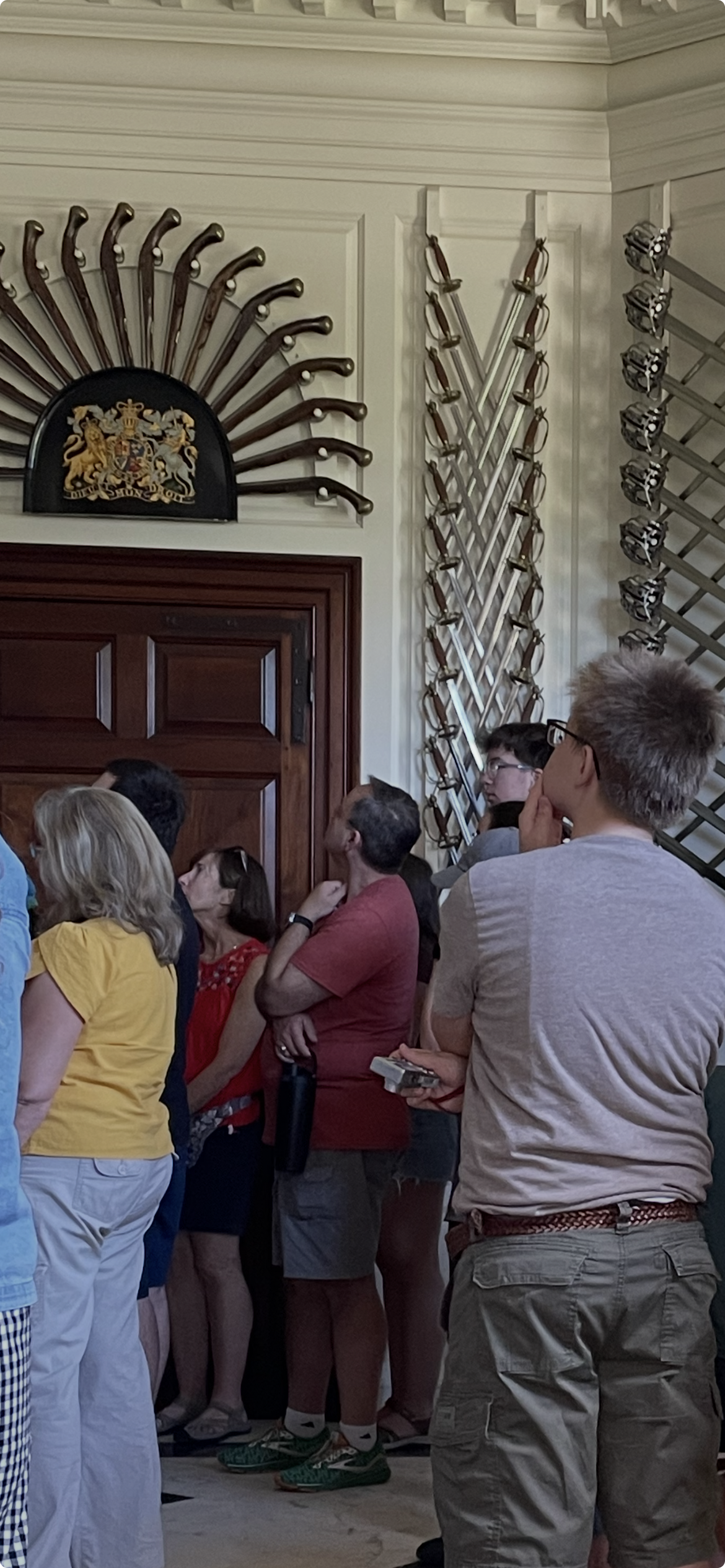
This is from the mansion where the British governors in Virginia lived before the Revolutionary War. All those weapons let you know to mind your place. All those gold shields in Solomon’s palace let you know to mind your place. They were also likely a way to put money away where you couldn’t easily get at it—like putting money in a CD. These shields would later be used as money when money was tight. That’s when the people would look back on Solomon’s reign as a golden age. The good old days can come back to haunt us with how good they were and how much worse it is now. We don’t know what the present will mean when it becomes the past—for ill and good.
We see past decisions of Solomon paying off in the present for Solomon with the construction of his throne; “the king made a great throne inlaid with ivory and overlaid with fine gold.” This ivory came from his shipping agreements with Hiram. The throne had six steps up to it and so if you went to speak with the king he might be sitting six feet above you while you negotiated. That’s a power move. The shields surrounding are a power move. The twelve carved lions are a power move.
Solomon is not to be intimidated. He is intimidating. Is that good? In some ways. Solomon certainly dealt with some difficult people during his reign. A show of power isn’t always bad, but the power moves do seem rampant. Intimidation is becoming a way of life for Solomon. Something has been lost and you can see it when you remember how he started; “Now, Lord my God, you have made your servant king in place of my father David. But I am only a little child and do not know how to carry out my duty…” That dependance is being lost and dependence upon God is part and parcel of faith.
Solomon thinks he’s enough of on his own; he has enough; he has so much that all his “goblets were gold, and all the household articles in the Palace of the Forest of Lebanon were pure gold,” as verse 21 puts it. This excessiveness calls to mind a bit by Steve Martin after he hit it big. He said, “I love money. I love everything about it. I bought some pretty good stuff. Got me a $300 pair of socks. Got a fur sink. An electric dog polisher. A gasoline powered turtleneck sweater. And, of course, I bought some dumb stuff, too.” Solomon enough money to get a lot of dumb stuff. The people in exile reading these words could see that. They were slaves with nothing thanks, in part, to Israel falling in love with money; the love of money is at the root of all kinds of trouble.
You see the focus of money from a different angle with the silver; verse 21, “Nothing was made of silver, because silver was considered of little value in Solomon’s days.” That’s like being embarrassed to be seen with a wad of $50 bills because they’re not $100 bills. It’s like throwing away your iPhone 17 because it’s not an 18 and then throwing away your 18 because it’s not an 18 Pro and then throwing that away because it’s not the iPhone 18 Pro Max. Silver was like the iPhone 18 Pro that wasn’t an iPhone 18 Pro Max; don’t worry, though, Solomon still got his hands on silver too.
Is that bad? It’s dangerous. It was prohibited for the king. The king doesn’t receive too many direct commands in the law of Moses but he is told that, “He must not accumulate large amounts of silver and gold. When he takes the throne of his kingdom, he is to write for himself on a scroll a copy of this law… It is to be with him, and he is to read it all the days of his life so that he may learn to revere the Lord his God… and not consider himself better than his fellow Israelites.” Solomon accumulates gold and silver, turns from the law, and considers himself better. The Lord knows why He commands what He commands. We are to trust that He knows why and follow His commands even when we don’t understand why. Solomon would have been wiser to do that.
He wouldn’t have been as intimidating, though. He wouldn’t have seemed as dominant, but is that what matters? When the King of Kings came did he govern by gold? Did he summon the people to speak to him as he sat six feet above them surrounded by armory and gold? No, king Jesus said, “Foxes have dens and birds have nests, but the Son of Man has no place to lay his head.” “You know the grace of our Lord Jesus Christ, that though he was rich, yet for your sake he became poor, so that you through his poverty might become rich.” Which king impresses you?
King Solmon impressed many people in his day; after all he “had a fleet of trading ships at sea along with the ships of Hiram. Once every three years it returned, carrying gold, silver and ivory, and apes and baboons.” This is one of the more exotic verses in the Bible. These ships would run along the coasts for three years going to possibly Spain and Africa. The Hebrew includes the word Tarshish where which is where Jonah and Paul both tried to go for different reasons. It’s the edge of the world in that day. That’s where Solomon’s ships went and they came back with gold, apes, and baboons. It’s a different day and age from two generations before when the Philistines wouldn’t let the Israelites have blacksmiths lest they make swords. It would all be lost, though, due to sin. Sin will take everything from you if you let it. Don’t let it. Don’t dabble in it. Don’t give it any quarter. “Kill sin or it will be killing you,” as Owen put it. This was Israel’s golden age but it’s just that all that is not gold—sometimes not even all that is gold is truly golden as we continue to see in our second point: a worldwide wonder.
This chapter of 1 Kings is designed to impress. It offers “one last picture of Solomon at his best,” as Hubbard put it. “King Solomon was greater in riches and wisdom than all the other kings of the earth. The whole world sought audience with Solomon to hear the wisdom God had put in his heart,” as verses 23-24 put it.
We’ve noted some of the dangers of this, but this chapter overall, is a crown of glory on Solomon’s head. It’s a glowing report about him and his splendor. He’s better than the best rumors about him as we saw last week. It is many ways good news that there is a good king in Israel. Yes, there’s trouble, but so it has always gone for the world’s richest man—just read the varied and complicated views on Elon Musk, or Carnegie, or Rockefeller. This chapter, in general, highlights the wonder of the wealth.
Wealth, in and of itself, is not bad. It’s also not unimportant. Getting that wrong can make plenty go wrong in your life. Wealth is complicated and you can’t avoid it’s complications by shunning it. Charles Schultz, the creator of Peanuts, thought his net worth had grown, in his words, “embarrassingly large.” He told a Christian magazine, “no one can be worth all this money.” He also said, “you can’t help it. You’re just in a business where there are a lot of people who want the drawings and it makes money, and that’s all. But it makes money for a lot of other people, too…” “I cannot help that the comic strip brings in a good deal of money. I do not draw the comic strip to make money. I draw it because it is the one thing which I feel I do best, and I can see no reason why I should give up drawing the comic strip in order to go to the mission field… and become a terrible missionary… merely… [to] seem to be closer to spiritual things.” Schultz, like his characters, is complicated, and wealth is complicated. That’s why the claim of this sermon is not “money is the root of all kinds of evil” but “the love of money is the root of all kinds of evil.” “The Bible shows the same ambivalent attitude toward riches everywhere that it shows in the Solomon narrative,” as Oswalt put it.
Wealth is dangerous not because it’s bad but because it can bring so much good that you start to treat it as a master. The need is to learn to master yourself and self-control is no easy virtue to learn. That’s why the answer to Tevye’s question, “Lord, who made the lion and the lamb you decreed I should be what I am. Would it spoil some vast eternal plan if I were a wealthy man?” for some of us may be—yes, it would spoil His vast eternal plan for you if you were wealthy and for others it wouldn’t. The point in wealth and in want and in ordinariness is to serve the right master and “no one can serve both God and money,” as one wiser than Solomon tells us.
We see Solomon set up as a master in verse 25, “Year after year, everyone who came brought a gift—articles of silver and gold, robes, weapons and spices, and horses and mules.” Why bring those gifts? Why bring robes and spices and mules and gold when you stand before this king who has everything? ‘Solomon’s subjects did not bring valuable and exotic “gifts” because they were awed, but because they owed,’ as one commentator explains—‘owed to the dominant and insistent power in the region.’ Solomon might not have demanded these gifts but they were demanded by the situation and these visitors, as well as Solomon, were caught up in this process.
The horses near the end of that gift list are prioritized next and last in this catalogue of wealth. Solomon traded in them as well in chariots—the superweapon of his day. He is a go-between—trafficking in arms and making money. He’s unwittingly arming his future enemies. 1 Kings is written looking back and can see that Solomon didn’t need the money from trading in weapons and that these very weapons were used against his people. This is not wise long-term planning. You are left with the question as to whether Solomon is still the same king of chapter 3—“give Your servant a discerning heart to govern Your people and to distinguish between right and wrong. For who is able to govern this great people of Yours?”
So be thankful, careful, responsible, and humble regarding whatever God gives you. Gold is mentioned at least ten times in today’s passage and what is the passage entitled by the NIV? It’s not Israel’s Splendor. It’s Solomon’s Splendor. It’s Solomon’s gold; “The weight of the gold that Solomon received yearly was 666 talents.” Something has gone awry. The king isn’t supposed to be above the people. He is supposed to be the servant of the Lord for the sake of the people. Israel, however, has become the Solomon show. That’s different from King Jesus. “The son of man came not to be served but to serve and to give his life as a ransom for many.” Which king are you following? Which king are you imitating with whatever power and wealth you have?
In Solomon’s day the wealth of the nations came to Jerusalem. In a vision on the far other side of exile, Isaiah saw the wealth of the nations coming again; “you will look and be radiant, your heart will throb and swell with joy; the wealth on the seas will be brought to you, to you the riches of the nations will come.” So, it seems, we ought not denigrate this wealth. We ought to look forward to a new golden age. The book of Revelation does saying of the new Jerusalem, “ The city does not need the sun or the moon to shine on it, for the glory of God gives it light, and the Lamb is its lamp. The nations will walk by its light, and the kings of the earth will bring their splendor into it.”
It will be different, though. Unlike Solomon, the Lord won’t parade His wealth. His golden age isn’t about impressive others lining the walls of his palaces with shields to intimate. He puts up whatever golden things we bring Him—like Handel’s Messiah, your best efforts with your children, a cup of cold water given to someone who is thirty—and He lines His walls like a parent putting up a child’s art. “She made this for me.” “That’s a picture of him and me.” “That’s a song about him and me.” That’s true wealth. That’s what you can bring to God and it will be on God’s wall forever in His kingdom which will make Solomon’s kingdom seem like stones before gold. Amen.