“1 The Lord said to Moses and Aaron in Egypt, 2 “This month is to be for you the first month, the first month of your year. 3 Tell the whole community of Israel that on the tenth day of this month each man is to take a lamb for his family, one for each household. 4 If any household is too small for a whole lamb, they must share one with their nearest neighbor, having taken into account the number of people there are. You are to determine the amount of lamb needed in accordance with what each person will eat. 5 The animals you choose must be year-old males without defect, and you may take them from the sheep or the goats. 6 Take care of them until the fourteenth day of the month, when all the people of the community of Israel must slaughter them at twilight. 7 Then they are to take some of the blood and put it on the sides and tops of the doorframes of the houses where they eat the lambs. 8 That same night they are to eat the meat roasted over the fire, along with bitter herbs, and bread made without yeast. 9 Do not eat the meat raw or cooked in water, but roast it over the fire—head, legs and inner parts. 10 Do not leave any of it till morning; if some is left till morning, you must burn it. 11 This is how you are to eat it: with your cloak tucked into your belt, your sandals on your feet and your staff in your hand. Eat it in haste; it is the Lord’s Passover.
12 “On that same night I will pass through Egypt and strike down every firstborn—both men and animals—and I will bring judgment on all the gods of Egypt. I am the Lord. 13 The blood will be a sign for you on the houses where you are; and when I see the blood, I will pass over you. No destructive plague will touch you when I strike Egypt.
14 “This is a day you are to commemorate; for the generations to come you shall celebrate it as a festival to the Lord—a lasting ordinance. 15 For seven days you are to eat bread made without yeast. On the first day remove the yeast from your houses, for whoever eats anything with yeast in it from the first day through the seventh must be cut off from Israel. 16 On the first day hold a sacred assembly, and another one on the seventh day. Do no work at all on these days, except to prepare food for everyone to eat—that is all you may do.
17 “Celebrate the Feast of Unleavened Bread, because it was on this very day that I brought your divisions out of Egypt. Celebrate this day as a lasting ordinance for the generations to come. 18 In the first month you are to eat bread made without yeast, from the evening of the fourteenth day until the evening of the twenty-first day. 19 For seven days no yeast is to be found in your houses. And whoever eats anything with yeast in it must be cut off from the community of Israel, whether he is an alien or native-born. 20 Eat nothing made with yeast. Wherever you live, you must eat unleavened bread.”
21 Then Moses summoned all the elders of Israel and said to them, “Go at once and select the animals for your families and slaughter the Passover lamb. 22 Take a bunch of hyssop, dip it into the blood in the basin and put some of the blood on the top and on both sides of the doorframe. Not one of you shall go out the door of his house until morning. 23 When the Lord goes through the land to strike down the Egyptians, he will see the blood on the top and sides of the doorframe and will pass over that doorway, and he will not permit the destroyer to enter your houses and strike you down.
24 “Obey these instructions as a lasting ordinance for you and your descendants. 25 When you enter the land that the Lord will give you as he promised, observe this ceremony. 26 And when your children ask you, ‘What does this ceremony mean to you?’ 27 then tell them, ‘It is the Passover sacrifice to the Lord, who passed over the houses of the Israelites in Egypt and spared our homes when he struck down the Egyptians.’” Then the people bowed down and worshiped. 28 The Israelites did just what the LORD commanded Moses and Aaron.”
Rituals helps us remember. This month we have a nationwide ritual designed to help us remember the gifts for which we are thankful—Thanksgiving. Next month we have a ritual designed to help us remember the incarnation of the Son of God—Christmas. At the turn of the subsequent month we have a ritual designed to help us remember the fleeting nature of time and consider new beginnings—New Year’s Day.
We are creatures of ritual. God made us this way. He made us to get emotional watching the fireworks on the fourth of July remembering those who have fought for our freedoms. He made us to reflect on the year past and the year ahead on our birthday and anniversary. He made time and made us to consider our passage through time. He gave us rituals along this journey.
You and I working our way through time. Sometimes we reflect on it. Often we don’t. Life is better if we do reflect on it which is why God gives the sort of rituals we see in this passage. He gives them so we will remember Him and that’s what’s most needful all the time. We remember God’s works through ritual. That’s the claim of this sermon.
We will study this in three points. First: the Passover. Second: the feast of Unleavened Bread. Third: carrying it out. First, in verses 1-13, the Passover. Second, in verses 14-20, the feast of unleavened bread. Third, in verses 21-28, carrying it out.
We see the meaning behind the ritual in our first point: the Passover. After chapters of frogs, hail, and darkness, we turn to rituals. That might seem a bit boring, but a written of description of fireworks of the fourth of July might seem boring too. These rituals we will study were designed to help the people remember the frogs, hail, and darkness. They were designed to help them remember the power of salvation. They needed that. We need that. Amid our confusing lives, we often forget that God is mighty to save.
God reminds us. You see that in the calendar reset; verse 2, “This month is to be for you the first month, the first month of your year.” God’s people were to mark months from their independence from Egypt so they would always remember God. We do the same with years. 2025 is marked from the birth of Christ. Every time you write a check you are reminded of the incarnation. Every time they recalled the month, they were reminded of the Exodus. We need these reminders because we forget that this same God is still at work in our church, our childrearing, and our aging bodies.
This calendar reset was a new beginning. The people were, for the first time in Scripture, called a “congregation.” Our translation of verse 3 uses the word “community.” The ESV, King James, and the more literal translations use the word “congregation.” The Hebrews were being set apart. This is why we call ourselves a congregation too—we are a gathering set apart.
They were to share the Passover meal as a congregation as families. If your family was too small to eat a whole lamb by itself, you would get together with neighbors—maybe this meant nearby family members; maybe this literally meant the person next door. Either way, the point was that everyone ate lamb, and each lamb must be eaten completely. Everyone ate lamb together because they were saved together. Each lamb had to be eaten completely for the same reason you leave Christmas presents unopened after Christmas.
The Lord left it up to the people to decide how to divvy up each lamb. “You are to determine the amount of lamb needed in accordance with what each person will eat.” That’s a principle—eat each lamb completely—executed with wisdom—“determine the amount of lamb needed in accordance with what each person will eat.” Principles executed with wisdom is still a safe way to avoid legalism and lawlessness in a congregation. Such instructions urge us to be neither rigid nor mindless.
The Passover lamb was to be without defect. The Lord called the people to sacrifice their best. The Lord Himself would. We are redeemed from our sin through, “the precious blood of Christ, a lamb without blemish or defect,” as Peter put it. God offered His best.
The Lord gave these Passover commands to prepare the people for Jesus. Now Passover meant a great deal to them before Jesus came but it meant even more after he came. I hope there is a great deal about Jesus that means a great deal to you today. Please know that he will mean even more when he returns. That’s how it works throughout Scripture—some now, all later.
The congregation was instructed to begin slaughtering these lambs at twilight. They were to butcher them after the sun had gone down but before it had gotten dark. They were to slaughter them on the fourteenth day of the lunar calendar meaning that it would be a full moon. The Lord wanted them to have enough light by which to slaughter, spread blood, and roast and distribute pieces of lamb. The Lord has good reasons for all His commands if you take the time to consider why He’s asking what He’s asking.
The congregation was instructed to smear the lamb’s blood on the sides and tops of their doorframes. They were to smear this blood before they ate because the meaning of the meal was more important than the meal itself. The angel of death would see the blood and pass over—that’s why it’s called the Passover. The blood was likely applied to the doorframe because that’s the most vulnerable part of the house. We lock our doors at night for this same reason.
This blood was a statement. It was, as Doug Stuart puts it, a demonstration of “confidence in God’s power to kill as well as rescue.” It was a sign of trust that the Lord would judge Pharaoh for refusing to let them go. It was a sign of trust that the Lord would spare those with faith because of their trust shown in sacrifice. The cross is our sign of those same truths. It reminds us that God holds unrepentant sin accountable and that God will spare us for the sake of our trust in the sacrifice.
The instructions about how to eat this meal were highly symbolic as our are rituals. The people ate the meal with bitter herbs, probably as a reminder of their bitter service. The root of the word for “bitter” here is the same as what you find in the description of their slavery; “They made their lives bitter with harsh labor.” The people ate it quickly roasting the lamb whole rather than cutting it up or boiling it. The dressed like they were taking a journey with sandals on and belt tucked in. That’s the opposite of, “take of your shoes… stay a while.” Everything about this meal screamed, “hurry!”
The meal was a sign they were leaving. It’s hard to leave, though, even when you want to leave. These people had memories in Egypt. Their children were born there. They had made a life there and even though it was a hard life, it was the life they knew. There is pain in saying, “goodbye.” The symbolism of this haste was a reminder that there was no turning back.
These rituals drew more distinctions between the Hebrews and the Egyptians. To this point the Lord has drawn the distinctions Himself sending hail and locusts and darkness on Egypt but not Goshen. Now the people are to draw a distinction. God often does that. He acts and then invites us to act like Him. The people are to draw a distinction by way of blood—“The blood will be a sign for you on the houses where you are; and when I see the blood, I will pass over you.” They were to participate in the grace that saved them as are we.
This ritual is part of the last plague—the plague of death. It is judgment. It is, as verse 12 puts it, “judgment on all the gods of Egypt.” The Hebrews had doubtlessly picked up reverence for the Egyptian gods over the past 400 years. Think about the reverence for the LGBTQ movement in our own culture. Companies are very concerned about being perceived as homophobic. You can see the shift in just the past 10 years. Imagine the shift over 400 years of living in Egyptian idolatry rather than American idolatry.
The Passover—this ritual of death and deliverance from death—was an attack on the Egyptian god Osiris. Please bring up our slide.
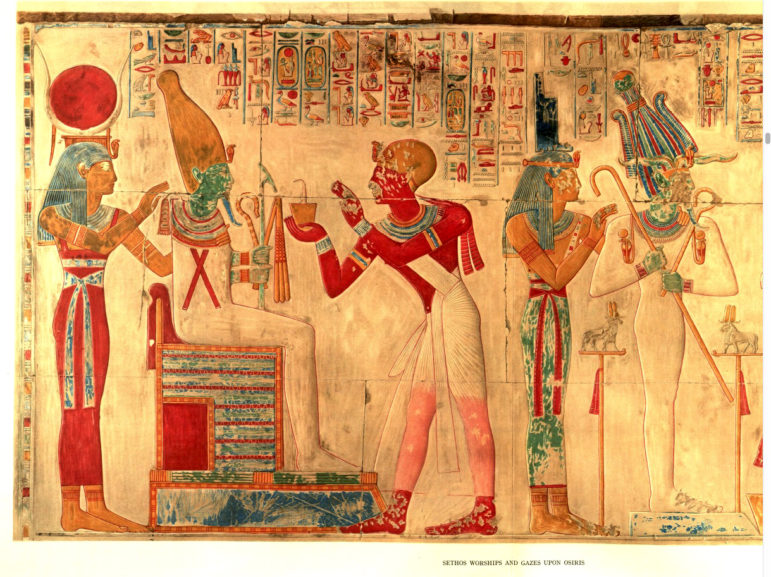
This is Osiris—god of the dead, god of new life. It wouldn’t be the god of the dead taking the lives of the firstborn that night. It wouldn’t be Osiris sparing the lives of the firstborns with blood on their doorframes. Osiris couldn’t kill and he couldn’t save from death. He is nothing. The Lord is everything.
These plagues show His superiority over the gods of Egypt. They reveal that what we fear and trust in is ultimately powerless. That’s the glory war. This glory war between the Lord and the world isn’t over. The Lord continues to undercut our trust in every rival to show that He alone is in charge. “What’s your only comfort in life and in death? That I am not my own but belong body and soul in life and in death to my faithful savior Jesus Christ.”
We see more of how God uses ritual to help us reflect rightly in our second point: the feast of Unleavened Bread. This weeklong ritual of eating bread without yeast started the night before the Passover meal. So, it included the Passover meal and extended beyond it. It’s a bit like how you are still eating stuffing five days after Thanksgiving; you see this in verse 18, “In the first month you are to eat bread made without yeast, from the evening of the fourteenth day until the evening of the twenty-first day. For seven days no yeast is to be found in your houses.” The word “yeast” appears seven times in seven verses. Observant Jews still do a ritual search for yeast at the beginning of this feast. This lack of yeast was another sign of haste. The people needed to be ready to leave at any moment. They didn’t even have time to wait for their bread to rise.
The congregation was instructed to eat this meal annually. That’s how rituals work. The repetition brings meaning. Every Thanksgiving we have cranberries. We have cranberries consistently because my mom’s father loved cranberries. I ate them for years without liking them because my grandpa liked them and I liked my grandpa. Now I like cranberries. When I take those cranberries at Thanksgiving, I think about him. I imagine that each of us have experiences like that with annual feasts and other repeated rituals. They make meaning and are reminders. Eating this unleavened bread worked its way into the people. We grow to appreciate new parts of it.
Consider that particularly if you are young because younger people tend to dismiss rituals while older people appreciate them. When I was younger, we would have family reunions. I didn’t understand the point other than recognizing that these were people I had never met before but was not supposed to marry. As you get older, you see that these people are like you whether you like it or not or they like it or not and there is a lot to learn there.
Annual rituals are important. You see how important in the fact that anyone who refused to participate was, in the words of verses 15 and 19, “to be cut off from Israel.” Being cut off is not a minor matter. It’s also not a consequence for minor infractions. We get so anxious with these passages that we miss the point. The point is the heart. What kind of a heart would refuse to celebrate salvation? We will study that tonight. Hearts that refuse to celebrate that salvation do not belong to the Lord. That’s what’s going on here.
We do the same with the Lord’s Supper. We warn people against eating the bread or drinking the cup of the Lord in an unworthy manner. It's not about not dropping the piece of bread. It’s about the heart. Being cut off is a result of having a heart that doesn’t want to participate in salvation—salvation from Egypt, salvation from sin. If you have that sort of heart, ask God to change it. His unearnable grace is the only way.
These rituals are designed to help us participate in the grace that saves us; verse 17 says this feast of Unleavened Bread commemorates the day, “I brought your divisions out of Egypt.” This is military language. It’s translated in other versions as the day I brought “your brigades out of Egypt”, or “your forces out of Egypt,” or “your armies out of Egypt.” The language is a bit humorous in that it portrays these people as an army who would do none of the fighting. The Lord is the only warrior. That’s what we’ve seen in the plagues. That’s what we’ll see at the Red Sea. “The Lord will fight for you; you need only to be still.” That’s what we see at the cross. Who is the hero? Make sure it’s the Lord.
Our role is to trust this hero and rituals are acts of trust; that’s our final point: carrying it out. Moses instructed the people to carry out these commands. He told them to cover their doorframes with blood and then stay inside. “Not one of you shall go out the door of his house until morning,” as verse 22 puts it. In other words, don’t leave the safety of salvation. Noah was not to leave the ark. The people were not to leave the blood covered doorways on the night of the Passover. We are not to leave the body of Christ, the church. This is not a new message. The Bible says the same principles over and over again in different ways so that we get the point.
As the people carried out this Passover ritual, they got the point; verse 23, “When the Lord goes through the land to strike down the Egyptians, He will see the blood on the top and sides of the doorframe and will pass over that doorway, and He will not permit the destroyer to enter your houses and strike you down.” The Lord would pour out wrath and mercy simultaneously. He was the One striking and the One not permitting His people to go out lest they be struck. He’s the One pouring out wrath for sin and He’s the One sheltering people from wrath by means of blood. It’s God doing both. That’s the Passover. That’s the cross.
I trust you are seeing that our rituals aren’t all that different. I trust you are seeing that because people will ask you about rituals. “Why is it we have turkey?” “Why fireworks?” Rituals, by their nature, invite questions. Moses assumes that. He assumes, in verse 26, that little children will ask, “What does this ceremony mean to you?” Rituals are to be followed, but never blindly. Ask questions. Answer questions. These are the keys to learning. Children help adults with that because they are still earnest enough to believe rituals must mean something. If you’re an adult, it’s worth considering if that’s something you’ve lost. If you have children in the home, be thankful for the question after question coming your way. Sometimes we adult grow old in ways we were never meant to and must remember how often Jesus held up children as models to emulate.
Here at the first Passover the people got ritual right; that’s the end of verse 27, “Then the people bowed down and worshiped. The Israelites did just what the Lord commanded Moses and Aaron.” Worship is the culmination of God’s rituals because it’s about us and Him and that’s how you know you are actually interacting with God—you worship.
It is remarkable how interested God is in relationship with people like us. He is willing to send ten plagues to secure one. He was willing to take on flesh and die on a cross to secure one. The fact that He takes such pains doesn’t say much about how remarkable we must be. It says a great deal about how remarkable He is. That’s the depth of ritual—be it the Passover, the Lord’s Supper, baptism, a birthday. Connect it to God and you get the point. Miss God and you miss the point. Let’s get the point. Amen.