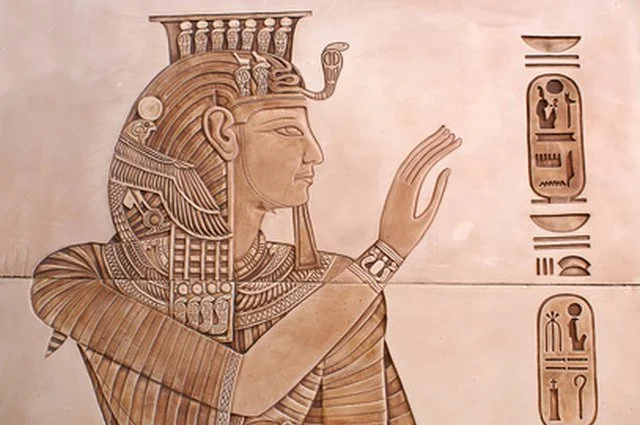
“29 At midnight the Lord struck down all the firstborn in Egypt, from the firstborn of Pharaoh, who sat on the throne, to the firstborn of the prisoner, who was in the dungeon, and the firstborn of all the livestock as well. 30 Pharaoh and all his officials and all the Egyptians got up during the night, and there was loud wailing in Egypt, for there was not a house without someone dead.
31 During the night Pharaoh summoned Moses and Aaron and said, “Up! Leave my people, you and the Israelites! Go, worship the Lord as you have requested. 32 Take your flocks and herds, as you have said, and go. And also bless me.” 33 The Egyptians urged the people to hurry and leave the country. “For otherwise,” they said, “we will all die!” 34 So the people took their dough before the yeast was added, and carried it on their shoulders in kneading troughs wrapped in clothing. 35 The Israelites did as Moses instructed and asked the Egyptians for articles of silver and gold and for clothing. 36 The Lord had made the Egyptians favorably disposed toward the people, and they gave them what they asked for; so they plundered the Egyptians.
37 The Israelites journeyed from Rameses to Succoth. There were about six hundred thousand men on foot, besides women and children. 38, as well as large droves of livestock, both flocks and herds. 39 With the dough they had brought from Egypt, they baked cakes of unleavened bread. The dough was without yeast because they had been driven out of Egypt and did not have time to prepare food for themselves.
40 Now the length of time the Israelite people lived in Egypt was 430 years. 41 At the end of the 430 years, to the very day, all the Lord’s divisions left Egypt. 42 Because the Lord kept vigil that night to bring them out of Egypt, on this night all the Israelites are to keep vigil to honor the Lord for the generations to come.
43 The Lord said to Moses and Aaron, “These are the regulations for the Passover: “No foreigner is to eat of it. 44 Any slave you have bought may eat of it after you have circumcised him, 45 but a temporary resident and a hired worker may not eat of it. 46 “It must be eaten inside one house; take none of the meat outside the house. Do not break any of the bones. 47 The whole community of Israel must celebrate it.
48 “An alien living among you who wants to celebrate the Lord’s Passover must have all the males in his household circumcised; then he may take part like one born in the land. No uncircumcised male may eat of it. 49 The same law applies to the native-born and to the alien living among you.” 50 All the Israelites did just what the Lord had commanded Moses and Aaron. 51 And on that very day the Lord brought the Israelites out of Egypt by their divisions.
1 The Lord said to Moses, 2“Consecrate to me every firstborn male. The first offspring of every womb among the Israelites belongs to me, whether man or animal.” 3 Then Moses said to the people, “Commemorate this day, the day you came out of Egypt, out of the land of slavery, because the Lord brought you out of it with a mighty hand. Eat nothing containing yeast. 4 Today, in the month of Abib, you are leaving. 5 When the Lord brings you into the land of the Canaanites, Hittites, Amorites, Hivites and Jebusites—the land He swore to your forefathers to give you, a land flowing with milk and honey—you are to observe this ceremony in this month: 6 For seven days eat bread made without yeast and on the seventh day hold a festival to the Lord. 7 Eat unleavened bread during those seven days; nothing with yeast in it is to be seen among you, nor shall any yeast be seen anywhere within your borders. 8 On that day tell your son, ‘I do this because of what the Lord did for me when I came out of Egypt.’ 9 This observance will be for you like a sign on your hand and a reminder on your forehead that the law of the Lord is to be on your lips. For the Lord brought you out of Egypt with his mighty hand. 10 You must keep this ordinance at the appointed time year after year.
11“After the Lord brings you into the land of the Canaanites and gives it to you, as he promised on oath to you and your forefathers, 12 you are to give over to the Lord the first offspring of every womb. All the firstborn males of your livestock belong to the Lord. 13 Redeem with a lamb every firstborn donkey, but if you do not redeem it, break its neck. Redeem every firstborn among your sons.
14 “In days to come, when your son asks you, ‘What does this mean?’ say to him, ‘With a mighty hand the Lord brought us out of Egypt, out of the land of slavery. 15 When Pharaoh stubbornly refused to let us go, the Lord killed every firstborn in Egypt, both man and animal. This is why I sacrifice to the Lord the first male offspring of every womb and redeem each of my firstborn sons.’ 16 And it will be like a sign on your hand and a symbol on your forehead that the Lord brought us out of Egypt with his mighty hand.””
Why teach a child that three times three is nine? Because it’s true? Well, there’s a lot that’s true. Ryan Crouser holds both the indoor and outdoor world records for shotput; that’s true. The women’s outdoor shotput record is much closer to Crouser’s than you might imagine. That, like three times three equaling nine, is true but my guess is that no child here has been taught those world records.
So, why teach a child that three times three is nine? Because learning is for living. It’s nearly impossible to live productively in this physical world without the category of numbers like three and your prospects in life will be greatly divided without the skill of multiplication. There are bridges to construct, accounts to tally, recipes to bake, and so much more worth doing which requires math and so we teach children that three times three is nine because their lives and the lives of others will be bettered by such learning. Learning is for living.
That’s true. Learning is for living, but what is living for? Living is for learning. It’s happily circular. The most satisfied marriages are those in which partners continue to learn about their spouse and in which each spouse is willing to be learned about. The most satisfied workers are those who have mastered their craft sufficiently to start solving the problems that have come to truly interest them. The most interesting people are interested people.
Jesus says eternal life is about learning. “Now this is eternal life: that they know you, the only true God, and Jesus Christ, whom you have sent.” It will be continued interest in God who is eternally interesting.
Some people—we call them dilettantes—like to learn with no intention of living. Paul warns Timothy against them saying they are “always learning but never able to come to a knowledge of the truth.” Other people—we call them fools—like to live with no intention of learning. Solomon warns his sons about them saying, “the waywardness of the simple will kill them, and the complacency of fools will destroy them.”
The Bible is many things, but today we consider how it’s learning is for living and how living it out leads to further learning. That interplay is seen in the disparate passages we’re studying this morning—history and ritual interwoven together; that’s learning and living in hybrid.
Let’s work through this passage in three points. First: leaving Egypt. Second: keeping the Passover. Third: offering the firstborn. Verses 29-42 of chapter 12 is leaving Egypt; verses 43-51 of chapter 12 is keeping the Passover; verses 1-16 of chapter 13 is offering the firstborn.
We see that first in our first point: leaving Egypt. Promise keeping is the moral fabric which maintains relationships. If a mother says there will be ice cream for children who finish their plates, there must be ice cream. If a father says there will be no story for children who aren’t ready for bed on time, there cannot be a story if children aren’t ready. The Lord is the perfect promise keeper. That’s why He can be perfectly trusted.
His consistency has been on display in the plagues and that consistency is why the record of the final and most awful of plague is so succinct; “At midnight the Lord struck down all the firstborn in Egypt.” There are so few details given because this is the Lord doing exactly as He promised. We tend to think that culminations must be drawn out. The Bible, though, rarely goes into exhaustive detail when the final domino drops. That simplicity is designed to echo the reality that everything happens just as God said it would. Stories like this are designed to build our faith in God’s process. This same God who did as He said with Egypt will do as He says with preserving your soul, resurrection, final judgment, and making all things new.
The Lord’s process did as He promised regarding the freedom of the slaves. ‘During the night Pharaoh summoned Moses and Aaron and said, “Up! Leave my people, you and the Israelites! Go, worship the Lord as you have requested. Take your flocks and herds, as you have said, and go.”’ Pharaoh can’t say “get out” quickly often enough or emphatically enough. He has now lost everything, and he lost it by trying to hang on to it all. He wanted to hang on to his slaves and so he lost his comfort, his health, his crops, his livestock, the respect of his people, his firstborn son, and now the very slaves he was trying to keep. “What good is it for a man to gain the whole world, yet forfeit their soul?” Jesus asked. It didn’t do Pharaoh any good. It would be just as foolish for you or I to give it a try. It’s worth considering how much of what we do is driven by ego because it will go as well for us as him.
Pharaoh still, though, doesn’t get the point as seen in him asking for a blessing. That is his final words to Moses, “And also bless me.” Pharaoh seems to have some sense of the Lord’s power in this, but it yet again is merely circumstantial. There is no hint of, “I’ve come to see that we were wrong to enslave and oppress and kill their baby boys.” There’s not the, “I want to change,” that we will see the need for tonight. There’s none of that, and yet he—like everyone—wants to be blessed. Just because people use Biblical categories like blessing, faith, hope, and love doesn’t mean they join the process. The deeper you see into the heart of Pharaoh, the shallower you find him to be.
The rest of the Egypt is ready to say goodbye to the Hebrews. ‘The Egyptians urged the people to hurry and leave the country. “For otherwise,” they said, “we will all die!”’ Can you imagine the Egyptians saying any of that when they were beating the Hebrews for not working hard enough? Can you imagine the Egyptians saying any of that when Moses and Aaron first came asking for a leave of absence to worship the Lord? The thought of that would have been laughable. No one’s laughing now. What a difference the Lord can make and so it is today. This world in which we live excels in mocking and scoffing. It will not always be so.
The idea that Israel would leave with Egypt’s gold and silver would have been laughable as well, but that’s just what they did. This gold and silver was, in part, remuneration for decades of slavery. It was also the raw material for the tabernacle. It was also the raw material for the golden calf. God’s blessings are the raw material for acts or gratitude or ingratitude. That’s true about whatever blessings you are enjoying right now. One is deeply honoring to God. One is deeply dishonoring. What are you doing with your blessings. That’s worth considering this Thanksgiving week.
The Israelites left with the plunder. Moses tells us that they journeyed from Rameses to Succoth. We don’t know whether these were regions or cities or precisely where they were, but the basic message is clear—Israel is on the way out. A gigantic number was on the way out; verse 37 tells us, “There were about six hundred thousand men on foot, besides women and children.” This, “besides women and children,” might mean that at least 2 million people left Egypt. Now the Hebrew word for “thousand” can also be translated as “military division.” We’ve seen and will keep seeing that the Lord spoke of that generation as His army so this could mean that we’ve got just 600 divisions of men leaving Egypt with their wives and children. That would make the total quite smaller. However, Numbers 1:46 gives us a precise count, “the total number [of men] was 603,550.” Exodus began by saying, “the Israelites were exceedingly fruitful; they multiplied greatly, increased in numbers and became so numerous that the land was filled with them,” and this fact is what led to their slavery, it seems safe to accept that this number was that massive. The lesson there is to ask sensible questions of Scripture and to keep looking within it for its answers, which is what so many of you are doing in Bibles studies.
This mass of humanity which left was mixed; verse 38, “Many other people went up with them.” The Lord repeatedly made a distinction between Egypt and Israel—hail on Egypt but not Goshen, darkness over Egypt but not over His people—so that anyone watching would get the hint to come to the Lord’s side. The message with this mixed multitude is that some did. People continue to do so. That’s why Jesus sent and sends his disciples to all nations. The only reason that mixed multitude leaving Egypt knew about the Lord was because of the Lord’s acts. That’s true about this group gathered in this sanctuary this morning too. You know the Lord because of the Lord just as surely as anyone who saw those plagues; that’s how anyone comes to know Him still, and that’s the final plague. Now we turn back to ritual. That’s our second point: keeping the Passover.
Moses moves between history and ritual, ritual and history to the annoyance of some readers. We do the same, though, with scrapbooks and Facebook posts; they are rituals capturing history and commentary. Please pull up our first slide.

Here’s a picture of Lila and some facts about her—her favorite time of day, her favorite childhood toy. It’s history and commentary. The next slide is about making candy apples.

You’ve got pictures of what happened and commentary on how it happened. The pictures help you understand the text and the text helps you understand the pictures. It’s circular like learning and living. That’s what Moses is doing by oscillating between ritual and history here in our disparate passages for today; that’s verse 42 in a nutshell, “Because the Lord kept vigil that night to bring them out of Egypt, on this night all the Israelites are to keep vigil to honor the Lord for the generations to come.” In other words, “we keep the Passover because the Lord kept us safe when He passed over.” Ritual and history. That’s why we do so much of what we do in worship. We are entering into God’s story.
We studied the what, when, where, and how of this ritual last time. Now we see the who—who may eat the ritual meal? Only the covenant community can eat this meal. We’ve seen with the mixed multitude leaving Egypt that anyone can join, now we see that joining involves changes. When you join the covenant community, you promise to keep the covenant. You promise to start making God’s ways into your ways; that’s verse 48’s, “An alien living among you who wants to celebrate the Lord’s Passover must have all the males in his household circumcised.” It’s learning for living and living for learning.
The same is true with the church. Many church signs say, “all are welcome.” That’s true—all are welcome. It’s just as true that joining involves changes. Grace calls us as we are but doesn’t leave us as we are.
We must hold those two in tension and that’s difficult. We miss the point when we only welcome a certain kind of person. We also miss the point when we change God’s ways to fit people as they are. The history of God’s people proves just how quickly we can turn becoming a believer into becoming like us and how quickly we can be to deny any need for change in hopes that someone might join us. Both are errors. This matter of who may celebrate the Passover meal shows that we need to avoid both. That’s an implication of verse 42, “The same law applies to the native-born and to the alien living among you.” We’re just as prone to exclude a man because he’s not like us as we are to change God’s ways in hopes of welcoming a man.
We continue to see this living and learning in our final point: offering the firstborn. We’ve considered the bitter herbs, the blood on the doorframe, and eating the meal in haste. Now we see that this Passover ritual of sacrificing the firstborn lamb has everything to do with the plague on the firstborn. The ritual and the history are mutually interpreting; the same goes for Christian rituals—the Lord’s Supper enacting the cross, baptism enacting new birth; they are like th plague on the firstborn and Passover of the firstborn; verse 2, “Consecrate to me every firstborn male. The first offspring of every womb among the Israelites belongs to me, whether man or animal.”
The plague on the firstborn was a sign of the death of hope and this consecration of the firstborn is a sign that hope comes from belonging to the Lord. The firstborn might be all you get, so you give it straight to God because it’s all His anyway. The ritual for a son involved buying the boy back—redeeming him at the cost of five shekels. Joseph and Mary did this with their firstborn, Jesus. ‘Joseph and Mary took [baby Jesus] to Jerusalem to present him to the Lord (as it is written in the Law of the Lord, “Every firstborn male is to be consecrated to the Lord.”’
Firstborns of the plague were given over to death. Firstborns were returned safely to their parents through the ritual. Firstborn animals had to be sacrificed. Work animals, like donkeys, could be redeemed by death, by the sacrifice of another animal. No firstborn is ours, though. If you refuse to redeem the work animal, its neck is to broken. If you refuse to cover your doorframe with blood, you lose your firstborn. The point of the rituals is that in life anything that’s the Lord’s which you claim as your own will be lost. Give it and get it back; keep it and lose it. That’s the way of life, “For whoever wants to save their life will lose it, but whoever loses their life for me will find it,” as Jesus put it.
Jesus’ identity as the firstborn is stressed throughout Scripture; “she gave birth to her firstborn, a son.” He is the firstborn over all creation, firstborn from among the dead, God’s firstborn. Your salvation is about Jesus being the firstborn. “For those God foreknew he also predestined to be conformed to the image of His Son, that he might be the firstborn among many brothers.” This firstborn ritual in Exodus points to him. His whole life was one of consecration to God; “consecrate to me every firstborn male.” Like a sacrificial animal, he died as a substitute so that others might live.
Israelite parents didn’t know all that when they brought their firstborns to the temple to be consecrated. Joseph and Mary didn’t understand that when they brought baby Jesus for this ritual. They just took this ritual as a reminder to give the Lord what’s His and so get him back. The life, death, and resurrection of Jesus just shows that too. Jesus gives his life and gets its back. The living led to this learning.
It’s the same with the ritual of Passover; verse 46 says of the lamb, “Do not break any of the bones.” This was a reminder that the people got rushed out of Egypt and didn’t have to boil their meat. Jesus shows that there’s more to these unbroken bones. Throughout his gospel, John presents Jesus as the Passover lamb. The men who were crucified alongside Jesus had their legs broken so they would die quicker. Jesus had already died and so they didn’t break his bones. ‘These things happened so that the Scripture would be fulfilled: “Not one of his bones will be broken,”’ writes John. Maybe you thought about that when we read verse 46, “Do not break any of the bones.” Maybe you didn’t. There’s a lot in learning and a lot in life that’s about Jesus that we miss with regularity.
God trains us to see by learning and living, living and learning; that’s verse 14, ‘In days to come, when your son asks you, “What does this mean?” say to him…’ Why teach a child that three times three is nine? Why teach a child about Passover or about the cross? Why learn right now? Because learning is for living and because living is for learning. The point of life is knowing—knowing God. This disparate passage—was it just a collection of history and ritual or is it your means to knowing God? This coming week—is it just a collection of time and habits or is it your context to know God? Are you learning? Are you living? Amen.